A Legacy- Rewi Alley
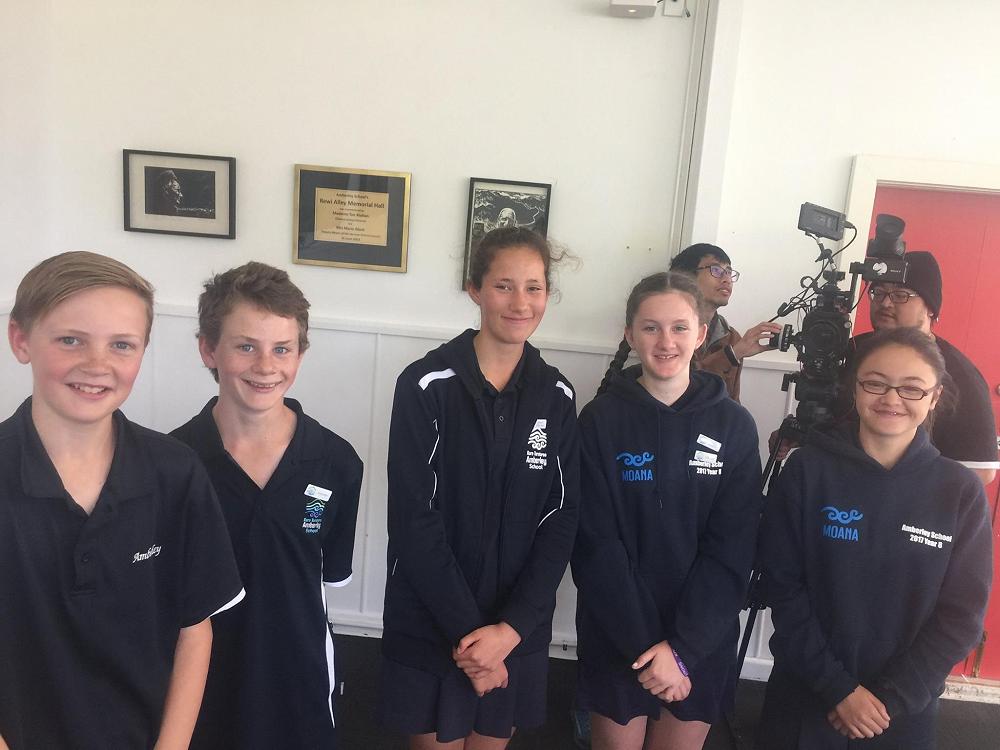
Last week a film crew came to interview Amberley School in relation to the upcoming commemoration of Rewi Alley.
We know we have a building called 'Rewi Alley' but do you know the history of the man? Or his significance to Amberley School? One of our Year 8 students, Tatiana Austin, recently wrote an essay on Rewi and has been recognised for her outstanding writing. The following was written by her:
Rewi, born on the 2nd of December, 1897, and passed on the 27th of December, 1987, was a hero, fighter, belief-maker and risk-taker, was a role model to many. For China, for New Zealand, for soldiers during the war. For everyone.
Rewi was born in Springfield, Canterbury, New Zealand. He had four siblings, older brother Geoffrey (1903-1986), sister Gwendolen (1894-1988), younger sister Joyce (1908-2000) and brother Phillip (1901-1978).
He was named after Rewi Maniapoto, a Maori chief famous for his strength, tolerance, resistance and attitude during the wars of New Zealand between the British and the Maori the 1860s.
For his primary education, Rewi was sent to Amberley School, then another school, Wharenui School, where his father was promoted headmaster in 1905. For his secondary school, he attended at Christchurch Boy’s High School.
In 1916, just after finishing secondary school, Alley joined the New Zealand Army where he was sent to work for France, and where he won the Military Medal. During the war, he was injured and wounded, but rescued by Lyall McCallum and another man, who took him back to safety.
After the war, Alley progressed with a career of farming in New Zealand. In 1927, he decided to go to China.
He moved to Shanghai with hopes of joining the Shanghai Municipal Police. However he was appointed a fireman.
During his time there he slowly became aware of the racism in the Chinese communities.
He joined a political group which included himself, Alec Camplin, George Hatem, Ruth Weiss, Trude Rosenberg, Heinz Schippe, Irene Wiedemeyer, Talitha Gerlach, Maud Russell, Lily Haass, Cora Deng and Cao Liang.
In particular, a famine in 1929 made him aware of the abuse of China’s peasants.
At this time, he adopted a 14-year-old Chinese boy, Duan Si Mou, who he named Alan, in 1929.
After a quick visit to New Zealand, where Alan received public racism, Alley was promoted to Chief Factory Inspector for the Shanghai Municipal Council in 1932. During this time he was a secret member of the Communist Party of China and was involved in anti-criminal activities.
He adopted another son from China, LI Xue, whom he renamed he Mike.
Edgar Snow wrote of the Alley’s work in the CIC:
“Where Lawrence brought to the Arabs the distinctive technique of guerrilla war, Ally was to bring China the constructive technique of guerrilla industry…”
He progressed on with writing poetry, from translating some poems and writings to making his original works.
“It became my way of contributing. There was so much going on in China. I felt I had to help people understand. I am not a writer. I am certainly not much of a poet. But it was my work. You know, sometimes it would take me hours to get one page finished.”
-Rewi
Some more of Rewi Alley’s quotes revealed more information and backstory about himself, as well as inspiring others:
“Never mind about whether you are a student of China or not, as long as you are among the ordinary people you will get an understanding, a real understanding of this country. You’re already in amongst it... Some very bad things happened. The price of China breaking free of foreign domination and the bad things of its past was enormous. They reckon that it cost 30 million lives to build new China. The West should have a bit more gratitude for the struggle of the Chinese. If it wasn’t for the resistance in China during the Second World War, the Japanese would have had tens of thousands more men and they may have got as far as Australia and New Zealand. Back then sides were clear-cut. They were clearer even before the war, if you had the wit to see it. I became involved in China’s struggle and I chose my side. After the war and the revolution, I knew I had a choice. I could have joined the critics of China, but China had become like my family and as in all families, even though you might have been arguing with each other, when the guests come you present a loyal unified face to the world. I could have joined the journalists and so-called sinologists in condemning everything about the revolution, but I had already chosen my side.”
“This place is a great case study of humanity; one of the biggest examples of humanity’s struggle. If you can’t feel for these people, you can’t feel anything for the world. Although it was in France, in the First World War, that I first had a taste of China. I can remember when there were a lot of shells falling and we had our rifles and our steel helmets on and there were these coolies. Coolies, that’s a word people don’t use much any more; but that’s what they were, these Chinese labourers. Coolie comes from the word bitterness. These blokes were eating their fair share of bitterness in France. Navvies for the poms, they were. Shells bursting and the ground shaking like there was an earthquake, and they were stripped to their skinny waists and just kept unloading the wagons. I saw endurance and a determination that I had seldom seen before. Then later, back there in the thirties, I was involved in the factories in Shanghai and I can remember seeing sacks in the alleys at the back of the factories. At first I thought they were sacks of rubbish, but they weren’t, they were dead children. Children worked to death in the foreign-owned factories. Little bundles of humanity worked to death for someone’s bloody profit. So I decided that I would work to help China. I suppose then it was like a marriage of sorts and I wrote what I wrote and said what I said out of loyalty to that marriage. I know China’s faults and contradictions; there are plenty of those. But I wanted to work for this place and I still do. I woke up to some important things here and so I felt I owed China something for that.”
“I had human principles and I made choices based on these. I have always been and will always be a New Zealander; although New Zealand has not always seen me as that. But I know my own motives. The buggers even refused to renew my passport at one point and they treated my adopted son very badly. Did you know that when Robert Muldoon visited Mao Zedong in the 1970s he was the last head of state to see him? Well I’m told that when Muldoon asked what he could do for Mao, Mao is supposed to have said ‘Give Alley his passport back.’ "
“I love New Zealand, and sometimes miss it. New Zealand is a good country, populated by basically just and practical people. But there is a fascist streak in New Zealand as well, and we must always be vigilant to prevent it from having too much sway. I remember as a boy, I was walking along the beach near Christchurch and there was a group of men coming back from a strike, or a picket of some kind. Suddenly, out of the dunes came police on horseback and they rode into these unarmed working men, swinging their clubs as if they were culling seals. I will stand up against such forces as long as I can stand. Even here, in the Cultural Revolution, when some young blokes came in here and started breaking things I grabbed one of them and put him over my knee and gave him a proper hiding. I got army guards on the gate after that. That was thanks to Zhou Enlai, looking after an old mate from Shanghai; but I stood up to them. I know many in New Zealand see me as a traitor to their culture, but I have never betrayed New Zealand. What I betrayed was the idea many New Zealanders had of what a Kiwi should be and what was right and wrong in the political world. There is a very big difference.”
“Successive New Zealand governments have tried hard to discredit me as if I was some sort of communist threat to them or a traitor. Well I am a communist, but I am not a traitor. I have always loved New Zealand. I just said what I thought was important and true.”
Tatiana Austin, Year 8
Gallery