
From our Tumuaki / Principal
Ngā mihi nui kia koutou katoa, warm greetings to you all.
As our weather continues on its cold and wet trajectory, the news from my globe trotting whānau sets a startling contrast. My mum is currently travelling in beautiful Sri Lanka, sending pictures of blue skies and bright smiles in Colombo. My eighteen year old Australian nephew has just landed in the UK in summer, off on his OE around the UK and Europe; and my younger brother is sending us pictures of himself and his wife on various beautiful beaches in Bali. I’ll just huddle up in my oodie and wait for summer!
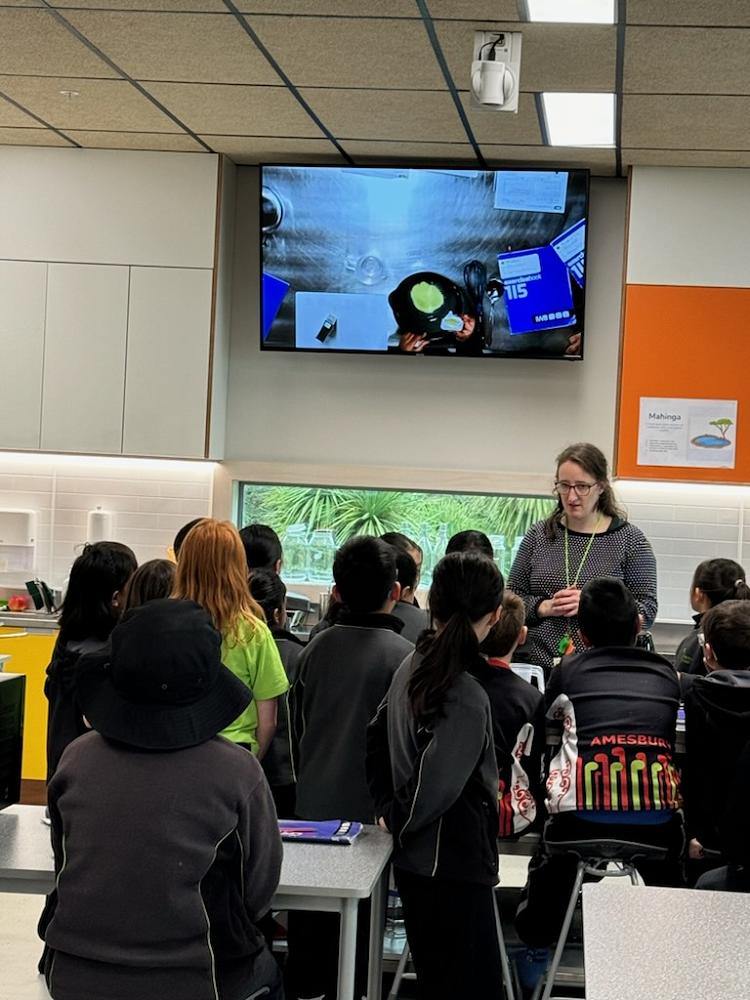
It has been another busy week on the go in the hubs. We have had shape monsters being created in Koru Hub, as ākonga (students) explored 2-D and 3-D shapes. We have also had a range of experiments happening to find out more about how heat changes materials. In Pōhutukawa they have also been exploring a range of recipes and experiments to see the effect of heating and cooling. The photograph in this article shows a group of Year 4 students looking at how heat causes changes in state.
We gathered as a staff on Friday to wish Emma well as she leaves to begin her parental leave. Emma will be away for the rest of this year as she and her partner, Nic, welcome their new wee one into the world. We wish them both all the very best, and we can’t wait to be introduced to the newest member of their whānau. Rupert will take over as hub leader for the rest of the year, with Brydon, Gar Kee and Charlotte all in support roles, and Jenny as learning leader.
Refreshed Literacy and Maths curricula for 2025
Recently, there has been a lot of media focus on the changes to our literacy and maths curricula for next year, particularly given the government’s announcement last week about the changed timeline for our refreshed maths curriculum.
The Koru team has been working this year with Kerri Satherley from Massey University, implementing structured literacy in our Year 1-3 literacy programmes. We will continue with this professional learning this year, and we are looking to work further with her next year, further developing and enhancing our learning around this. Kerri will be holding a parent and whānau session about structured literacy in a few weeks’ time, to let you know more about this approach to learning. See this article for more detail, and we hope to see many of you there.
The refreshed curriculum will soon be available for schools, and will be in use in schools in Term 1 2025. Structured literacy content will be part of this curriculum, and we have been working this year to determine what this looks like for our programme at Amesbury School. As we have been exploring this approach this year, it has been clear to us that a consistent and explicit approach to literacy learning is highly beneficial. We can also see that while a consistent scope and sequence of learning is highly effective, it is necessary to have a tailored approach to this, to meet the very varied needs of our ākonga. Having key content that needs to be taught in a clear and methodical way, alongside a range of tools and strategies for teaching that suit the different ways our children learn, is already proving to be an effective way to run our literacy programme.
The recent announcement about the refreshed maths curriculum laid out changes to the implementation of the updated curriculum, bringing it forward by one year and including structured maths as part of the learning, alongside structured literacy. The curriculum will be available for feedback in the next couple of weeks, and once confirmed, will be implemented in schools from Term 1, 2025. As with literacy learning, a clear and explicit scope and sequence of learning that is used across all schools will be useful in maintaining consistency for ngā ākonga (our students), within and between schools. The same approach as we have taken with literacy will apply to maths learning: an explicit and consistent approach to learning content is useful, alongside a tailored pedagogical (teaching practice) approach that ensures we can effectively meet each student’s needs. Ākonga do not all learn in the same way and at the same rate. Following a sequence of content and utitilising a range of approaches to ensure we carefully build on students’ learning, enabling them to master key content before moving on to new learning, helps students to learn the basics and then build on this learning to continue progressing.
As we know more about the refreshed literacy and maths curricula, we will keep you all updated.
Finally, it was lovely hosting a group of educators and architects from the LENZ Educational Learning Environments conference on Friday. As part of the conference, there were several bus tours around a number of recently built learning environments, and our new Pōhutukawa Hub building was part of one of the tours. The visitors to the building came through at lunchtime, which turned out to be very useful timing! It was great to have conversations with them about the ways our kaiako (teachers) and ākonga (students) use the different spaces within the hub, the design aspects that work well, and the ones that are not as helpful. Listening to the group, it reminded me again of how lucky we are to have such beautiful learning spaces, and we are certainly aware that many schools are not nearly as lucky.
And so we sign off for the week. Here’s hoping Emma gets some much needed rest for the big arrival, and I hope you all have a lovely weekend with whānau and friends.
Hei tērā wiki, see you next week.
Ngā mihi nui,
Urs