Confirmed in Christ
Words: Gareth Bezett, Director, Theology House
I've had the enormous privilege to help people prepare for confirmation in recent years. It really is a joy to sit and talk with people who are considering making a public commitment to living out their faith in Christ.
I see my job in leading confirmation preparation classes as helping the candidates explore the words of the service so that these words are meaningful to them when they come to say them. When the candidates say the words, they are not just reading them out of the book, but they mean what they say because that is expected of them. I'm much less concerned about whether the words mean exactly the same thing to them as they do to me. This approach leads to classes talking about what it means to call God 'Creator' and what it means to call Jesus 'Saviour'.
Madison Ashworth, Year 13 at St Margaret's College says,
"Throughout the classes I did a lot of thinking and reflection, and I loved how we could talk about anything. I'm really glad I went along to the classes as it allowed me to better understand religion in general and it meant that when I did choose to be confirmed I fully understood what I was doing, and I knew that I was doing it for the right reasons."
This is exactly what I hope for. The confirmation service requires a serious commitment to a life of discipleship. Perhaps the most daunting thing people are asked in their confirmation is, "Will you accept the cost of following Jesus Christ in your daily life and work?" I would hate for anyone to take this lightly or make these promises half-heartedly.
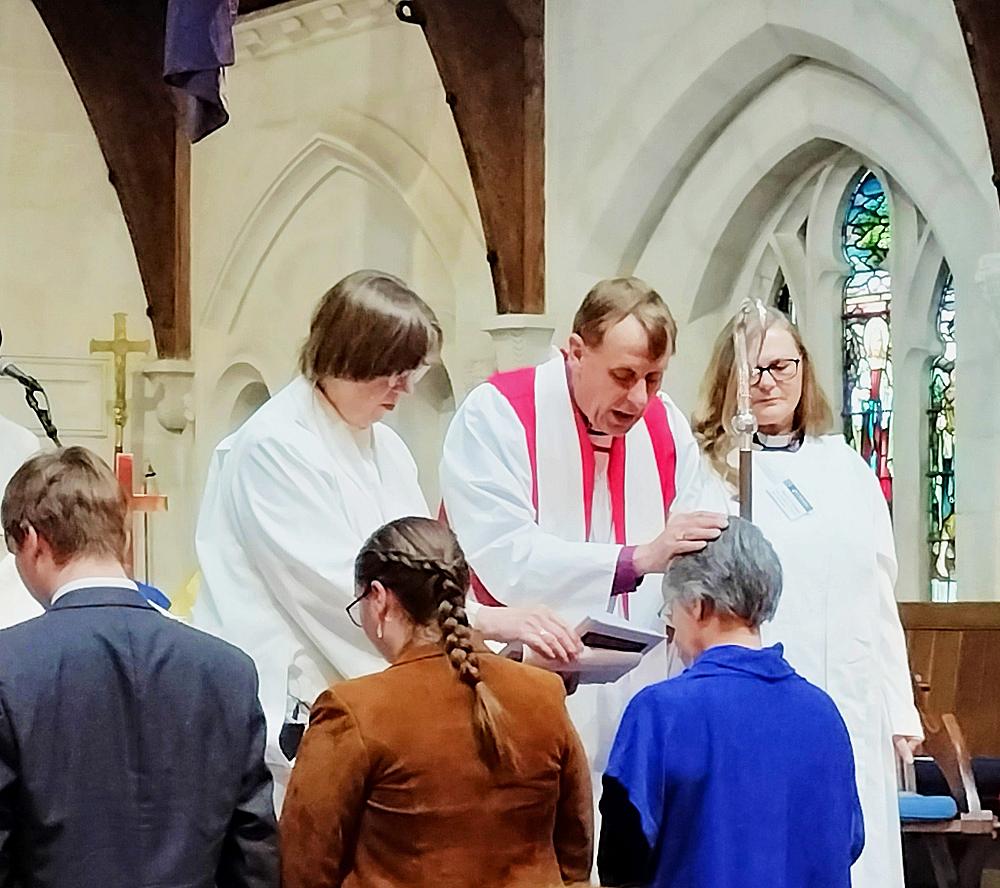
If you peruse A New Zealand Prayer Book/He Karakia Mihinare o Aotearoa (APBNZ), you will find a liturgy starting on page 383 called "The Liturgy of Baptism and The Laying on of Hands for Confirmation and Renewal". The title is quite a mouthful, and it is a complex liturgy that allows for many options. It's entirely appropriate, however, that confirmation and baptism go together because, at its core, confirmation is about our baptism. The liturgy sits right before the eucharistic liturgies because it is via baptism that we enter into the Church and share in the Church's family meal, communion. None of this is accidental.
One of the obvious uses of confirmation is that it allows someone who was baptised as an infant to make a formal public declaration of their faith. They take on for themselves the promises made on their behalf by their parents and godparents. For much of our history someone baptised as an infant would be the 'normal' candidate for confirmation.
In the confirmation preparation classes I've been involved with in recent years there have been a mix of baptised and unbaptised people. Some of the unbaptised are preparing for baptism itself and some were to be baptised ahead of confirmation. This is the reality of church today.
I was baptised as an adult. Because I'd heard confirmation talked about in terms of the old normal, I didn't think it was something I 'needed' or would want. However, when I left my role as Diocesan Manager in Wellington to study full time at St John's Theological College in Auckland, it was a formal requirement of enrolling at college that I was confirmed. However, I didn't want it just to be a compliance exercise, or to gatecrash someone else's spiritually meaningful occasion to tick a box. Instead, we structured a service at the Cathedral that was a commissioning and a sending off for me and my wife Tracey, which included our confirmations, and the commissioning of the new Diocesan Manager.
The liturgy (page 383, APBNZ) also allows for more than just baptism and confirmation, which cannot be repeated. Baptised Christians can reaffirm their faith and receive the laying on of hands for renewal. This might be appropriate where someone who is already baptised and confirmed has a particular experience of conversion or where someone has returned to the faith after a period away from the Church.
Confirmation (or renewal) has long been used as a way to receive people from other denominations into Anglican and Catholic churches. This has been a way to recognise a deliberate move of faith with a public rite.
However, I make it very clear that we are never baptising or confirming Anglicans: We are baptising or confirming Christians. The faith of our baptismal creed is one we share with the whole Church. If someone has come from other Protestant denominations, confirmation can seem like one of the things that are distinctively Anglican. It is, however, practiced in the Catholic Church too. In Eastern Orthodoxy, their equivalent chrismation is routinely done immediately after baptism.
Lastly, confirmation is one of the rites that is reserved to bishops in our Anglican tradition just like the ordination of deacons, priests, and bishops. Traditionally understood as the successors to the Apostles who received the Holy Spirit at Pentecost, bishops confirm and ordain because we are seeking a particular work of the Holy Spirit. Both rites equip baptised Christians for ministry. While this is more obvious in the case of ordination, we pray that the Holy Spirit would bestow on the candidates the gifts they need for ministry.