
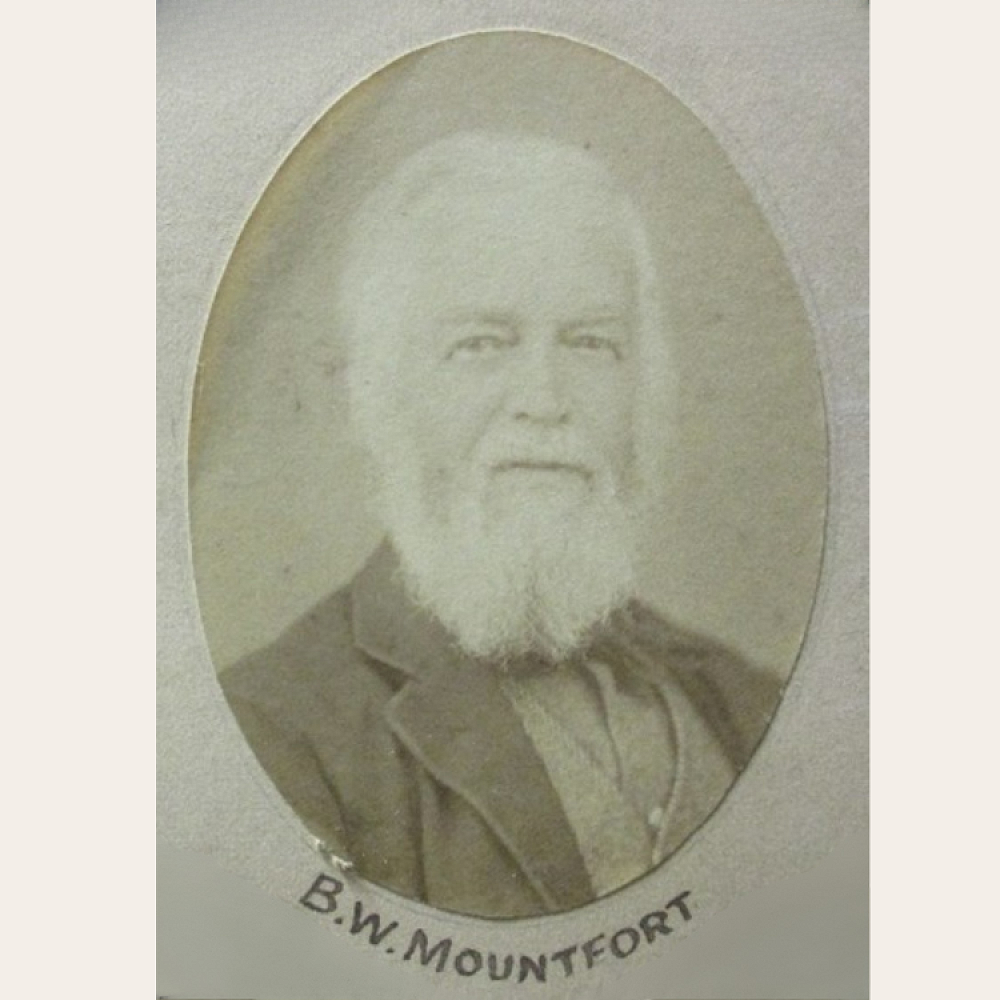
Benjamin Woolfield Mounfort (1825-1898)
Words: Jane Teal
13 March this year will mark 200 years since the birth of Benjamin Woolfield Mountfort, so it seems appropriate to re-introduce him to some and introduce him to others.
Members of Church Property Trustees are familiar with the words "it's a Mountfort" when referring to the wooden buildings that are part of the ecclesiastical landscape that they care for.
Yet Mountfort had a somewhat inauspicious beginning as a Canterbury architect. Quite simply the congregation in Lyttelton "assembled in terror" in the first Church of the Most Holy Trinity when there was a nor'wester. Why? Because Mountfort was not familiar with the shrinkage that occurred in New Zealand woods (having been used to working with oak) and when the brick nogging[i] rattled it was decided that the congregation would return to the room they had previously inhabited in the Immigration Barracks. The building was ultimately pulled down, but not until 1857.[ii]
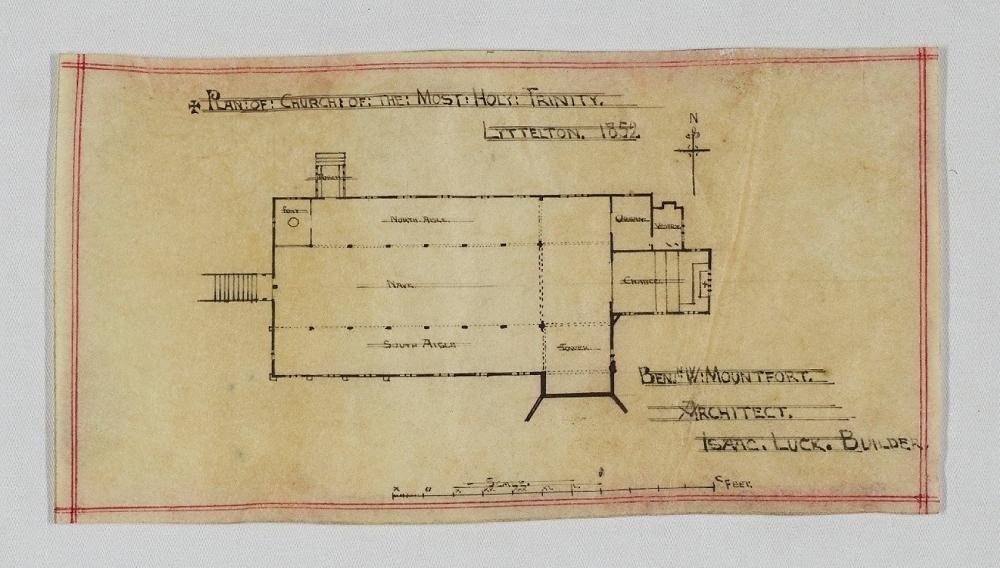
Even while the parishioners of Lyttelton were trying to decide the fate of their building, Mountfort was at work at Kaiapoi, designing St. Batholomew. But work as an architect was not proving to be particularly lucrative so he set himself up as a Bookseller and Stationer in Cashel Street and later in Colombo Street. It was in this latter building that he advertised in April 1857 as being able to take portraits by the “new Collodion process”.[iii][iv]
But all was not lost. In the same year Architects Mountfort and Luck[v] were advertising for tenders for a Goalers House and Police Barracks in Lyttelton and for carpenters for the Bank Buildings in the same location. [vi] This was also the year in which Bishopscourt was completed.
On 14 November 1857, the Lyttelton Times announced that the firm had obtained the tender to build a church to be called St. Peter in Ferry Road. Although the church in Ferry Road was actually the original St. Mary in Heathcote and nothing like the cob building that tenders were called for, it was from this date that Mountfort and Luck, and then Mountfort on his own, obtained ecclesiastical work.
Based on various lists, there are 28 church buildings that he was involved in, and all or part of them are still extant. The involvement could be as small as the additions to the nave and a vestry at St. Mary the Virgin in Addington, or the whole building at Tinwald and St. Mary, Otaio. All Saints Prebbleton was destroyed by fire in 1906 and later rebuilt to the same plans whereas St. Philip and St. James Waterton can now be found at the Plains Museum. Further research of the original signed plans has shown that St. Saviour West Lyttelton (that wandered off to Cathedral Grammar and came back again to the Holy Trinity site) is not a Benjamin Mountfort, but the work of his son Cyril Mountfort.[vii]
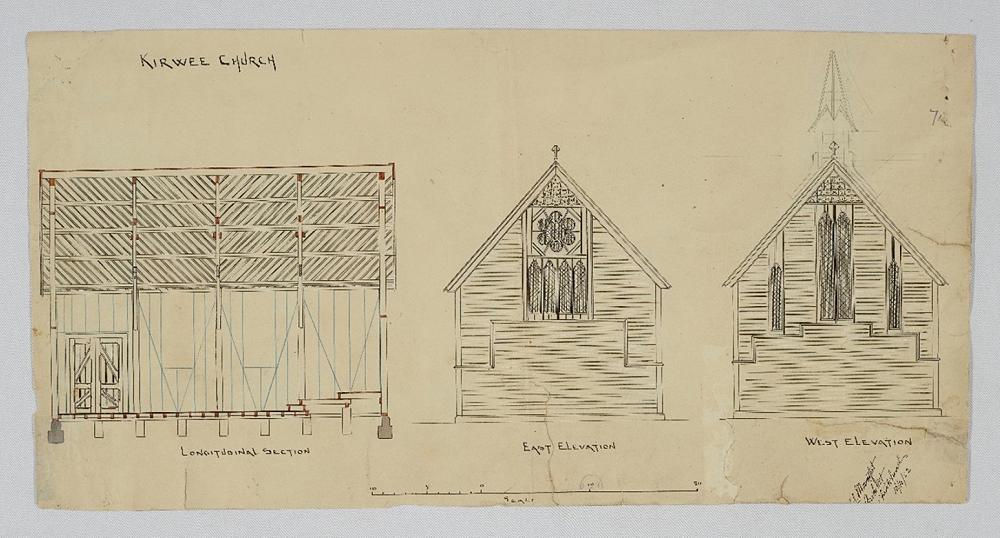
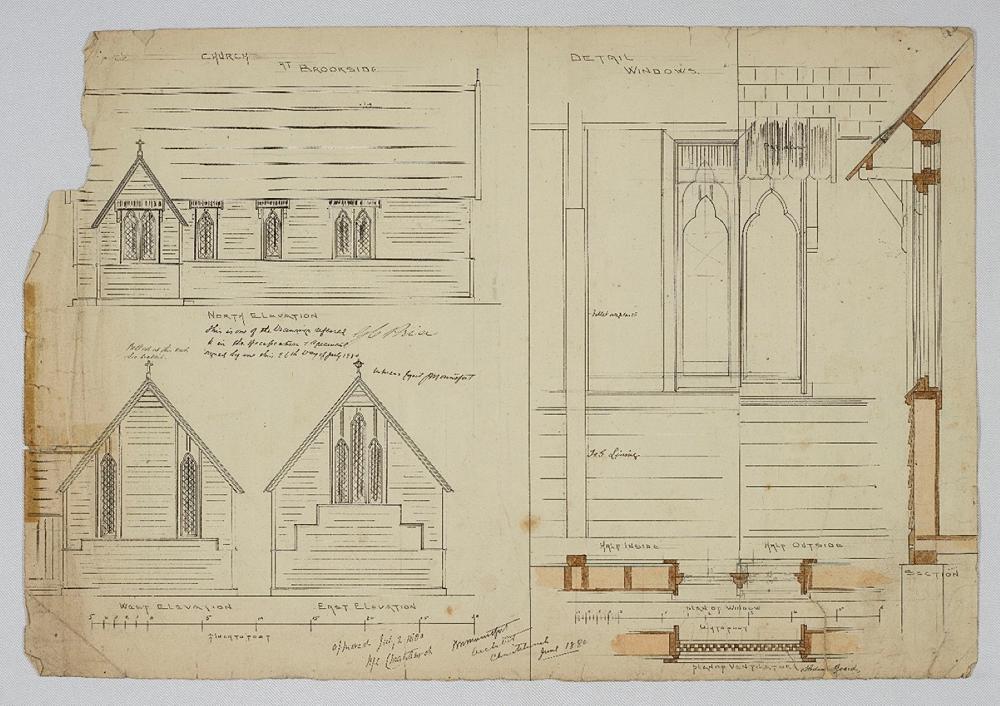
The Diocesan Archives have digitised the Mountfort plans in its possession. Below are two examples.
********
[i] Brick nogging is where bricks are laid between the beams and framing of a building to create insulation. Surprisingly when repairs were undertaken on the Lyttelton Vicarage in the 1980s it was discovered that at least the west wall was brick nogged.
[ii] Lyttelton Times 11 March 1857. BW Mountfort provided the specifications for pulling the building down. FA Weld's painting of the building can be found here.
[iii]. The wet collodion process used a prepared piece of glass which, in the darkroom, would be coated with collodion and then made light-sensitive with further chemicals. Before the plate could dry, it would be placed in the camera and exposed. These are now in many collections as glass plate negatives.
There is a possibility that Alfred Charles Barker, whose photographs of early Christchurch are so well-known, was taught by BWM.
[iv] Lyttelton Times 8 March 1856 and 18 October 1856.
[v] Isaac Luck Married BWM's sister Susannah in Lyttelton in 1853.
[vi] Lyttelton Times 17 June 1857.
[vii] See Teal, FJ 2013 Here, There and Back again. Anglican Historical Society.
Further Reading
Lochhead, Ian 1999 A Dream of Spires. Canterbury University Press.
Mountfort, Ian J 1990 Mountfort, Benjamin Woolfield.
https://teara.govt.nz/en/biographies/1m57/mountfort-benjamin-woolfield