

War and Peace in the Assyrian Empire
Words + Photos: Rev'd Dr Tim Frank
I doubt many Christians use the words of the prophet Nahum as their devotional reading. His message seems crass and vengeful.
"The Lord takes vengeance on his foes and maintains his wrath against his enemies."
"Woe to the city of blood, full of lies, full of plunder, never without victims!"
"Draw water for the siege [...] the fire will devour you; the sword will cut you down, and, like grasshoppers, consume you".
The book ends:
"Everyone who hears the news about you claps his hands at your fall, for who has not felt your endless cruelty?"
All these words were hurled at the city of Nineveh, the capital of the Assyrian Empire, which fell in 612 BCE.
Why was the defeat celebrated in Judah and much of the Ancient Near East? Because Assyria was a cruel military empire that through its heavy-handed oppression exacted crippling tribute payments from its vassals. It reigned by fear and terror. It did this through the best-equipped army seen until then. To get greater tribute the Assyrian empire continually had to expand to new territories. Assyria had fallen into a vicious circle: it needed to make war to obtain resources for its army; it needed a professional, well-equipped army to make war. No wonder that those who had seen their relatives tortured by the Assyrian army and their nation reduced to economic servitude were glad at the downfall of this superpower.
However Assyria saw things differently. The Assyrian kings justified their military campaigns in their accounts. These justifications for war in the Assyrian Royal Inscriptions have been examined in a 1992 book by Bustenay Oded.
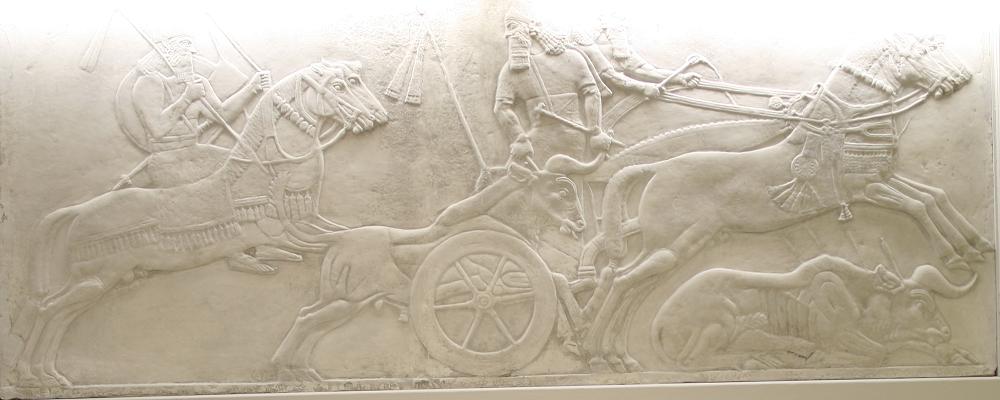
Assyrians went on military campaigns under the auspices of the gods, whether only one, such as Ashur, or a whole host. Generally, the Assyrian king claimed to prefer peace. Nevertheless, Assyrians saw war as a frequent necessity, for "peace will not be concluded without a fight[...]; good relations will not come about without a battle" (Epic of Tukulti-Ninurta). The Assyrian King Sargon felt compelled to destroy the land of Ashdod—a Philistine city state—for example, because its king "had uttered numerous lies and evil things to incite [other kings] to rebel against me". The Assyrian army also frequently intervened if in one of the vassal states rebellion was brewing or a local leader loyal to Assyria had been replaced by someone whose loyalties were not as clear. A vassal who "disregarded the oath he took by the great gods and decided not to pay tribute" was considered not only to have offended the Assyrian king, but also the gods. Punishment by war was necessary.
From the Assyrian viewpoint, outside the Assyrian imperial order there was only chaos. War was used to impose order and peace. The Assyrians saw themselves as saving the peoples from the powers of anarchy and "bringing rest to the weary people".
Sennacherib, one of the most ruthless Assyrian kings, said that the god Ashur made him the shepherd of mankind, leader of all people. To ward off dangerous and hostile forces Assyrian kings saw themselves obliged to resort to violence to keep world peace, which was only attained by spreading terror and fear. Through war Assyrian kings also showed their glory and justified such descriptions as "the brave one, fearless in battle". King Esarhaddon could state: "I am powerful, I am supremely strong, I am lordly, I am glorious, I am strong". It was the mission of the Assyrian kings—and the army and state—to bring control and order to the world through conquering and keeping subject the nations. The Assyrian king Ashurbanipal proclaimed that the gods "decreed as my fate to exercise dominion over all inhabited regions and made their kings bow down at my feet". In Assyria the wars and stated reasons had broad public support. From the Assyrian point of view the enemy kings either did not know what was good for them or were evil.
War and terror were justified by words about peace, justice, and security. Little has changed across the millennia, as advocates of the military complex still maintain that well-equipped and practiced forces are required to keep order. It was the Romans who coined the phrase Si vis pacem, para bellum!—"if you want peace, prepare for war!" The theologian Karl Barth pointed out that such a peace undergirded by weapons always looks forward to war. Rather, the motto should be Si non vis bellum, para pacem!—"if you don’t want war, prepare peace".
Peace is hard work. It requires justice—including economic justice, a fair distribution of resources, and reconciliation of old wrongs. As those who follow the Prince of Peace, we are called to continually work for peace.
Tim Frank has participated in several archaeological excavations of ancient cities destroyed by the Assyrian army. His historical novel Daughter of Lachishis set in ancient Judah during the time of the Assyrian invasion led by Sennacherib.