
Question & Answer with Author, Dr Hugh Kemp
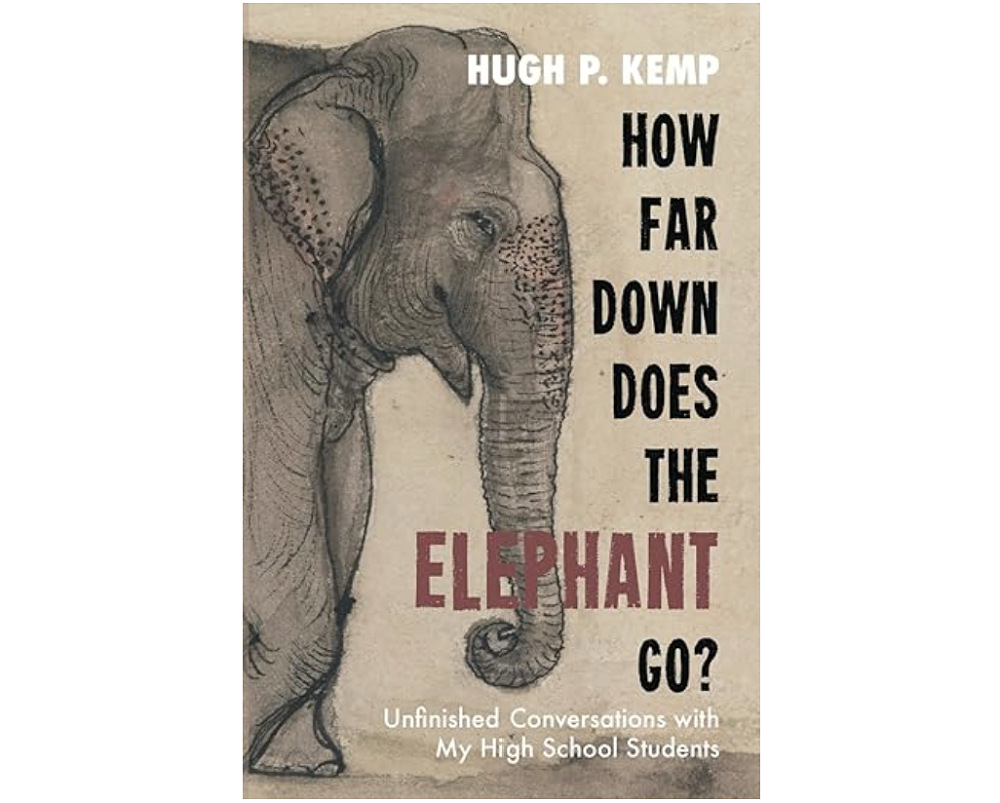
We learn more about Hugh's new book, How Far Down Does the Elephant Go? in this interview.
Q: We are excited about your latest and third book, Hugh. What inspired you to write your latest book, How Far Down Does the Elephant Go?: Unfinished Conversations with My High School Students?
A: I had some time open up for me in the second half of 2023, so thought I'd use it wisely and do something worthwhile. I enjoy writing, particularly about things that are immediately relevant: in the case of this new book, I had just left 8 years of teaching at Saint Kentigern College in Auckland and had a whole lot of my students' questions on scraps of paper in a folder. I thought I'd get them out, try and make sense of them, and the result was this book. The book is 30 conversations around 12 big questions which my senior students, Years 11–13 actually asked in and out of class. They're based on conversations sitting with individuals on the deck outside my classroom, or from lessons we actually did together. I don't give a lot of answers: my aim is to keep the conversations going. One of my reviewers said that the book "is not the final word, but it is a good word". I liked that.
Q: How did the title of your book come about? It’s inquisitive and shows a pastoral side of a teacher who cares for their students.
A: The question "how far down does the elephant go?", or, when you start reading, you'll see the question morphs also into "what is the elephant standing on?" draws on a picture from the Jātaka tales widely known throughout Asia, where four friends are out in the forest - a hare, rabbit, monkey, and elephant - and all stand on each other's shoulders to reach some juicy fruit high up in a tree. The elephant is obviously standing at the base of this tower. It acts as a metaphor for examining what our assumptions are, the axioms and starting places of the worldviews we hold. It's a picture that works well: when a student makes some off the wall claim in class, I find myself often challenging them with the phrase "Ok, so how far down does that elephant go?", meaning, have you taken the time to examine the foundational assumptions of your claim?
Q: In your years of teaching, how did you draw wisdom to engage with tough questions about life as a young person?
A: Far too much of life is built on proposition. And propositional claims are too black and white, I think. Life is too full of paradox. I find story works better for working through issues of identity and destiny, for those are the two key needs that my students express as their number one priorities. I've found that if you can prod and poke a student with the right question, then they tend to come to formulate their own quite valid answers. Growth only happens in the direction of the questions we ask.
Q: As a husband, father, theologian, teacher, writer, and mentor, how would you encourage parents of a tween, teen, teenager and young adult struggling with how they see themselves and the world?
A: Tough question. I think listen. Actually listen. And see them. Everyone needs to be seen and heard, especially our kids. And then hedge them about with open ended questions. Learning to ask good questions is a real challenge. Honour the process of conversation. And don't panic, even though there are a gazillion voices yelling at them for their attention: if you affirm what you can, coach them to see the outcomes of the decisions they make, and temper everything with a light touch. If your kids keep coming home after they officially leave home, then see that as a win.
Q: I heard there will be a book launch (or two). How will we hear about it?
A: I'd like to have some book launches. I have yet to nail down dates from the publisher in the USA as to when we can land hard copies. But you can order it through Amazon: I think it will ship from Australia, so copies should be arriving in country by mid-June. Word will spread re book launches through Anglican communications and possibly Laidlaw College. Also the Christian Schools network.

Dr Hugh P. Kemp has taught across educational modes and countries for over 35 years in high school and university sectors. He is the author of Steppe by Step: Mongolia's Christians from Ancient Roots to Vibrant Young Church (2000), and One Step Guide to World Religions (2013). Hugh has a PhD in religious studies and an MTh in Christian mission history. He continues to engage with thinking students in a high school in Christchurch, New Zealand. He speaks and publishes across the fields of Asian history and Christian mission, education, and religious studies. Hugh lives in a village near Christchurch with his wife, Karen Kemp, who teaches practical theology and coaches leaders. They have three adult daughters.