
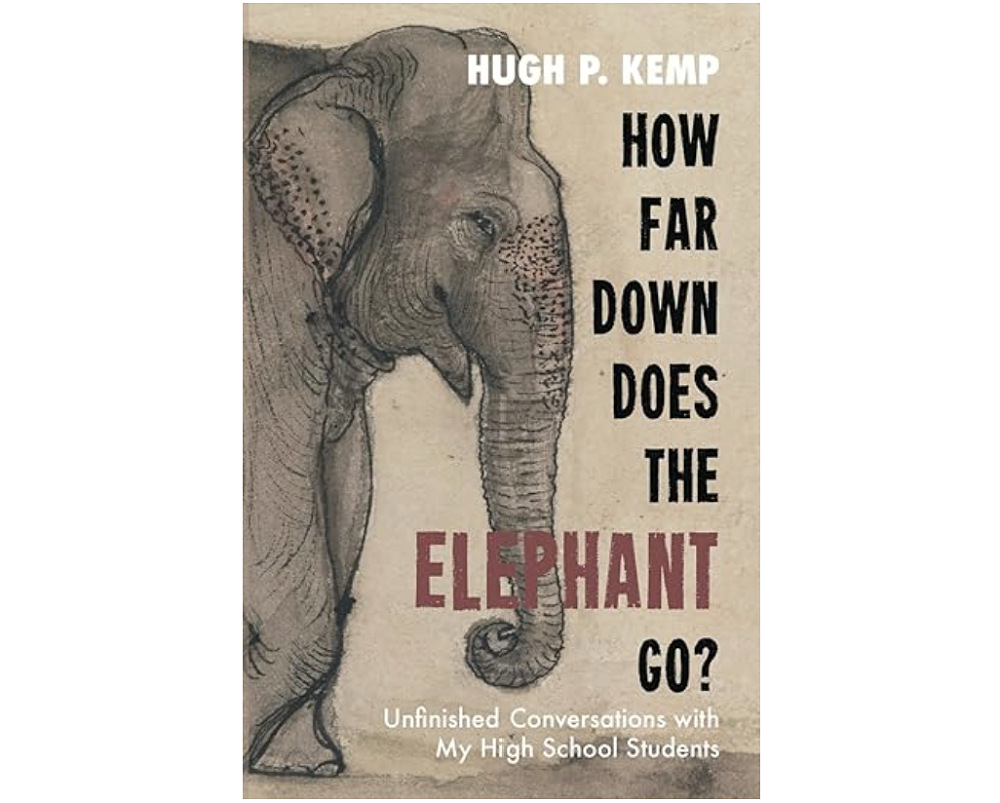
Book review: How Far Down Does the Elephant Go?
Words: Amber (Year 10 student)
"Helpful and hopeful."
A review of Hugh P. Kemp’s new book How Far Down Does the Elephant Go? (Eugene, OR: Wipf and Stock, 2024)
Amber - Year 10 student
Hugh Kemp's new book, How Far Down Does the Elephant Go? addresses big questions that teenagers from his classes over the years have raised: it is subtitled Unfinished Conversations with my High School Students.
The book is written in the style of letters, inviting conversations about the assumptions behind our questions. With headings like, "If God is so good, then why is there evil in the world?" and "What is the right thing to do, and why should I do it?" these letters are conversations from real life, and Kemp encourages his pupils to keep asking them.
Kemp investigates the assumptions behind each question and takes time to build a foundation of understanding: he gives good evidence, and other times he poses further questions. For example, in Chapter 2 – "Are you actually serious when you claim that Jesus rose from the dead?" – Kemp gives convincing evidence that Jesus was dead, and that He came back to life.
In his chapter on Ethics – What is the right thing to do? – he discusses AI becoming more humanoid. He asks the question: "how many artificial parts would a human have to have before we could declare they are not humans anymore?"
How Far Down Does the Elephant Go? made me think about my Christian Faith. One question really stood out: why is there so much evil in the world? Kemp compares Jesus' first coming as D-Day in WWII (6th June, 1944). This is when the Allies got a foothold in Europe: in this metaphor, it is when Jesus destroyed evil on the cross. His coming back is like V-E Day (8th May, 1945), when the war was finally over, and the enemy was defeated. Right now, we are in between these two days, and so the process of cleaning up evil is still in progress, but the victory is guaranteed. The ending of the book also really resonated with me. Kemp ends all his correspondence with the word shalom – "peace". The last paragraph explained how shalom carries the hope of the fulfilment of promises. This was powerful, and I was deeply moved.
Sometimes I found that I wanted more evidence in Kemp's answers. In one chapter, he writes about how the Bible is trustworthy. I would like to have included the evidence about the number of manuscripts that we have of the New Testament, and that the events were recorded by eyewitnesses. At some points I wanted more context surrounding a book or movie that he mentioned. I am still not entirely convinced about the way Kemp suggests Genesis was written, when compared to what scientists think about the start of the world today. Could the earth have been formed in seven days if God wanted to? The Creation story in Genesis may well have been written in more of a descriptive and poetic form: discerning its factual substance is a challenge.
There are countless books that help us to understand Christianity and to help answer questions about the world we live in. Another recent one is Rebecca McLaughlin's 10 Questions Every Teen Should Ask (and Answer) About Christianity (Wheaton, Il: Crossway, 2021). I came away from McLaughlin's book like I had not actually learnt much, despite the evidence it provided. However, Kemp's left me feeling like we have so many reasons to be hopeful.
How Far Down Does the Elephant Go? is suited for teenagers because the questions come from them. Kemp gives good background to most of the points that arise, and it would be useful to readers who are new to Christianity, from other religions, and appreciate worldview conversations. Youth group leaders and parents should also read this book. It will give answers and more deep-thinking questions for teenagers on a more personal level. It will be a helpful book for parents to coach their teenagers about how to ask questions and find some answers. In fact, I would recommend this book to everyone!
Out of ten, I think this book is a nine. Some of my own personal questions were answered in a helpful way - this book gave me hope. Overall, Kemp's new book left me feeling completed, and that I had learnt a great deal of information to help me in my life. It was interesting reading what other teenagers wonder about, and this book prompts me to share what I have learnt.
How Far Down Does the Elephant Go? is variably priced and is available from amazon.com.au, directly from the publisher Wipf and Stock (wipfandstock.com) or directly from the author for $20 + p&p if applicable.