Ko te Tūhono – new Octagon artwork
At the end of May, the Public Art Selection Panel met over Zoom and after thoughtful discussion chose Ayesha Green’s proposal Ko te Tūhono as the city’s newest public artwork.
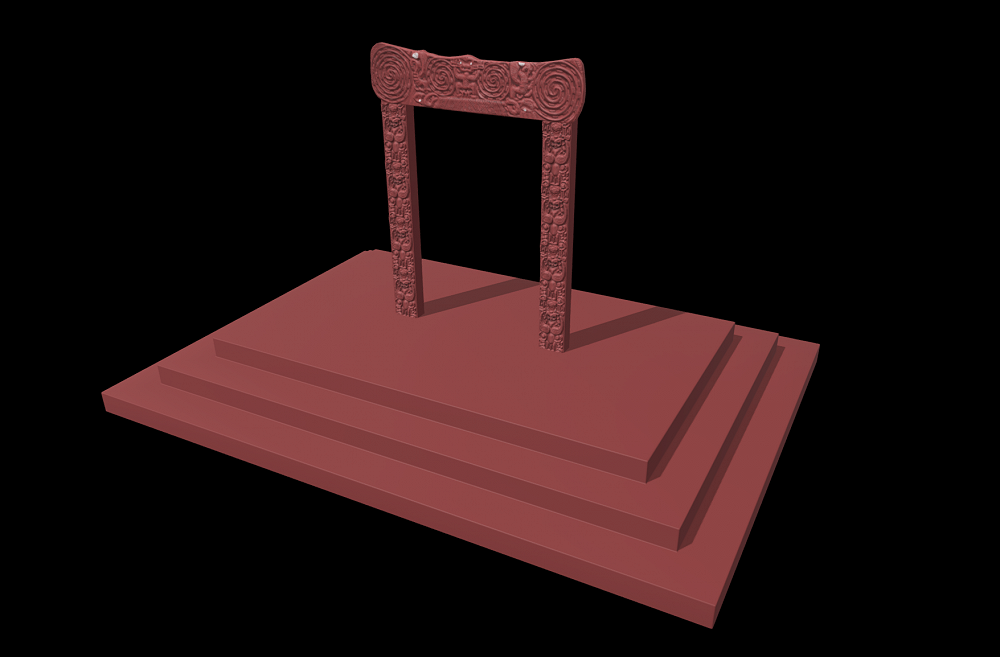
“Ko te Tūhono is a gateway connecting us with our deep ancestral ecologies; it is a passage to our landscape, our life and the wairua we share with the harbour… When you move through Ko te Tūhono you are inside and outside, you are coming and going. As a monument to our tipuna and our tamariki, Ko te Tūhono transcends time and place.” – Artist Ayesha Green (Kāi Tahu, Ngāti Kahungungu)
Since her proposal’s selection, Ayesha has been working with Te Rūnanga o Ōtākou and her team to fine tune her concept and also met recently with DCC staff from Parks, Planning, and Urban Design to look at the various policies and guidelines that govern the Octagon space.
Public artworks can be intimidating projects for artists: the artwork will be an unfamiliar object in a very familiar place; it is paid for by public money; every step of the process is open to scrutiny. Of course, it goes without saying that every person and their dog will have an opinion about the new artwork – and a number will voice this loudly indeed!
That said, when the public was invited to provide feedback about the four shortlisted submissions, it was wonderful to see the considered comments people left. Responses to Green’s work included:
“I love Ayesha Green’s piece. Incredibly on point bringing manawhenua into the heart of the city where they once occupied and to push it even further it talks of one of the greatest Rakatira of Ngāi Tahu and Ōtākou.”
“[The work] seems to capture the real essence of the relationship of the early settlers and the local inhabitants, it brings the existing marae into the centre of the city and allows us to fully appreciate this harmonious relationship.”
“Ayesha Green’s piece is wonderful as it’s interactive. I love the way you can sit around it, walk through it or stand against the posts, even wrap your arms around it.”
Relationships Advisor – Council Initiatives, Lisa Wilkie, asked the artist for some of her thoughts about the city, the role of art, and what she hopes Ko te Tūhono will bring to Dunedin.
You have been based in Dunedin since your time here as an artist-in-residence with the Blue Oyster gallery. Has your sense of the city changed since your shift southwards almost two years ago? – I feel lucky that I still hold the same sense of curiosity that I arrived with. I feel settled but not too much; I am still finding myself in places I haven’t been before. I had originally only intended to move here for six months, but within that time I realised that Dunedin offered a type of thinking space that allowed me to really focus on my art practice. There is also a type of feeling, one that words can’t really explain, of being mana whenua in a place. It’s like a cozy feeling, but not in a sleepy way.
How have the conversations you explore in your art practice developed in that time? Are these reflected in changes to your art-making practice? – Reconnecting with my hapu has been a major shift in my life and has affected the way in which I approach my art making. In essence, I understand my role as an artist as a form of service, a service for my whanau and a service to my whakapapa. This has given me a lot more responsibility in understanding what it is that I want to say with my work and how I say it.
Ko te Tūhono will be the first significant public artwork for the city of Dunedin in six years and at the same time, it is your whakapapa. Did you have any concerns about bringing yourself into the public sphere in this way? – In a way, I am already in that space. My tipuna have occupied these public spaces in Dunedin for hundreds and hundreds of years, the mauri of me flows through there. In a way, I hope Ko te Tūhono can act as a beacon, something that binds and ties us to this place in a type of physical manifestation. Understanding Ōtākou’s place in the city is important for building relationships in our communities and I hope that Ko te Tūhono can help create these relationships and nourish them.
There is a very visible colonial narrative embedded within Dunedin’s built environment. How do you feel that Ko te Tūhono will work physically and conceptually within this colonised urban space? – I hope that there will be a power shift. To have our narratives included in the city space is an important way for us to see ourselves and to tell our stories in the way that we want them told. This is a way for mana to be restored. We are also being very generous in sharing our doorway. Ko te Tūhono, is a replica of the doorway into Ōtākou’s wharenui, Tamatea, and we want to share this with the city. Our stories and knowing who we are can be fruitful for everyone, not just our hapu.
How would you like the Dunedin public to see Ko te Tūhono in ten years’ time? – In ten years’ time I imagine it being one of many mana whenua sculptures in the city.