ICM drone photography: The sky’s the limit
As a Dunedin-based photography facilitator, commercial photographer, and video producer, personal creative projects have always been the fuel for my passion. But in 2022, a chance encounter sparked a new direction—one that involved taking my photographic technique, to new heights.
As a Dunedin-based photography facilitator, commercial photographer, and video producer, personal creative projects have always been the fuel for my passion. But in 2022, a chance encounter sparked a new direction—one that involved taking my photographic technique, to new heights.
After a commercial drone shoot in Ranfurly, I visited award-winning photographer Janyne Fletcher’s gallery. I was instantly drawn to her bird’s-eye photos from the Maniototo, specifically her abstract, geometrically strong images of a cemetery and stockyards captured with her Mavic 2 Pro—the same drone I owned.
Inspired, I began looking for my own take on abstract aerial photography. While Janyne’s work was stunning, I needed my own signature style. I turned to Intentional Camera Movement (ICM), a technique I'd previously enjoyed with a traditional camera, which uses a long exposure to create artistic blur effects.
I quickly realised that a drone offered three powerful advantages over a hand-held or tripod-mounted camera for ICM:
Unexplored Angles and Heights: Accessing vantage points simply impossible on foot.
Greater Speed and Range of Motion: Achieving dynamic blurs across a vast area.
Precise Control: Creating exact, repeatable camera motions.
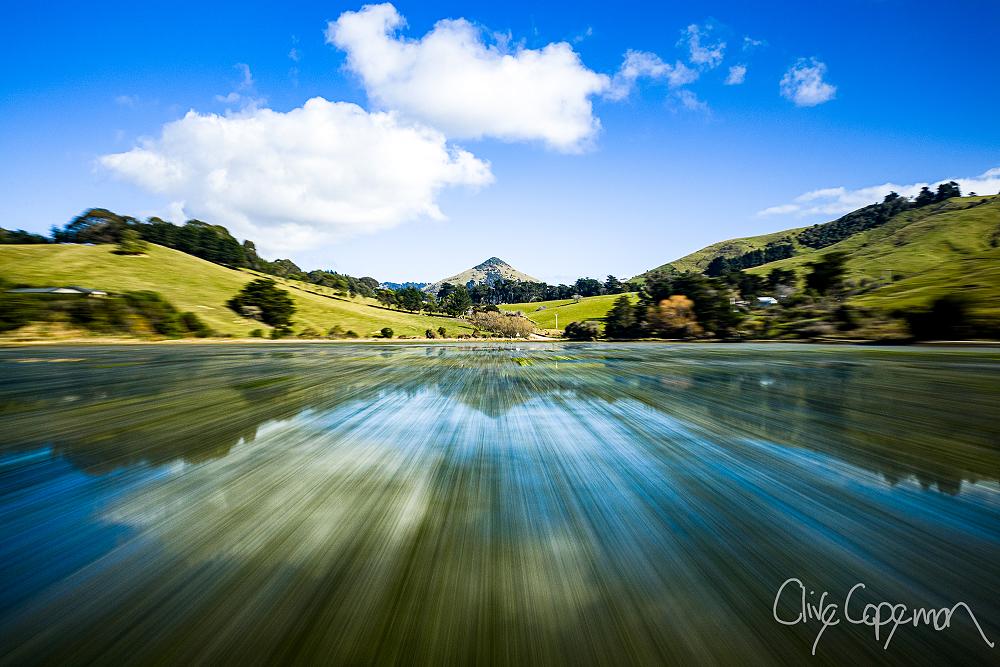
Through intensive experimentation, I developed techniques to produce precise linear, circular, spiral, and radial blur patterns. This was a breakthrough. The radial blur, in particular, created a truly unique style of landscape image. My other slow-shutter still images explore the relationship between time… both geological and biological, and identity. The passage of time, captured during the long exposure, blurs and erases identities, as new ones emerge.
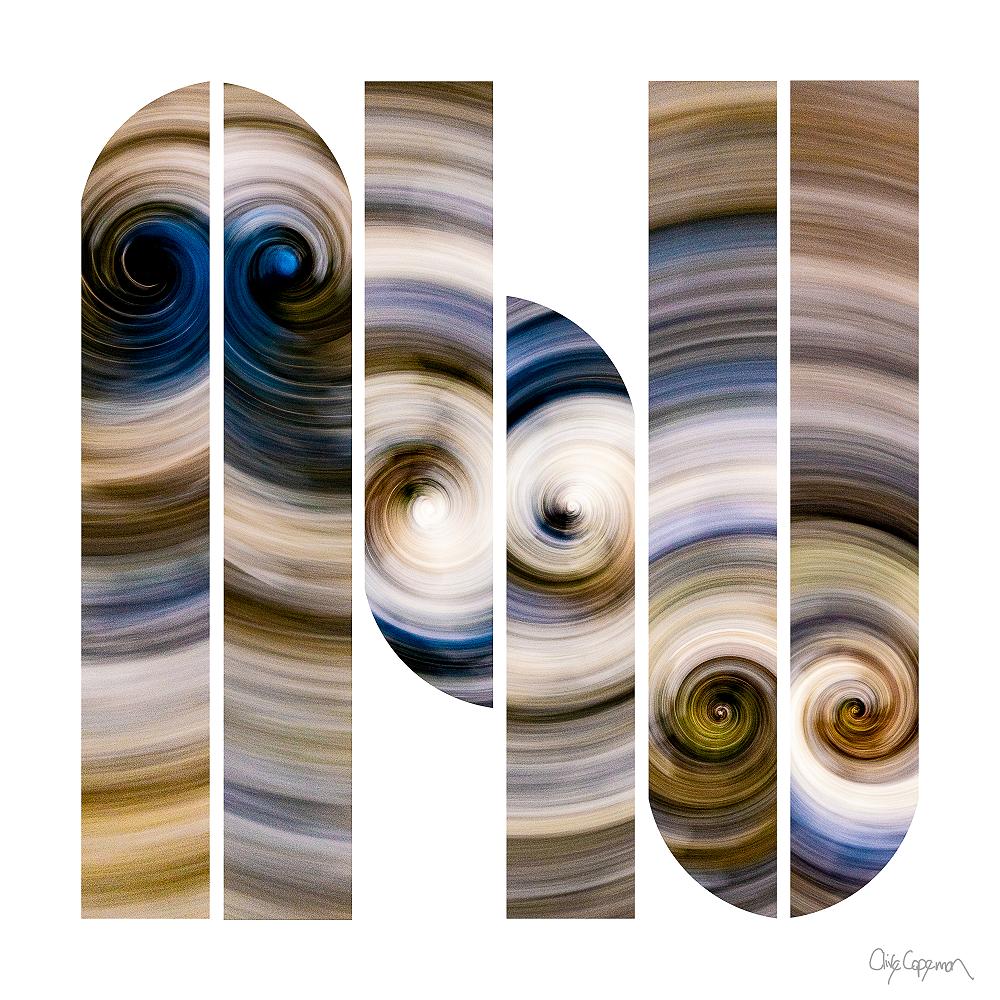
With a research grant from SIT2LRN, I was able to travel across the South Island — from rocky coastlines to snow-clad tussock lands — to capture a diverse series of abstracts. In addition to producing largely unaltered ICM images, I began exploring digital manipulations, creating combined pieces that drew inspiration from artists like Gordon Walters and his famous Koru works.
I presented my research at the OPSITARA research symposium and published my findings in Relevant Research. My work has since inspired other drone photographers to explore this new territory, though one attempt at ICM drone portraits proved a bit too risky — I doubt many people want a camera with propeller blades spinning at 10,000 rpm zooming toward their face!
Interestingly, my most pointed criticism has come from traditional ICM photographers who mistakenly believe the precision of my images is due to Photoshop, rather than the exaggerated, controlled motion of a high-tech flying platform.
Despite the time constraints and the many flight restrictions, this remains an exciting and largely unexplored field. I plan to continue developing, exhibiting, and selling more of my work, pushing the boundaries of what is possible with a flying camera.