
Study Technique of the Week
Study techniques are methods and strategies that are used to improve the learning, efficiency, and retention of information. Using various study methods is a great way to relieve school pressure.
Alexandrina Godfrey-Grant
Feynman Technique
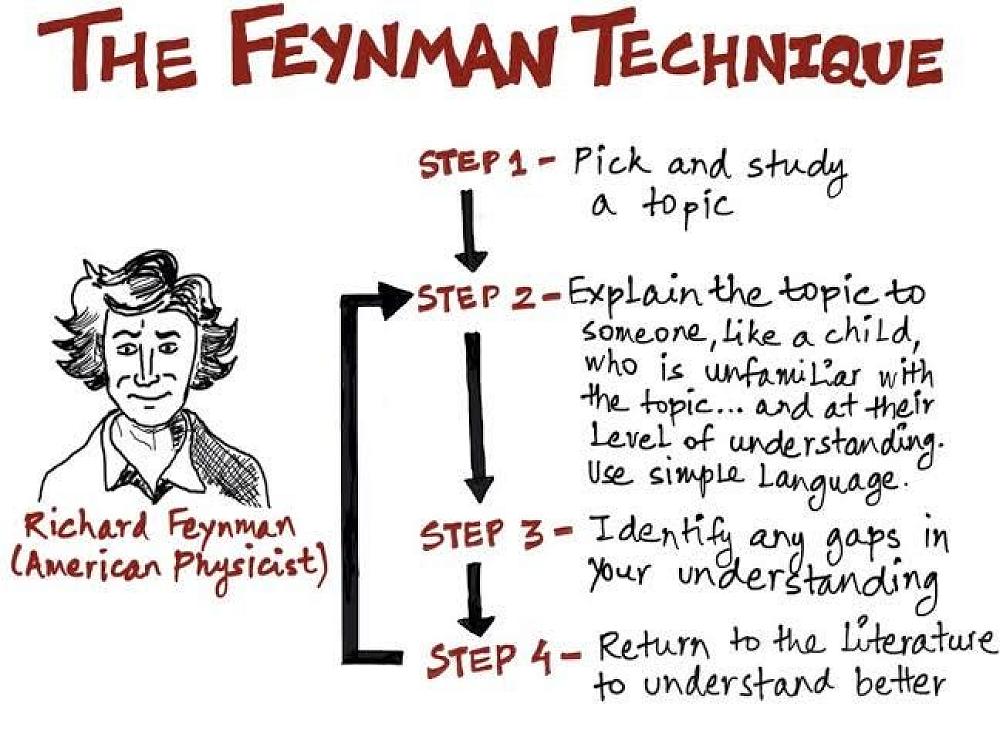
The Feynman Technique is a learning technique that was developed by the physicist Richard Feynman. The Feynman Technique is considered primarily to be an active recall method, along with partly being a passive review technique.
How to use it:
Choose a topic or concept - preferably one you have some knowledge about
Teach it to the best of your ability - Teach what you know so far about the topic out loud, as if you are teaching a child (keep it simplified).
Pinpoint the problematic areas - While explaining, you are likely to stumble over certain parts that are unclear, or too complicated to properly explain.
Highlight these problematic areas.
Review - Review the areas that you struggled on.
Try again - Try to explain the topic again but in a more refined way.
The Feynman technique has many benefits. It deepens understanding, improves retention, identifies knowledge gaps, improves communication and critical thinking skills. If you are unable to find someone to teach, just use a mirror and ‘teach yourself’.
Effective use of this technique requires time and dedication. Because of its depth, it can be very hard to apply to broad topics.
The Feynman Technique is especially effective when used in subjects that involve complex concepts, high levels of memorisation and detailed explanations. That is why the Feynman Technique is particularly useful in subjects like biology, physics, chemistry and mathematics.