
Te Peka Kaurera
Opened 13 January 2025, under the blessing of Te Taumata Tapu o Ngāi Tūāhuriri.
The Naming of Te Peka Kaurera
The name Te Peka Kaurera was gifted to the school by Mana Whenua, Ngāi Tūāhuriri. Kaurera refers to something being high or the highest, while Peka means a branch. Together, these words evoke imagery of a bird flying and soaring from one branch to another, eventually reaching the highest point. This narrative aligns closely with the school’s motto: “I Seek Higher Things.”
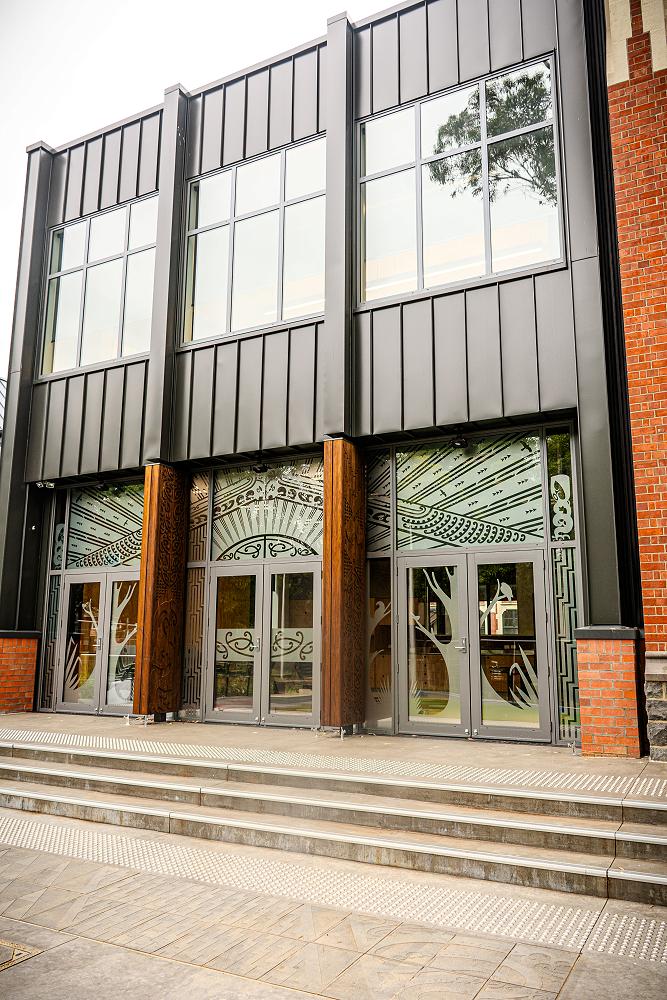
The name is celebrated through stunning Pou, Window Manifestations, and Blue Stone Paver designs by Te Aotahi Rice-Edwards (Ngāti Irakehu, Ngāti Hāua, Ngāti Rakaipaaka, Ngā Rauru) and Hori Te Ariki Mataki (Te Whānau ā Apanui, Ngāti Porou, Ngāi Tahu, Te Āti Haunui-a-Pāpārangi, Ngāti Kauwhata).
The artworks symbolise Kaitiakitanga (Guardianship) of our Taiao (Environment) and the pursuit of excellence, represented by the korimako (bellbird), which feeds on the berries of the kahikatea. This narrative is inspired by the surrounding ngahere (forest) of Pūtaringamotu (Deans Bush).
Explanation of Pavers
The blue stone pavers incorporate Ōtākaro (the local river) and the Kanakana (Lamprey), which were an important food source for local people. These pavers link back to the Pare which stands above the Quad-side of the Hall – acknowledging these important kaitikai of our local waterways.
The pavers incorporate several key patterns:
Niho taniwha: The triangular patterns in the centre represent leadership and the sharing of knowledge and stories.
Poutama: The stair-like patterns symbolize the pursuit of knowledge, much like the korimako striving within the forest.
Pūhoro: These patterns run along both sides of the pavers, symbolizing Ōtākaro and Waimairi (the local waterways) and the kanakana (lamprey), a key food source of the local people.
Explanation of Pou
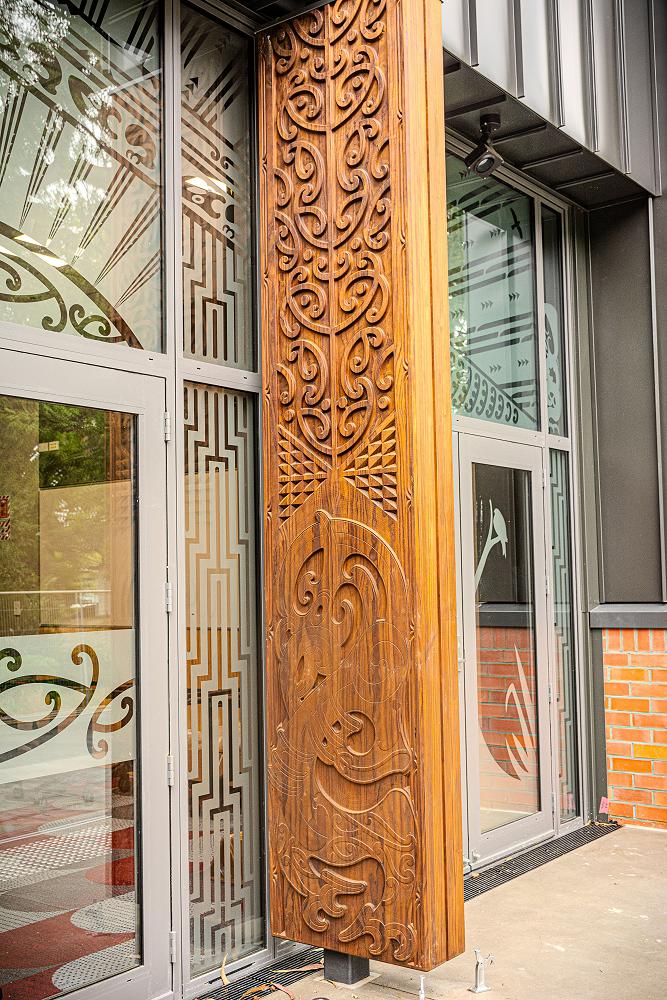
The pou exemplify the school’s motto, Altiora Peto ("I seek higher things"), through the whakataukī:
"Ko te manu e kai ana i te miro nōnā te ngahere, ko te manu e kai ana i te mātauranga nōnā te ao."
This whakataukī honors the korimako and its pursuit to gain the berries of the Kahikatea in Pūtaringamotu, emphasising the relationship between knowledge and the natural world.
The narrative can be seen in the following designs:
Poutama: The stair-like patterns symbolize the pursuit of knowledge and striving for excellence.
Niho taniwha: The triangular patterns represent leadership and the sharing of knowledge and stories.
The kōwhaiwhai that runs vertically down the panels reflects the tributaries of Ōtakaro and Waimairi that surround the kura and ties into the pavers to create cohesion throughout the designs.
The manaia forms at the base of the inner panels are guardians of our environment. Their inclusion on the pou symbolises the school’s commitment to kaitiakitanga—guardianship and stewardship of the environment.
Korimako: The carving of the bird on the outside panels, symbolises the Korimako (Bellbird) and how it climbs the kahikatea of Pūtaringamotu to feed on its berries, this serves as a metaphor that alludes to our school motto.
Explanation of Window Manifestations
The window manifestations symbolize the realm of Tāne, specifically Pūtaringamotu (Deans Bush), through depictions of local birds, trees, and fauna. The birds represent the students' journey—gaining knowledge and understanding of their environment. Upon completing their time at Christchurch Boys’ High, they will leave not only with educational success but also with a sense of belonging rooted in this understanding of where they come from and where they stand.
The designs also reflect the school’s motto and the concepts of Te Ao (creation) and Te Kore (potential), symbolized by the rays of the sun.
Te Peka Kaurera
I whakatuwherahia i te 13 o Hanure, 2024, i raro i ngā tāwharautanga o Te Taumata Tapu o Ngāi Tūāhuriri.
Ngā whakamāramatanga mō Te Peka Kaurera
He mea takoha te ingoa Te Peka Kaurera e Ngāi Tūāhuriri. Ko te tikanga o te kupu kaurera, koia tētahi mea e noho teitei ana, ko te kōtihi rānei o tētahi mea, ka mutu, ko te peka he wāhanga noa o te rākau. Kia tūhonotia ngā kupu nei, ka whakaatahia tētahi manu e rere ana ki tēnā peka, ki tēnā peka, nāwai rā ka tau ki te kaurera o te rākau. Ka hāngai pū tēnei kōrero ki te peha o te kura, arā, ko “Altiora Peto”
Kua whakatinanahia tēnei ingoa e ngā Pou, ngā Toi Matapihi, me ngā Whakairo Kohatu anō hoki. Ko ngā mahi toi, nā Te Aotahi Rice-Edwards (Ngāti Irakehu, Ngāti Hāua, Ngāti Rakaipaaka, Ngā Rauru) rāua ko Hori Te Ariki Mataki (Te Whānau ā Apanui, Ngāti Porou, Ngāi Tahu, Te Āti Haunui-a-Pāpārangi, Ngāti Kauwhata.) E hāngai pū ana ngā mahi toi ki te kaitiakitanga o te taiao me te whai hoki i te iti kahurangi, me te aha, e kite ana i ēnei kōrero i ā te korimako kai i ngā hua o te kahikatea. Ko te whakaaro nei, he mea i toko ake nō te ngahere e karapoti nei, arā, nō Pūtaringamotu.
He whakamāramatanga mō ngā Whakairo Kōhatu
E hāngai pū ana ngā whakairo kōhatu ki te awa Ōtakaro me te kanakana, tētahi kai motuhake nō te iwi o te rohe nei. He hononga tō ēnei whakairo ki te Pare (Pūtaringamotu) e iri nei ki te Hōro o te kura – e whakamana ai i ngā kaitiaki o tō tātou awa.
E whakauruuru ana ngā whakairo i ēnei tohu;
· Niho Taniwha: E tohu ana i te kaiārahitanga me te tukuihotanga o te mātauranga, ngā pūrākau anō hoki.
· Poutama: E tohu ana i te whai i te mātauranga, pērā i te korimako e whanake ana i te ngahere.
· Pūhoro: Kei ngā tahataha e rua, e tohu ana i a Ōtakaro rāua ko Waimairi, ka mutu, te kanakana hoki, tētehi kai motuhake a te iwi.
He whakamāramatanga mō ngā Pou
Ko tā te pou he whakatinana i te peha o te kura, Altiora Peto, mā te whakataukī:
"Ko te manu e kai ana i te miro nōnā te ngahere, ko te manu e kai ana i te mātauranga nōnā te ao."
Ka whakamana tēnei whakataukī i te korimako me tāna whai i ngā hua o te Kahikatea i Pūtaringamotu, otirā te kōtuitui i te hononga o te mātauranga me te taiao.
Ka kitea ngā kōrero i roto i ngā toi e whai ake nei;
· Poutama: E tohu ana i te whai mātauranga me te whakapeto ngoi ki te taumata tiketike.
· Niho taniwha: E tohu ana i te kaiārahitanga, te whai i te mātauranga me te tukuihotanga.
· Ko ngā Kōwhaiwhai e tohu ana i ngā awa o Ōtakaro me Waimairi e whakarohe nei i te kura, waihoki, ka hono atu ki ngā Whakairo Kōhatu kia kite tonu ai i ngā kōrero i roto i ngā toi.
· Ko ngā Manaia ngā kaitiaki o te taiao. Ko tā rāua, he tohu i tō te kura manawanui ki te Kaitiakitanga me te tiaki i te taiao.
· Korimako: Ko ngā manu kei ngā taha o waho o ngā pou, e tohu ana i te Korimako me tōna piki haere i te Kahikatea o Pūtaringamotu kia kaingia ōna hua, he whakataurite tēnei i te peha o tō mātou kura.
He whakamāramatanga mō ngā Toi Matapihi
Ko ngā toi matapihi e tohu ana i te waonui o Tāne, arā, i a Pūtaringamotu mā roto i ngā momo manu, ngā rākau me ngā tipu. Ko ngā manu e tohu ana i te haerenga o ngā tauira – te whai i te mātauranga, te pūrangiaho ki tō rātou taiao anō hoki. Ka puta ana te ihu i Te Kura Kahurangi, ehara i te mea ka wehe noa me ngā hua o te ao mātauranga, engari ka puta hoki he tangata mōhio ki tōna rangatiratanga, mōhio ki tōna mana motuhake nō tōna mōhio ki a ia anō me tōna ake tūrangawaewae.
E whakaahua hoki ana ngā toi i te peha o te kura me ngā āhuatanga o Te Ao me te Kore, nō roto mai i ngā hīhī o te rā.