
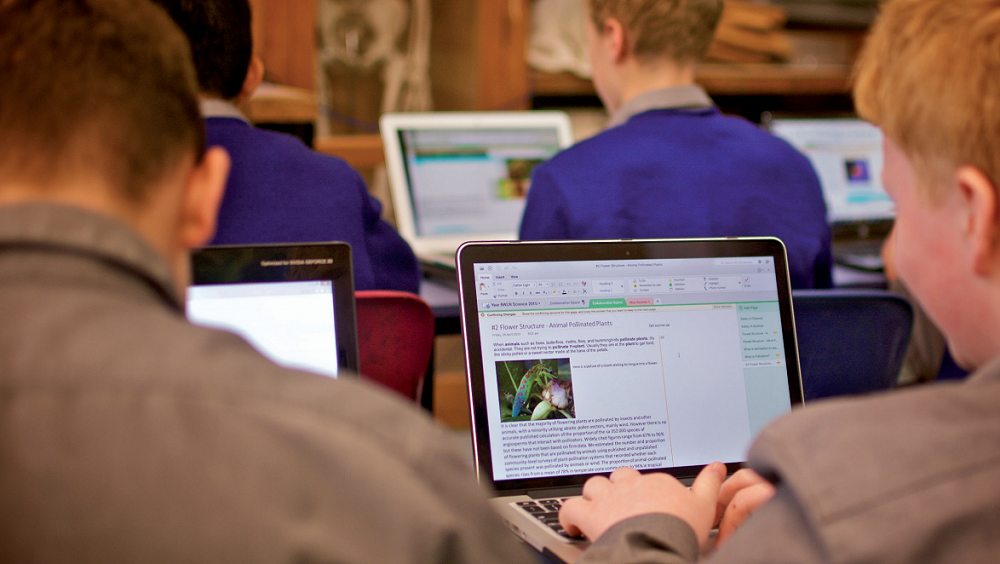
e-Learning in Action
Phillipa Williams from the English Department gives a run down of how she has been using technology to enhance her students' learning experience.
Embarking on my fourth year of this e-Learning journey I decided I’m ready to take it further. Beyond the four walls of the classroom. Beyond substituting paper resources for a OneNote page – not that there is anything wrong with that. After a large amount of research into what my next step should be for my boys, I decided on trialling a flipped classroom.
What is this? In short, the lectures are done at home and the homework tasks done in class. So, term one of the trial done and so far, it seems like a success.
There are many reasons I decided to trial this idea. Number one, I hoped to get a good routine going outside of the four hours I see them each week and help the variety of struggles between the 28 odd students. These precious four hours never provide enough time to get through everything you need to.
Number two, as much as the boys do not like to admit it, most of them like to make pretty notes. To highlight, to engage with the words. But this takes time, time to process and select the most important information, time to understand what is going on.
The final reason, was to raise our Excellence endorsements. Excellence in English generally means perceptive thinking. Thinking for themselves. Taking the idea and transforming it into their own lives or how it might affect society. This again, takes time.
So, if time and individual attention was ultimately what I needed, a flipped classroom seemed like an obvious solution.
And so, a discussion was had with my Year 11 students at the beginning of the year about what it looked like for them. To my surprise they openly agreed to the idea, even though it would involve more homework.
“It went really well,” Henry Rogers said.
A lot of the work this past term has been about getting the boys to have an opinion. They need this to get Excellence. But it also makes the novel study far more interesting if you can argue about the events taking place. I think so anyway.
At home they set about inquiries into history, setting up debates, completing and summarizing readings, and practising their writing skills at home. Essentially, investigating the vast world around them and forming opinions so that they could confidently speak up in class.
Henry pointed out a possible pitfall “because of other subjects and their workloads, there could be issues with the level of homework. It is ok when you know a long time before it is due, but if you only get overnight to do it, it can give you too much.”
In class, we have discussed, debated and argued what was happening in our novel, and what What we found in our research. We have collaborated and taken on other people’s views. The topics were hard hitting; abortions, euthanasia and moral compasses have been heavily discussed.
Sam Taylor’s reaction showed this, “I used to hate English, but this has given me confidence to speak up in class.” That is what I have seen. Every student has appeared comfortable in this classroom. Their opinions are equally valid. They understand, in depth, how the text works.
One moment has stuck in my mind from last term. We were learning about a short story that I have taught many times. If you want to look it up it is called 'On the Sidewalk Bleeding', by Evan Hunter. It is about a boy who has been stabbed because he is in a gang. He is lying on the sidewalk dying. No one will help him because he is wearing his gang’s jacket. He doesn’t understand this at first, but eventually realises that not everyone thinks of the gang as something they want to be a part of. In his final struggle to not die, he takes off the jacket. Unfortunately, this was too late. Every year I’ve asked the boys if this ending for Andy was justified. Should he have died? There is always good debate on either side. But no one could ever tell me why they felt this way.
This year was different.
I introduced it in class, but the boys read and did the comprehension questions at home (this is something that would have taken one of my precious four hours alone). At the end of their task they were told we would debating if the ending was justified. When they came to class they came armed with an opinion that they had settled on. They were confident about it. What was also surprising, was that some had gone about doing some extra research to back up their points.
Twelve weeks on and the result, so far, is that I have 30 boys who are comfortable speaking up, who have an opinion, but most importantly know why this is. They can justify themselves, discuss why their characters were designed, why they acted the way they did and why the novel is in existence.
The best part about this trial has been that for many boys they “didn’t even see a difference” in their workload, according to Tarn Puentener-King. At parent interviews I had many comments on how impressed they were by their boy’s engagement, excitement even, in English this year.
Unfortunately, I cannot report on the final figures of success because I will have none until examinations in November. But for now, I am pleased that I moved to this next stage of my e-Learning journey. I have started integrating the concept into other year levels and seen success. It will take me time to move to this approach fully and I don’t think I ever will. Some things I just need to stick to the lectures. But I am happy that I have in front of me a class of boys who are learning at a higher level than I have seen before.