
NCEA, Level 2 History
Students were required to "examine an historical event or place that is of significance to New Zealanders" for this NCEA assessment. This essay was written by Viena Pouanga.
The Bombing of the Rainbow Warrior
The Event
Early in July 1985 two undercover French agents from the DGSE posing as a honeymoon couple arrived at a NZ airport under Swiss passports while three other French agents along with a doctor (specialising in diving accidents) sailed into Northland New Zealand in a boat called the Ouvea carrying limpet mines and diving equipment. The honeymoon couple were actually French undercover Secret Service agents, Dominique Prieur and Alain Mafart. The agents met up to plan out the bombing of the Rainbow Warrior and decided to comence Operation Satanique on the 10th of July.
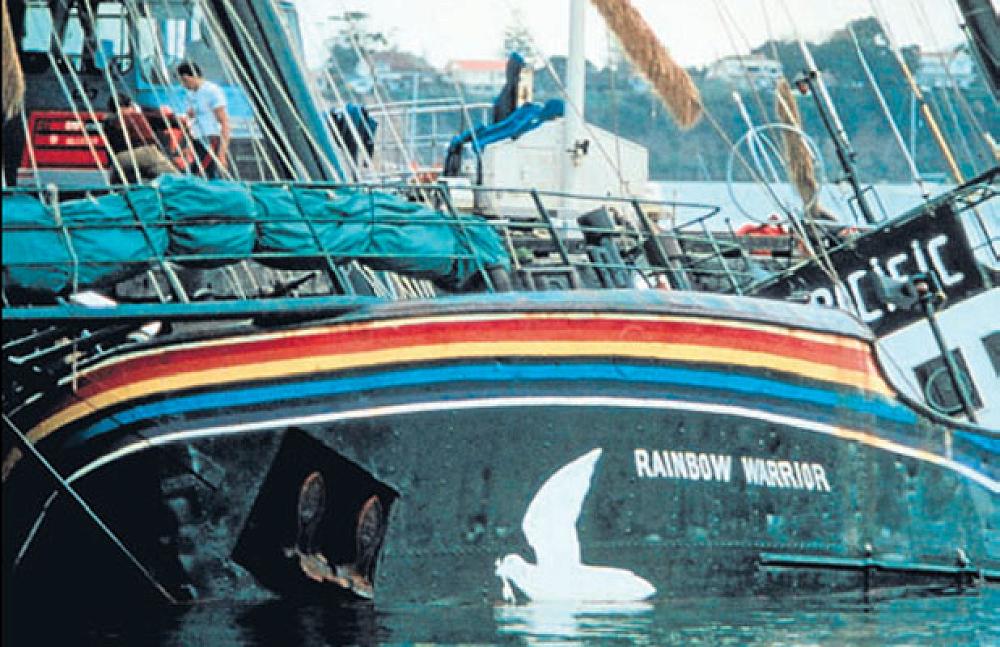
Then on the 10th of July, 1985, at Marsden Wharf, Waitemata Harbour, Auckland, where the Rainbow Warrior, a ship that belonged to Greenpeace was docked so they could prepare to head out to Muroroa, crew members were celebrating Steve Sawyer's (a crew member) birthday. Sometime close to midnight a bomb went off and the crew members were left in confusion until seconds later another bomb went off and the crewmembers hurried off the boat. That night the agents used the diving equipment, and they planted two limpet mines onto the hull of the Rainbow Warrior. Unfortunately, while Fernando Pereira, the Portuguese photographer and engineer, was trying to escape, the stairs collapsed and trapped him in the boiler room and he was not able to escape causing him to lose his life. The explosions from both of the limpet mines left 2 metre holes on the ship leaving the ship half sunk under water.
Police quickly figured out that the Swiss couple were actually French agents Dominique Prieur and Alain Mafart and were able to arrest them on the 15th of July before they were able to escape back to France. However, the agents on the Ouvea were able to escape. Prieur and Marfart were charged with murder, conspiracy, and arson. During their trial both Dominique Prieur and Alain Mafart pled guilty to manslaughter and were sentenced to 10 years of imprisonment. However, France made a deal with New Zealand (after forcing NZ with threats of trade sanctions) that they would take care of Dominique Prieur and Alain Mafart’s sentence under the circumstances that they were not allowed to serve it in France. The two agents ended up only spending two years of their 10 year sentence on the French owned Polynesian island of Hao before they were released back to France.
The Causes
The lead up to the bombing of the Rainbow Warrior started as far back as the end of WWII when America dropped an atomic bomb onto Japan which ultimately ended the war. However, the war may have ended but it triggered a political and military rivalry between U.S.A and the U.S.S.R; America had made a powerful bomb, the U.S.S.R decided to make an even more powerful bomb. Then the Nuclear Arms Race was born. The U.S.S.R and U.S.A and their respective allies raced to have more and powerful bombs then the other. France allied with the U.S.A and also developed a nuclear weapon programme. At first France was testing nuclear bombs in North Africa then changed to testing in the Pacific on Islands that France owned - Mururoa and Fangataufa atolls. The testing started in the 1960 and by 1985 France had already tested more than 150 nuclear bombs in the pacific.
As the race to develop weapons grew, so did the anti-nuclear movement. The movement was to stop nuclear testing and the disarmament of nuclear weapons. That was one of the things that Greenpeace was protesting against and was one of their main focal points. They were the spearhead of most protests and The Rainbow Warrior was their flagship that was used in the majority of the protests. The last mission that the Rainbow Warrior ever did was Operation Exodus which was to help with the evacuation of the Rongelap Islander who were victims of nuclear fallout from the ongoing testing in the Pacific region.
In 1961 the United States started nuclear testing at Bikini Atoll and France followed a few years later. Nuclear fallout ended up contaminating the local environment and affecting human life. Rongelap Island was one of the areas affected. After three days of exposure people showed symptoms of radiation such as nausea, vomiting and diarrhea. A few weeks later people started suffering from hair loss and skin lesions. For the past 31 years the people of Rongelap Island experienced many health problems and developed cancers like thyroid cancer, leukemia, and certain solid tumurs. It became clear Rongelap was unsafe for the islanders and this led to Operation Exodus. In May, 1985 the Rainbow Warrior evacuated the residents off Rongelap Island causing embarrassment for the French as it showed the world that people were suffering from nuclear testings while France continued to test nuclear bombs in the Pacific.
New Zealand had been against nuclear testing in the Pacific since the 1960s. NZ politicians were also against nuclear testing like back in 1973. Norman Kirk who led the third Labour Government sent out two navy frigates into nuclear test zones, Otago and Canterbury and randomly picked a Cabinet Minister, Fraser Colman to sail on those ships into the testing zones. Then year before the Rainbow Warrior bombing “In 1984, Prime Minister David Lange banned nuclear-powered or nuclear-armed ships from using New Zealand ports or entering New Zealand waters” (Wikipedia).
In summary, France bombed Greenpeace (Rainbow Warrior) because of the protests against French nuclear testing and it was an added bouns for the bombing to happen in New Zealand. New Zealand supported Greenpeace with an anti-nuclear stance and civilians were forming a flotilla to protest with Greenpeace. In was as if France killed two birds with one stone by bombing the Rainbow Warrior in New Zealand to deter the protesters from going to Mururoa.
The Consequences
The consequences of the Rainbow Warrior had long-reaching effects.
Firstly, on October 1987 an international arbitration tribunal sitting in Geneva ruled in favour of New Zealand and Greenpeace because the bombing was “an act of war”. France had broken international law so was ordered to pay Greenpeace 8.1 million dollars (US) and New Zealand 13 million dollars (US) for deliberately bombing and sinking the Rainbow Warrior. Because of the bombing and the fact that the United States sat on their hands while France worked to block New Zealand exports, New Zealand distanced itself from the United States.
Secondly, when France bombed the Rainbow Warrior in New Zealand, they did it in the hopes of stopping Greenpeace from protesting in the Pacific and drawing international attention to the nuclear testing and the effects it was having on people and the environment. It was also a strong message to New Zealand to stop their support of these protests. But the bombing ended up achieving the opposite effect; Greenpeace's international reputation was strengthened along with New Zealand's anti-nuclear stance which resulted in David Lange (NZ prime minister) declaring New Zealand officially nuclear free in 1987.
However even after all of this France continued to test nuclear bombs in the Pacific until 27 January 1996 which by then they had already set of 193 to 198 nuclear bombs between both Mururoa and Fangataufa atolls France believed that sinking the Rainbow Warrior would silence the protests, but instead brought international attention to France’s testing and created international outrage. This was a main contributing reason as to why France finally stopped testing bombs in the Pacific.
French apologised and admitted responsibility for the bombing and later on in the years the French agents later also admitted their roles in books explaining how they were part of the plot to bomb the Rainbow Warrior. The book was published by Prieur in 1995 and it was called Agent Secrète were she expanded her role in the bombing and talked how they felt when they learnt that someone had died in the bombing, "We were terrified and appalled ... We hadn't come here to kill anyone."
Significance to New Zealand
The reasons why the Rainbow Warrior incident is significant to New Zealand is because firstly, this was the first and only time New Zealand was attacked inside New Zealand and by the orders of the government of another country that we were on good terms with at the time. Secondly, the bombing strengthened our identity as an anti-nuclear country that banned ships or planes that had nuclear weapons or nuclear powered from entering New Zealand and New Zealand itself has remained staunchly anti-nuclear with the exception of nuclear medicine. We are recognised as a supporter of the anti-nuclear weapon movement. However, because of New Zealand's stance as a nuclear free country, New Zealand was suspended from the ANZUS alliance in 1986. The ANZUS treaty came about in 1951 and was to reassure the countries that they would protect and support each other from the communist powers. New Zealand, Australia and the United States agreed to maintain and develop the military resources needed to resist an attack in the Pacific. New Zealand was suspended from ANZUS because the United States didn’t support our stance on nuclear power however the suspension was lifted when they realised NZ was not going to budge on our anti-nuclear stance. The Rainbow warrior incident brought attention to nuclear free protests both internationally and within our own country.