
Columba College History
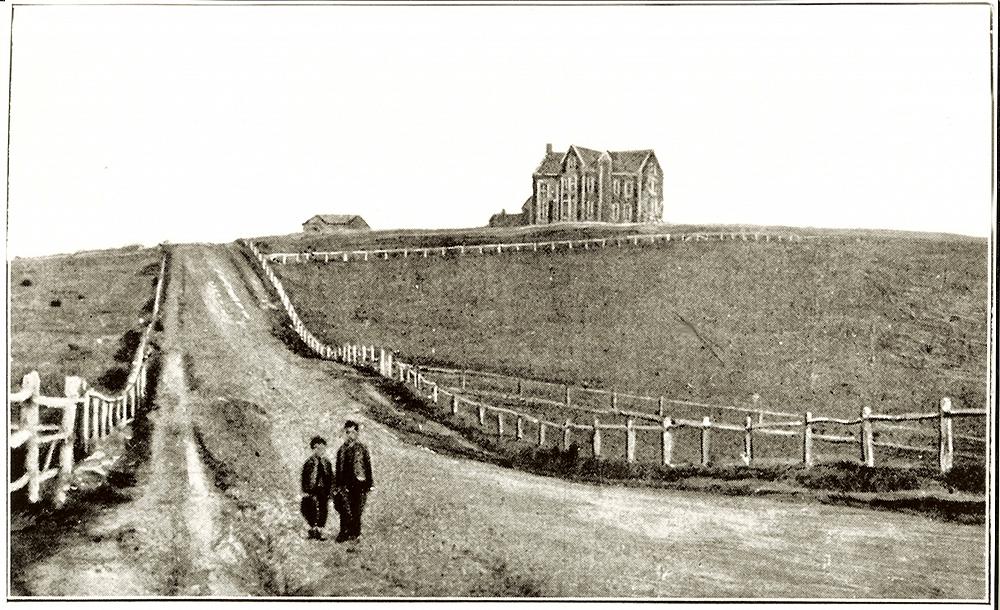
As early as 1900 The Rev. Alexander Whyte began suggesting that a Presbyterian boarding school was needed in Dunedin. In February 1915, Columba College opened its doors on a prime site on Highgate with 110 pupils.
The Presbytery of Dunedin had purchased Bishopscourt to achieve this. The school was named after Saint Columba who, from his base on the island of Iona, had brought Christianity to Scotland. The Presbyterian Church had later evolved from there.
Two early Dunedin private schools contributed many of the first pupils to Columba: Braemar House School, run by three sisters, the Misses Miller, and Girton College, established in 1886 by Miss Caroline Freeman, BA, the first woman graduate of Otago University. These two schools closed when Columba opened and Miss Frances Ross, Principal of Girton since 1911, became Columba’s first Head.
It is interesting to note how historical names are retained in various ways at Columba today. Katharine Buchan House built for Junior boarders in 1967 is also named after Miss Buchan, Principal from 1954-1973.
The historic Hill Jack property was purchased by the Columba College Board of Governors in July 2002. It comprises 0.56 hectares and makes the total school campus 2.64 hectares.
From the beginning of the 2004 school year, the Hill Jack campus was fully occupied and used by the College. The School Office relocated to the Hill Jack homestead. The Junior School also re-located then to the rest of the Hill Jack campus.
Like the Bishopscourt site, the Hill Jack property has an interesting early history. The story begins with Mr Archibald Hill Jack who bought the property in March 1863 for 800 pounds sterling. That was at a time when Highgate was known as High Street and the Roslyn area was called the Township of Linden.
It is thought the original wooden homestead was built by Mr Hill Jack in the 1890s. It was called "Romanoff" by the family but for many years has been known locally as "Hill Jack".
Born in 1836, Archibald Hill Jack was of Scottish descent, emigrating to New Zealand in 1865 and marrying Kate Mary Willis soon after his arrival here. The marriage produced six children but only four of them survived to adulthood.
Archibald Hill Jack became a prominent and wealthy businessman in Dunedin, and a local benefactor. He was a major influence in the building of St. John's Anglican Church in Roslyn in 1880 and his dedication to the parish never faltered, serving for many years as Parish Warden and Vicar's Warden.
After her husband's death in 1912, Mrs Kate Mary Hill Jack inherited the Hill Jack property and it was on her death in 1929 that the property was bequeathed to Dunedin for the care of incurable and crippled children.
Since the 1930s there have been many changes to the property, both in use and in additions. During World War II Hill Jack was commandeered under the War Emergency Regulations and was used as a convalescent home for wounded soldiers. After the war, it was leased to the Otago Hospital Board and for over thirty years was put to use as a training school for nurses, convalescent home, chest hospital and principally as a maternity home. The maternity home stirs memories for many local people as apparently 10,597 babies were reported to have been born at Hill Jack.
The hospital finally closed its doors to patients in 1967 and due to financial and political restraints Hill Jack remained unoccupied for the following thirty years. In March 1988 Hill Jack was purchased privately and was operated as the Dunedin Academy, a Vocational training Institute, until its purchase by the Columba College Board of Governors in July 2002.
Extensive upgrading of the buildings and site was carried out, with one central brick block demolished to enhance the green space and 'flow' around the new junior school campus. A relocatable building was moved across to the Hill Jack campus, while two others were sold to John McGlashan College. The junior school opened in 2004.
In 2006, the Board of Governors purchased the former Plunket Rooms on the corner of Oban Street and Tyne Street. It was converted to school use, initially as an art room, and then from 2009 a junior school classroom.
A competition was held among the students to name the former Plunket room. The late Chloe Anson and Laura Schep chose the winning name – Nancy Blackwell House after the first Dux of Columba College.
The Marsh Sports Centre is one of the more recent buildings to be built at the College. It is a wonderful facility for the whole school and was made possible by the generosity of the Marsh family and many donors from the wider school community. The Governor-General of New Zealand, Dame Silvia Cartwright, opened the Marsh Sports Centre on the 18th July 2006. The architect was Tim Heath of Architectural Ecology.
The residence formerly occupied by the House Manager was modified for school use in January 2009 and is now used by Visual Arts. It has been named Sargood House.