The New Zealand Curriculum
The New Zealand Curriculum document published by the Ministry of Education was implemented in 2010.
FOREWORD
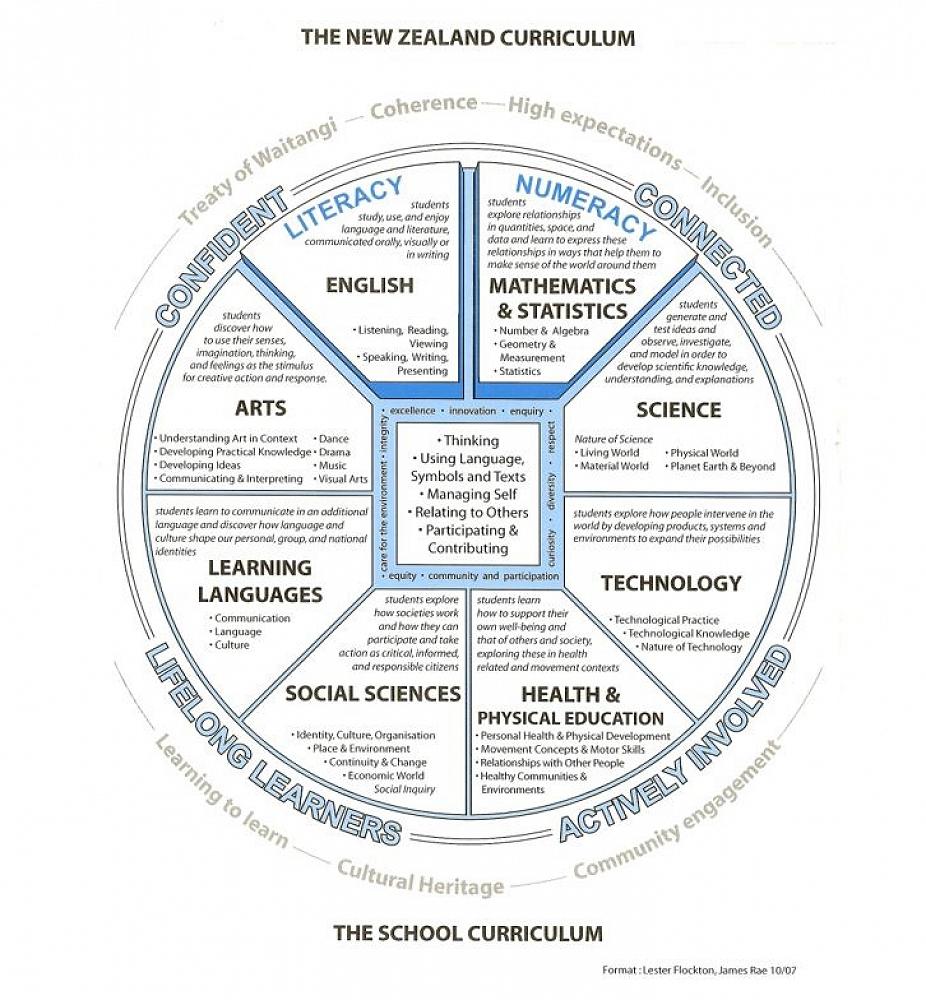
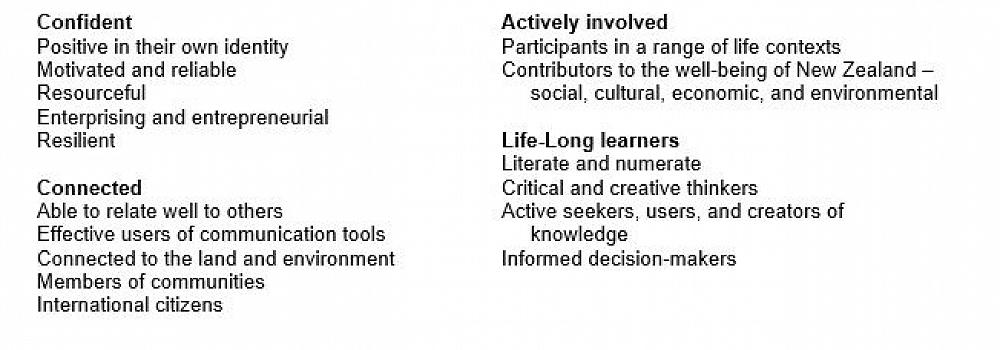
The New Zealand Curriculum is a clear statement of what we deem important in education. It takes as its starting point a vision of our young people as life-long learners who are confident and creative, connected, and actively involved It includes a clear set of principles on which to base curriculum decision-making. It sets out values that are to be encouraged, modelled, and explored. It defines five key competencies that are critical to sustained learning and effective participation in society and that underline the emphasis on life-long learning.
The New Zealand Curriculum states succinctly what each learning area is about and how its learning is structured. The sets of achievement objectives have been carefully revised by teams of academics and teachers to ensure that there are current, relevant, and well-defined outcomes for students. A new learning area, learning languages, has been added to encourage students to participate more actively in New Zealand’s diverse, multicultural society and in the global community.
Karen Sewell
Secretary of Education 2010
PURPOSE AND SCOPE
The New Zealand Curriculum is a statement of official policy relating to teaching and learning in English-medium New Zealand schools. Its principal function is to set the direction for student learning and to provide guidance for schools as they design and review their curriculum.
The New Zealand Curriculum applies to all English-medium state schools (including integrated schools) and to all students in those schools, irrespective of their gender, sexuality, ethnicity, belief, ability or disability, social or cultural background, or geographical location. The term “students” is used throughout in this inclusive sense unless the context clearly relates to a particular group.
VISION
Our vision is for young people who will:
be creative, energetic, and enterprising
seize the opportunities offered by new knowledge and technologies to secure a sustainable social, cultural, economic, and environmental future for our country
work to create an Aotearoa New Zealand in which Māori and Pākehā recognise each other as full Treaty partners, and in which all cultures are valued for the contributions they bring
continue to develop the values, knowledge, and competencies that will enable them to live full and satisfying lives
be confident, connected, actively involved, and life-long learners
PRINCIPLES
Foundations of curriculum decision-making.
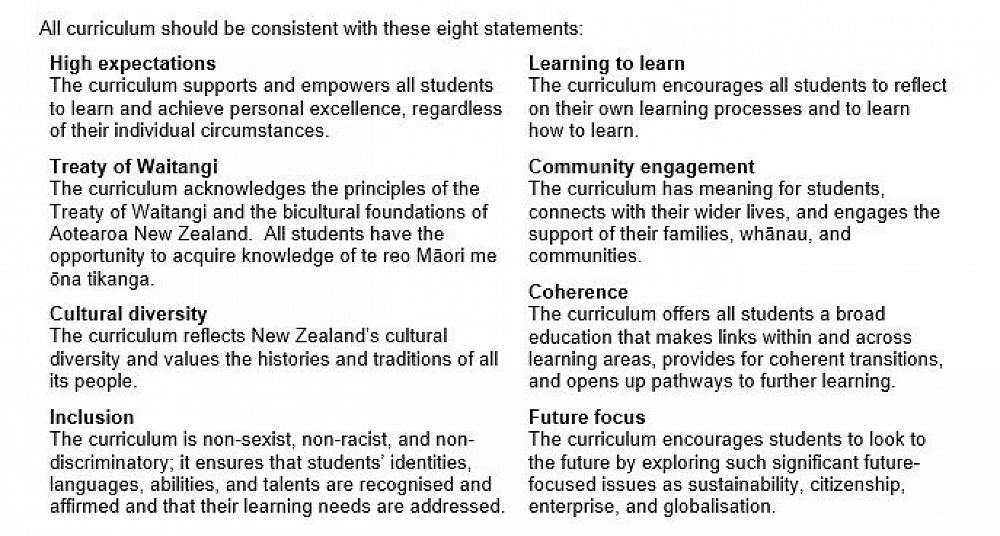
The principles set out below embody beliefs about what is important and desirable in school curriculum – nationally and locally. They should underpin all school decision-making.
These principles put students at the centre of teaching and learning, asserting that they should experience a curriculum that engages and challenges them, is forward-looking and inclusive, and affirms New Zealand’s unique identity.
Although similar, the principles and the values have different functions. The principles relate to how curriculum is formalised in a school; they are particularly relevant to the processes of planning, prioritising, and review. The values are part of the everyday curriculum – encouraged, modelled, and explored.
VALUES
Values are deeply held beliefs about what is important or desirable. They are expressed through the ways in which people think and act.
Every decision relating to curriculum and every interaction that takes place in a school reflects the values of the individuals involved and the collective values of the institution.
The values on the list below enjoy widespread support because it is by holding these values and acting on them that we are able to live together and thrive. The list is neither exhaustive nor exclusive.
Students will be encouraged to value:
excellence, by aiming high and by persevering in the face of difficulties
innovation, inquiry, and curiosity, by thinking critically, creatively, and reflectively
diversity, as found in our different cultures, languages, and heritages
equity, through fairness and social justice
community and participation for the common good
ecological sustainability, which includes care for the environment
integrity, which involves being honest, responsible, and accountable and acting ethically
respect, for themselves, others, and human rights
The specific ways in which these values find expression in an individual school will be guided by dialogue between the school and its community. They should be evident in the school’s philosophy, structures, curriculum, classrooms, and relationships. When the school community has developed strongly held and clearly articulated values, those values are likely to be expressed in everyday actions and interactions within the school.
Through their learning experiences, students will learn about:
their own values and those of others
different kinds of values, such as moral, social, cultural, aesthetic, and economic values
the values on which New Zealand’s cultural and institutional traditions are based
the values of other groups and cultures
Through their learning experiences, students will develop their ability to:
express their own values
explore, with empathy, the values of others
critically analyse values and actions based on them
discuss disagreements that arise from differences in values and negotiate solutions
make ethical decisions and act on them
All the values listed above can be expanded into clusters of related values that collectively suggest their fuller meanings. For example, the value of 'community and participation for the common good' is associated with values and notions such as peace, citizenship, and manaakitanga.
KEY COMPETENCIES
Capabilities for living and life-long learning.
The New Zealand Curriculum identifies five key competencies:
thinking
using language, symbols, and texts
managing self
relating to others
participating and contributing.
People use these competencies to live, learn, work, and contribute as active members of their communities. More complex than skills, the competencies draw also on knowledge, attitudes, and values in ways that lead to action. They are not separate or stand-alone. They are the key to learning in every learning area.
The development of the competencies is both an end in itself (a goal) and the means by which other ends are achieved. Successful learners make use of the competencies in combination with all the other resources available to them. These include personal goals, other people, community knowledge and values, cultural tools (language, symbols, and tests), and the knowledge and skills found in different learning areas. As they develop the competencies, successful learners are also motivated to use them, recognising when and how to do so and why.
Opportunities to develop the competencies occur in social contexts. People adopt and adapt practices that they see used and valued by those closest to them, and they make these practices part of their own identity and expertise.
The competencies continue to develop over time, shaped by interactions with people, places, ideas, and things. Students need to be challenged and supported to develop them in contexts that are increasingly wide-ranging and complex.
Thinking
Thinking is about using creative, critical, and metacognitive processes to make sense of information, experiences, and ideas. These processes can be applied to purposes such as developing understanding, making decisions, shaping actions, or constructing knowledge. Intellectual curiosity is at the heart of this competency.
Students who are competent thinkers and problem-solvers actively seek, use, and create knowledge. They reflect on their own learning, draw on personal knowledge and intuitions, ask questions, and challenge the basis of assumptions and perceptions.
Using language, symbols, and texts
Using language, symbols, and texts is about working with and making meaning of the codes in which knowledge is expressed. Languages and symbols are systems for representing and communicating information, experiences, and ideas. People use languages and symbols to produce texts of all kinds: written, oral/aural, and visual; informative and imaginative; informal and formal; mathematical, scientific, and technological.
Students who are competent users of language, symbols, and texts can interpret and use words, number, images, movement, metaphor, and technologies in a range of contexts. They recognise how choices of language, symbol, or text affect people’s understanding and the ways in which they respond to communications. They confidently use ICT (including, where appropriate, assistive technologies) to access and provide information and to communicate with others.
Managing self
This competency is associated with self-motivation, a 'can-do' attitude, and with students seeing themselves as capable learners. It is integral to self-assessment.
Students who manage themselves are enterprising, resourceful, reliable, and resilient. They establish personal goals, make plans, manage projects, and set high standards. They have strategies for meeting challenges. They know when to lead, when to follow, and when and how to act independently.
Relating to others
Relating to others is about interacting effectively with a diverse range of people in a variety of contexts. This competency includes the ability to listen actively, recognise different points of view, negotiate, and share ideas.
Students who relate well to others are open to new learning and able to take different roles in different situations. They are aware of how their words and actions affect others. They know when it is appropriate to compete and when it is appropriate to cooperate. By working effectively together, they can come up with new approaches, ideas, and ways of thinking.
Participating and contributing
This competency is about being actively involved in communities. Communities include family, whānau, and school and those based, for example, on a common interest or culture. They may be drawn together for purposes such as learning, work, celebration, or recreation. They may be local, national, or global. This competency includes a capacity to contribute appropriately as a group member, to make connections with others, and to create opportunities for others in the group.
Students who participate and contribute to communities have a sense of belonging and the confidence to participate within new contexts. They understand the importance of balancing rights, roles, and responsibilities and of contributing to the quality and sustainability of social, cultural, physical, and economic environments.
LEARNING AREAS
Important for a broad, general education.
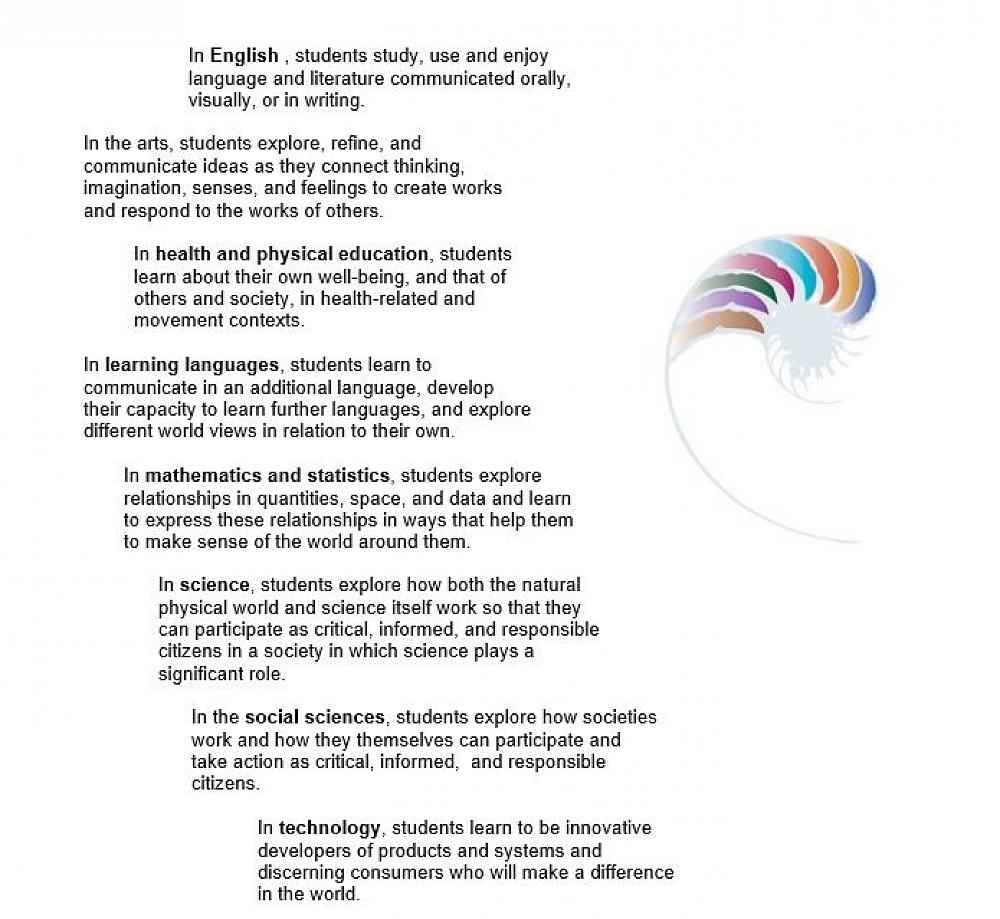
The New Zealand Curriculum specifies eight learning areas: English, the arts, health and physical education, learning languages, mathematics and statistics, science, social sciences, and technology.
The learning associated with each area is part of a broad, general education and lays a foundation for later specialisation. Like the key competencies, this learning is both end and means: valuable in itself and valuable for the pathways it opens to other learning.
While the learning areas are presented as distinct, this should not limit the ways in which schools structure the learning experiences offered to students. All learning should make use of the natural connections that exist between learning areas and that link those learning areas to the values and key competencies.
Learning areas and language
Each learning area has its own language or languages. As students discover how to use them, they find they are able to think in different ways, access new areas of knowledge, and see their world from new perspectives.
For each area, students need specific help from their teachers as they learn:
the specialist vocabulary associated with that area
how to read and understand its texts
how to communicate knowledge and ideas in appropriate ways
how to listen and read critically, assessing the value of what they hear and read
In addition to such help, students who are new learners of English or coming into an English-medium environment for the first time need explicit and extensive teaching of English vocabulary, word forms, sentence and text structures, and language uses.
As language is central to learning and English is the medium for most learning in the New Zealand Curriculum, the importance of literacy in English cannot be overstated.