Cotswold Mātāhae School Cultural Narrative
As part of our school redevelopment programme we have been working with Ngāi Tuāhuriri to develop our cultural narrative. A cultural narrative recognises the historical relationship between the area and its mana whenua. It describes what is unique about the place and the people our school is part of. It helps build a common understanding of heritage, traditional and spiritual connections, and values.
For a school in Aotearoa New Zealand, embracing the cultural narrative of mana whenua represents a commitment to an enduring partnership that is built through open conversations consistent with two world views. It shows we recognise mana whenua and value their knowledge and ways of being.
Cotswold Mātāhae School
As part of our cultural narrative Ngāi Tuāhuriri have gifted us the name Mātāhae.
Mātāhae talks of a divergent stream from the main channel of a river. The Black Map from 1856 clearly shows a stream directly through Cotswold School. This stream is significant as it encapsulates both the North and the South of Cotswold School’s Zone Catchment. This stream is fed from the Purarekanui Creek, through Raupō Swamp to the North, into a creek and into a swamp which borders the Wairarapa that all flow into the Ōtakaro.
Ngāi Tuāhuriri also gifted us the theme tuna. Tuna were plentiful in the waterways and still found in the Ōtākaro close to Cotswold Mātāhae kura. Tuna are also found in swamps like the two to the North and South of our kura. Ngehe is a name for a swamp eel. When tuna begin life, they are a tiny one millimetre in length. During their life, they can grow up to two metres long. Such as their time spent at Cotswold Mātāhae helping our learners grow and learn.
Although a valuable food source, the tuna are treated with respect as they have been a reliable food source for whānau for many generations. They have been migrating to and from Aotearoa for millions of years. They are responsive to their environment. They are the guardians of our waterways. They also need us to look after the waterways so they keep coming back to our shores.
This narrative and naming theme, leads to many opportunities for learning about mahinga kai (food gathering places), traditional economy, kaitiakitanga (guardianship), manaakitanga (care and hospitality), trapping, preserving, cooking methods then and now, as well as the technology/art opportunities in re-creating these traditional mahinga kai methods.
It also creates a more diverse culture within the kura and begins to foster opportunities within the school and wider community to embrace a bi-cultural worldview. This is an important step towards the recognition of a multi-cultural society.
Our New Tohu (Logo)
We have been fortunate in having one of our parents - Artist/Designer Morgan Mathews-Hale work with us in developing a new tohu (logo) for our school which reflects Cotswold Mātāhae’s narrative and values.
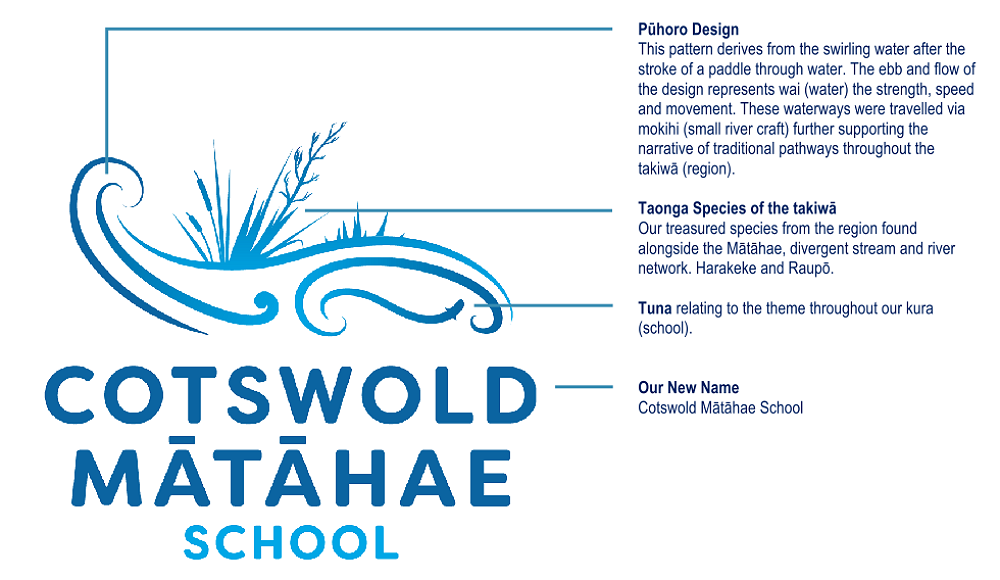
Our new logo will be incorporated into our school over time. It is currently visible through our website, Hero postings, letterhead and school documentation. It will also feature on new signage as this is developed for our school.
School uniform items with the new logo will be available from early 2023 for parents to purchase as and when their child requires a new uniform item. A natural and gradual transition from old to new will be implemented over the next three to five years.
Names for Learning Spaces
Representing The Tuna Narrative Throughout Our School
Matauraka Mahaanui have identified the following names for parts of our school based on the relationship between the purpose of these spaces and the overall narrative.
- Kōhau – Hall: There are many names for eel traps/pots/weirs. This name is relevant to the South Island. Kōhau was chosen for the hall as this is a place to gather, as tuna do.
- Akura - Admin-Office: This is one of the names for the entrance to an eel pot. This was chosen for the admin/office area as it the first point of call for manuhiri (visitors) and often kaiako (teachers) before they start their day.
- Pūrangi – Library: Net attached to a hīnaki to guide the eels to the mouth. A hīnaki is the name for an eel pot used by Ngāi Tahu. We guide ākonga to and through the library as the pūrangi guides tuna into the hīnaki.
- Rohe – Rooms 1 – 4: A small net placed inside the eel pot. Relevant because of the important job of such a small part of the pot.
- Matamoe - Rooms 5 – 12: Shortfin eel, Anguilla australis - a quite large type of eel, dark olive to olive-green in colour, and whitish-grey to silvery ventrally. Widespread in lowland fresh waterways. Usually nocturnal and lives under cover of overhanging rocks and de-bris. Chosen for this block as you weave your way, like a tuna, through the classrooms
- Tōnakenake – Rooms 13-17: A creeping plant with a fine stem which was used for making eel pots.
- Toi – Rooms 18 – 21: To fish for eels. Toi or ‘bobbing’, where worms are threaded on to harakeke (flax) fibres, the tuna are caught and flicked into a pool of water that has been dug on the riverbank, where the tuna release their grip.
- Kōkopu – Rooms 21-25: Large species of eel (also the name for a type of pounamu and whitebait... all prized by Ngāi Tahu)