Denouements, closures, darkness, light: St John’s, Invercargill
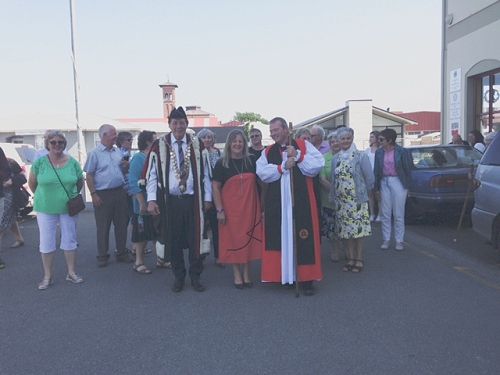
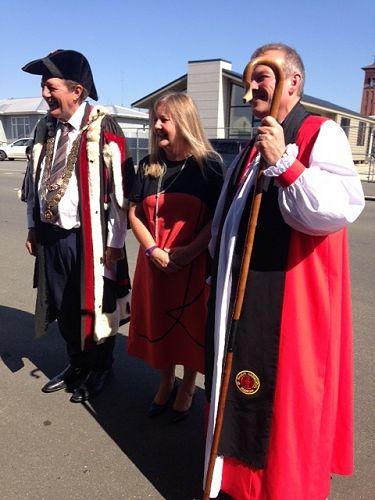
A reflection by Rev'd Michael Godfrey on the final service at St John's Invercargill on Sunday 2 December 2018.
It was from Australian Indigenous peoples that I began to learn of the Spirit of Place. Even as a Christian I was somewhat secularist, materialist, until I began to hear more ancient voices. There are places that we don’t spit on, sacred, tapu, because a whole nation or people has known, loved, lived and died there.
We might think of Spirits’ Bay and Cape Reinga, where spirits leap to the after-world, or Gallipoli where so many, Māori and Pākehā, fought and died, shoulder to shoulder. We might speak of Kura Tawhiti (Castle Hill), where Papatuanuku and Ranginui where cleaved apart in some of the sacred Māori mythologies, and which the Reverend Charles Clarke, described as outcrops “grouped like the buildings of a Cyclopean city, or the circling seats of a vast amphitheatre” and “like the gigantic monoliths of Stonehenge.”
There are, too, our personal sacred places. Some will remember the place of their first kiss, or where they first made love. They may recall a place that took their breath away because … well just because Spirit of Place. Places where they – where you – loved or laughed or cried or picnicked on life’s journey.
For many of us who have embraced the Anglican Christian pilgrimage there will be churches amongst our sacred memories. Our children or we ourselves were married there, confirmed there, fare-welled loved ones there. Yes, we stand in a tradition, a kaupapa that reminds us that nothing is eternal, and my mate St Paul wrote “what is seen is temporary, but what is not seen is eternal” (2 Cor. 4.18b) – hence my earlier self’s initially atheistic and later Christian meh to Spirit of Place – but some things, places, routines are pregnant with meaning for us or for our people and we scorn them at great risk. We even say in our Eucharistic liturgy that “for us” bread and wine will become body and blood (and there are several layers of meaning to the words “for us”).
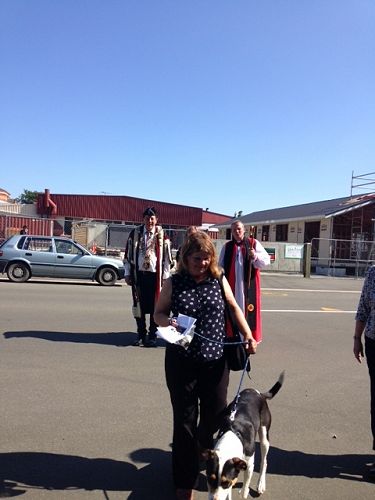
So the closure of a church is a rite saturated with meaning. Tread softly, for you tread on my memories. I’m no good at counting, but two or three hundred gathered in the presence of their memories. Most were believing too that these memories are deeply embraced in the love of the God of Eternity, the God of new hopes, the God who calls us into divine and therefore holy future. Did it hurt? The woman next to me, not even a parishioner, spoke of her sense of pain. I suspect 90% of those present had their own points, even saturations of pain. Others, like me, had only the knowledge of the pain of those around me (only the episcopal - Bishop Steve's dog - Marley remained impervious).
Either way: the words and actions of those who created and conducted the liturgy of closure there (as, indeed at Athol, only several days earlier) spoke to the sacred nature of those points of pain, breathing hope of new beginnings. Even more, they, compilers and participants, their words and gestures, rumoured not only the treasured continuance of sacred memories, but rumoured the Resurrection hope that dwells beyond the desiccation of all human memory. They rumoured the hope that dwells beyond existence, that is the very reason why we know there is good news amidst all our Gallipolis and Stonehenges and Kura Tawhiti and first kisses and broken dreams.
Vale, St John’s, haere ra, kia kaha. In this particular case the building that is dear, though deconsecrated, will continue to speak to those whose memories reverberate there. In some cases (above all, in our Anglican kiwi consciousness, the ruins of Christchurch Cathedral) this may not (who knows, yet?) be the case. The church and grounds where my father’s remains dwelt for a season are now long gone beneath “developments.” But either way the divine love that was rumoured by our bishop and the compilers of the Service of Deconsecration is greater than our sorrow or our joy.
Long after we and our memories turn to dust that love will beckon us on into the eternal light of the Lamb where sorrow and tears shall be no more – but love will be eternal. “May the power of God’s presence bless this moment of our moving on indeed.”
Gallery