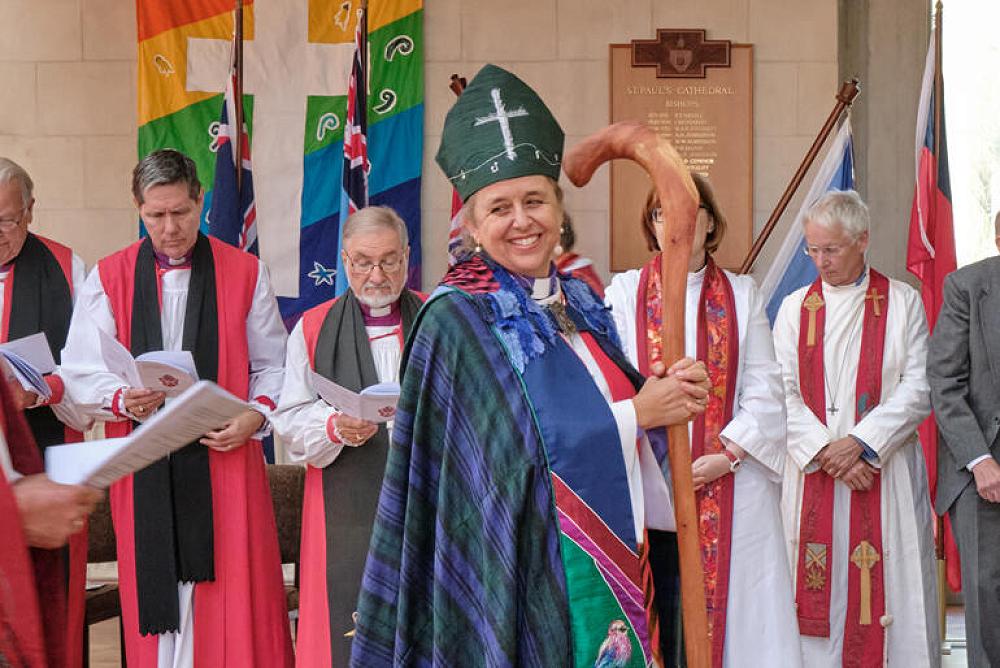
The story behind Bishop Anne's Cope, Mitre and Crozier
Bishop Anne reflects on her vestments and how they uniquely describe her new ministry...
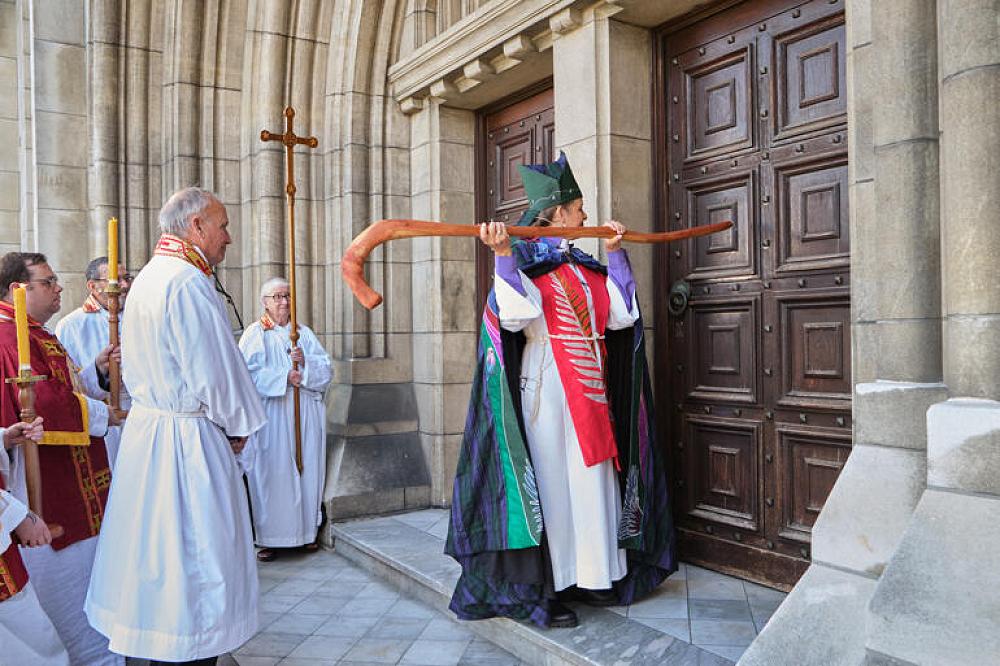
When I began to think about needing a cope, I struck a problem...I had plenty of ideas, but am severely lacking in artistic ability and had no clue how to communicate those ideas to someone in a workable fashion. I also imagined that everything I suggested would be deemed too complicated.
But then I thought of Diana Langdon: Diana who has what seems to me the miraculous ability to create visual designs which invariably leave you thinking, “That’s exactly right, that works.” So, to Diana I went, and much to my relief she agreed to try to untangle my ideas into something that would “work”.
More than that, she linked me up with Reverend Annette Cater. On a week when I was feeling a little bit overwhelmed and a little bit discouraged, I met with Diana and Annette on Zoom and they lifted my spirits amazingly! Nothing seemed too complex, nothing impossible. Ideas flew, and Annette calmly took them all on board and suggested more. Diana fitted them together into a satisfying whole, Annette turned them into reality, and here we have this beautiful cope.
Designed and made with generosity, skill, art, grace and joy.
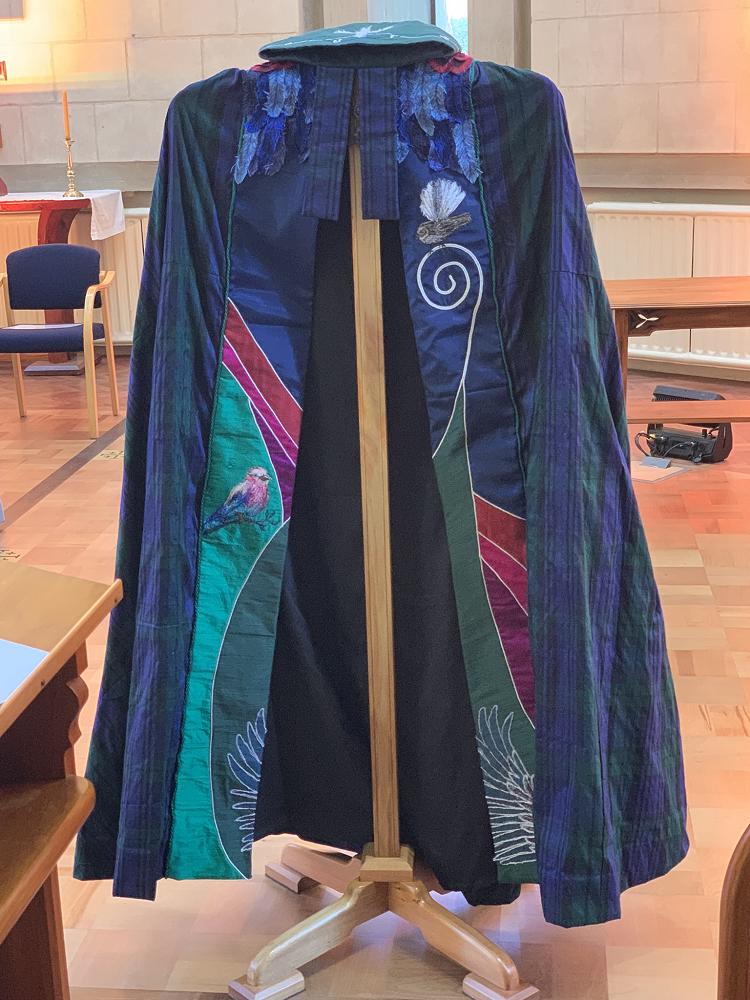
The birds all represent branches of my whakapapa
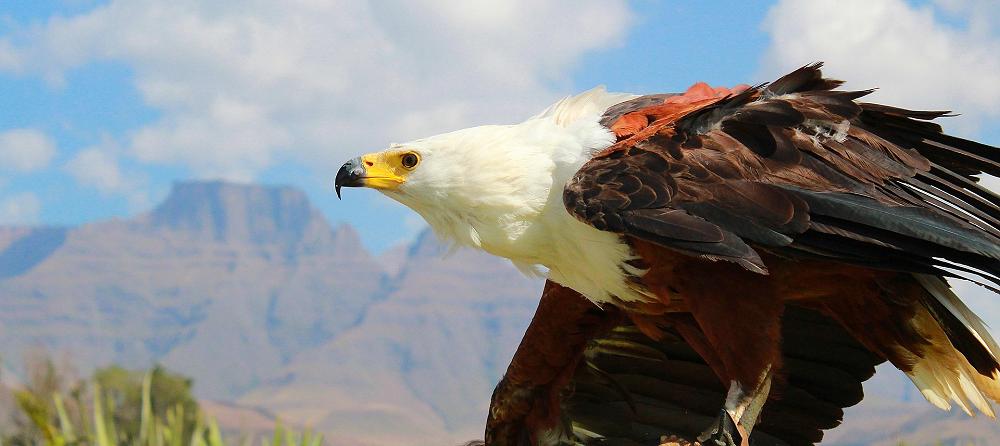
FISH EAGLE
The fish eagle is the national bird of Zambia.
My mother’s side of the family has roots solidly in that part of the world, with my great-great-great grandfather moving to southern Africa as one of the earliest LMS missionaries to the region, and each successive generation until my own growing up there.
When I returned to Zambia as a young adult, it felt like coming home. Returning again recently for my beloved uncle’s funeral, I had an afternoon by a dam on my cousin’s farm, watching two fish- eagles hunt and perch and fly.
Shortly afterwards, visiting my sister’s bach on an Australia beach, the fish eagle’s close relation, the Australasian Sea Eagle, was there, perched high on the skyline, connecting distant and more recent past for me.
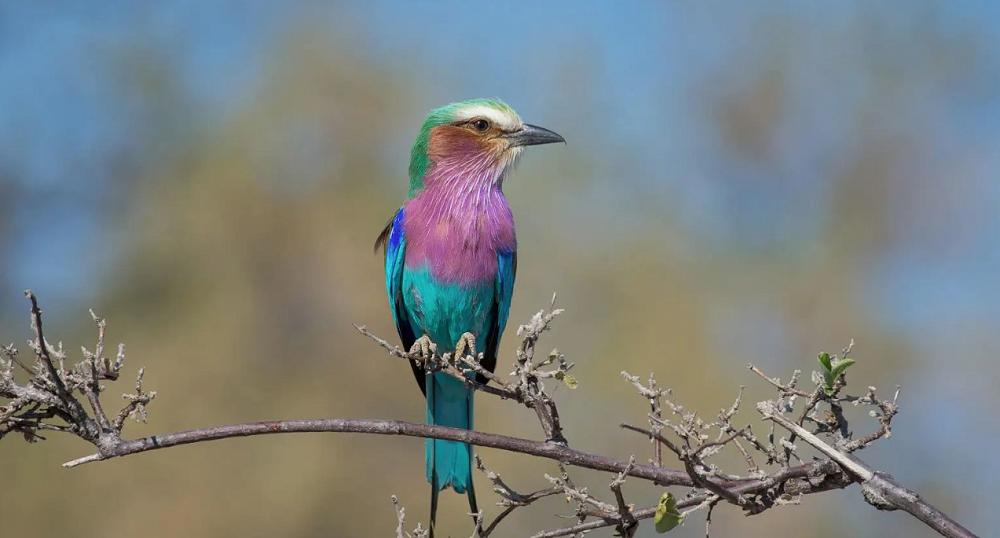
LILAC-BREASTED ROLLER
The Lilac-breasted roller was one of my maternal grandmother’s favourite birds from her life in Zambia, and was a rare but glorious sight when I returned there to teach for three years in my 20s. My grandmother had a deep love of birds, which she passed on to many in my family.
It can also be sighted in South Africa: the country of my birth and of my father’s family line, and also the country which gave me a glimpse of what the Church could achieve when united around a common justice cause.
The prayers and actions and self-sacrifice of those within the Anglican Church in particular played a crucial role in the ending of apartheid.
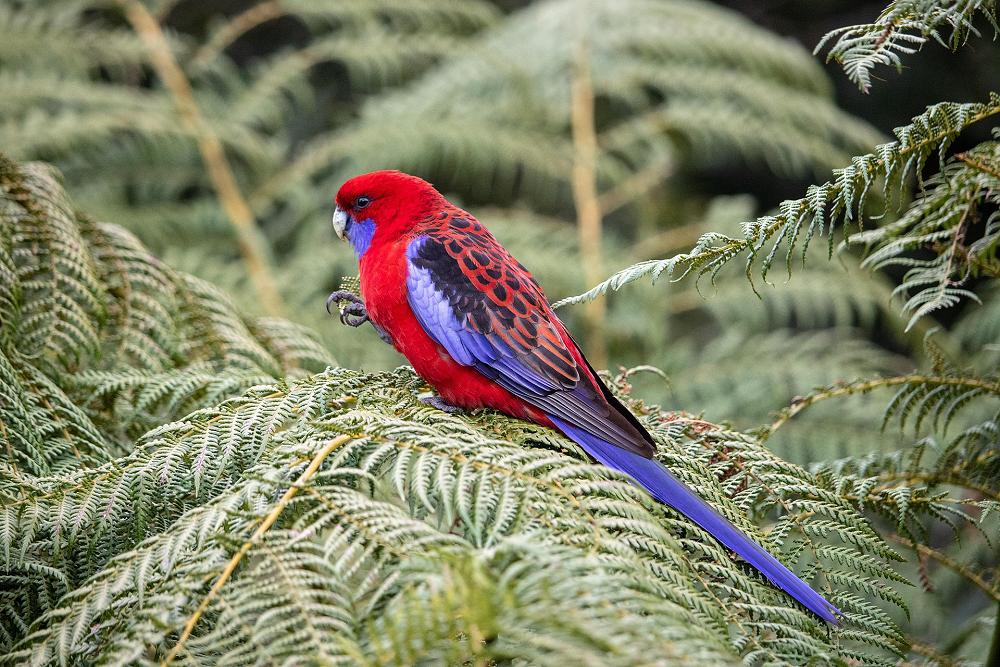
CRIMSON ROSELLA
The crimson rosella is an Australian bird, and was cross-stitched onto my ordination stole when I was made a deacon.
At the time, having a bird as a key symbol brought in my fascination with the Franciscan way of life.
Now it connects me to the country where my mother, brother and sister still live, and where I went through high school, university, and theological college.
Australia is also a country which held me as I worked my way through how to be a deacon, priest, wife, and mother. My final time there was as a diocesan educator among the people whose land I had been living on for many years in complete ignorance of their story. It has given me much.
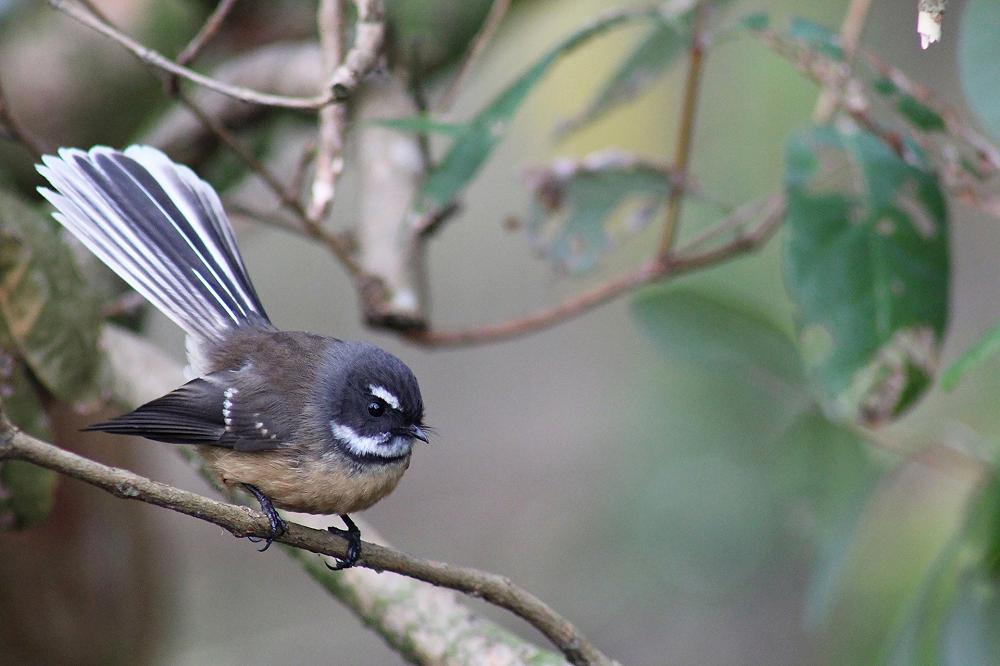
PĪWAKAWAKA
The pīwakawaka brings me to Aotearoa New Zealand, the country we came to when I was four and which welcomed us with such warmth that my family’s initial plans to “stop over” here on the way back to Africa turned into a decision to stay.
Although we moved to Australia when I began high school, the connections to the land made in primary school years have proven lasting both for me and for our two sons, who similarly did their primary schooling in New Zealand.
I am very grateful to Australia, and many of my closest friends, as well as family, are there, but Aotearoa kept drawing me back.
For me, the pīwakawaka is also a glorious symbol of the Holy Spirit: always moving, unexpected, bringing delight and cheer and wonder.

TOROA /SOUTHERN ROYAL ALBATROSS
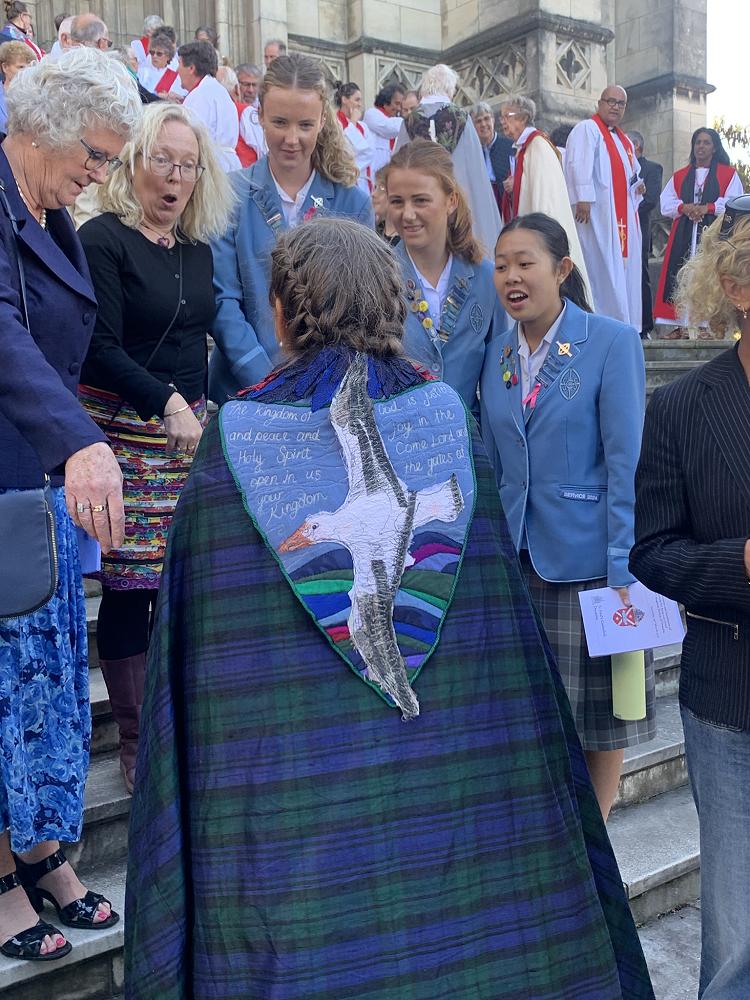
The Albatross on the hood of my cope comes with multiple meanings! It is, of course, Dunedin. It represents the joy of numerous trips in “The Monarch” out to the heads with visiting friends and family, marvelling every time at the grace and sheer size of these birds as they deigned to fly near. In flight the albatross takes on the shape of the cross: the centrepoint of all hope and life and love.
It also connects back to C. S. Lewis’ Dawn Treader where, in a scene where Lucy seems trapped in the nightmare of a dark, formless island, she calls to Aslan. Then she sees something in the darkness:
“At first it looked like a cross, then it looked like an aeroplane, then it looked like a kite, and at last with a whirring of wings it was right overhead and was an albatross. It circled three times round the mast and then perched for an instant on the crest of the gilded dragon at the prow. It called out in a strong sweet voice what seemed to be words though no-one understood them. After that it spread its wings, rose, and began to fly slowly ahead... But no one except Lucy knew that as it circled the mast it had whispered to her, “Courage, dearheart", and the voice,she felt sure, was Aslan's..."
Years ago a dear friend, Lisa, gave me a brooch with “Courage, dear heart” on it,
and I have worn it many times over the past year!
TAIZÉ WORDS
The words on the hood are a Taizé chant, based on Romans 14:17.
The kingdom of God is justice and peace and joy in the Holy Spirit.
Come, Lord, and open in us the gates of your Kingdom.
I do not know what the coming years will bring, but this is a key verse for me going forward.
I believe we were designed for joy, but joy needs peace, and peace cannot be true peace without justice.
These words sum up our hopes every time we pray for God’s Kingdom to come on earth as in heaven: a kingdom of justice, peace and joy.
TARTAN
The rich navy and green tartan was a surprise find for Annette, who happened to stumble upon it in Tākaka on holiday. “Ooh, this Dupion silk looks like it could be useful for a clerical project of some sort,” she thought.
This particular tartan is a universal tartan - meaning anyone can wear it, regardless of their heritage or background. The pattern and colouring symbolises strength and courage.
This fabric seemed like such an answer to prayer and a nod to Anne’s Scottish roots. Only after the cope was made by Annette did we discover that this tartan is the tartan all priests wear in Scotland, to show that their loyalty is to God and not to one particular clan. All in all, an appropriate tartan for the Bishop of Dunedin.
Bishop's Mitre…and Music
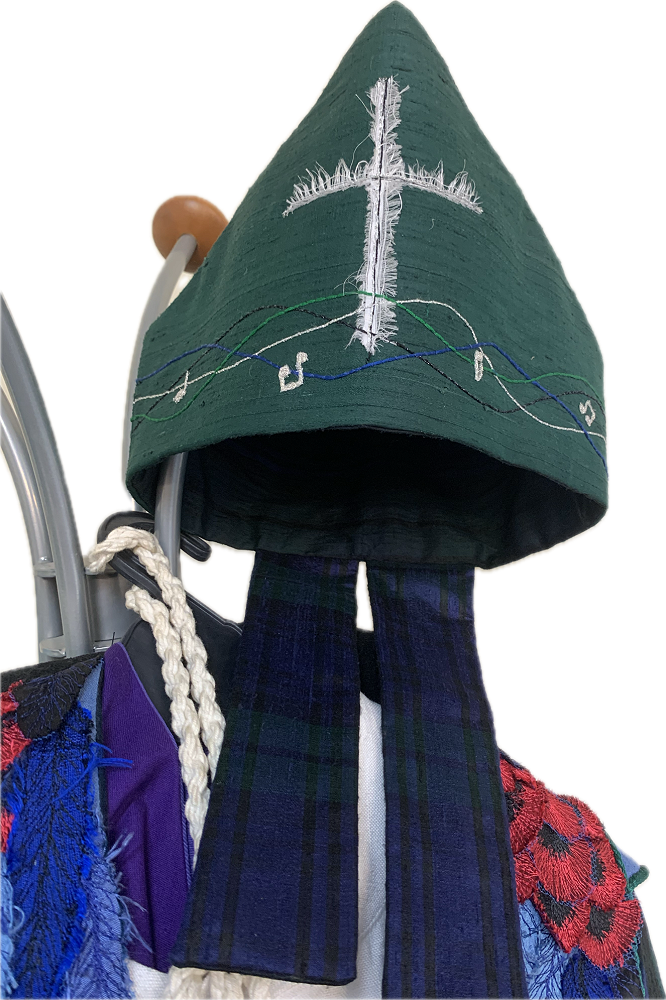
The mitre developed from the camelaucum, a helmet-shaped head covering worn by the pope during solemn processions, in the course of the tenth century the pope began to wear this head-covering not merely during processions to the church, but also during the subsequent church service. Mitres are also worn by some clergy in the Eastern Orthodox and Eastern Catholic churches, the Anglican Communion, some Lutheran churches, and by cardinals in the Catholic Church, whether or not they are bishops.
Bishop Anne writes this about her Mitre:
Front and centre on the mitre is the cross: the central symbol of our faith; the symbol we are called to follow; the symbol of the depth of God’s love for us and the power of God’s salvation held out to us.
Through my schooling and university years, music was an enormous part of my life. My undergraduate degree was in music – essentially piano performance, although I never wanted to be a soloist. I loved to accompany, and I also hoped at the time to go into music therapy.
My life has since headed in rather different directions. However, my wise organ teacher told me, before I left for Zambia, that I needed to ensure music remained part of my life, as I would need it for my “emotional sanity”. He was right!
But music has always been even more: something which convinces me on a level beyond reason of the existence, goodness and beauty of God, and of our own deep longing for him.
Hidden inside the mitre are a few words so dear to me that I will probably find myself wearing the mitre more often than I expected to. Ask me to see them sometime!
Bishop's Crozier
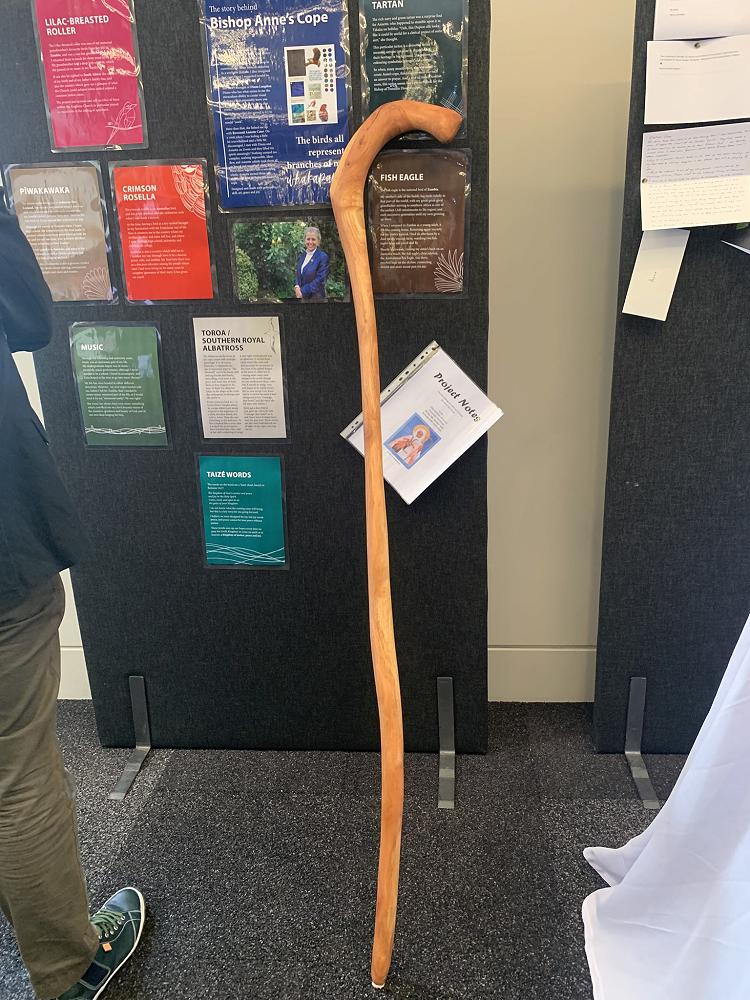
The unique crozier (Bishop's Staff) has an even more interesting story to tell, and we have attached the project notes given to Bishop Anne by its makers. The crozier was handmade by the Little Brothers of Francis at Franciscan Hermitage in New South Wales from an (appropriately named) Bloodwood tree. Brother Geoffrey writes:
Within its leafy canopy there grew a limb and at first glance it was such an odd-looking branch. Crooked and bent compared to all its sister limbs it looked so out of place. "I will give you what you want", said the Bloodwood tree. "This limb of mine is so crooked and odd looking; it doesn't blend well with my other lovely branches." My heart leaped. This is it. The candidate holding the potential I was looking for....
After taking the branch back to it's heartwood (removing around 80% of other material around it), the wood was oiled and left to harden for a few weeks, before being placed in the brother's prayer chapel, where on the third day it was blessed during a special service.
Postscript: Connections With the 7th Bishop of Dunedin
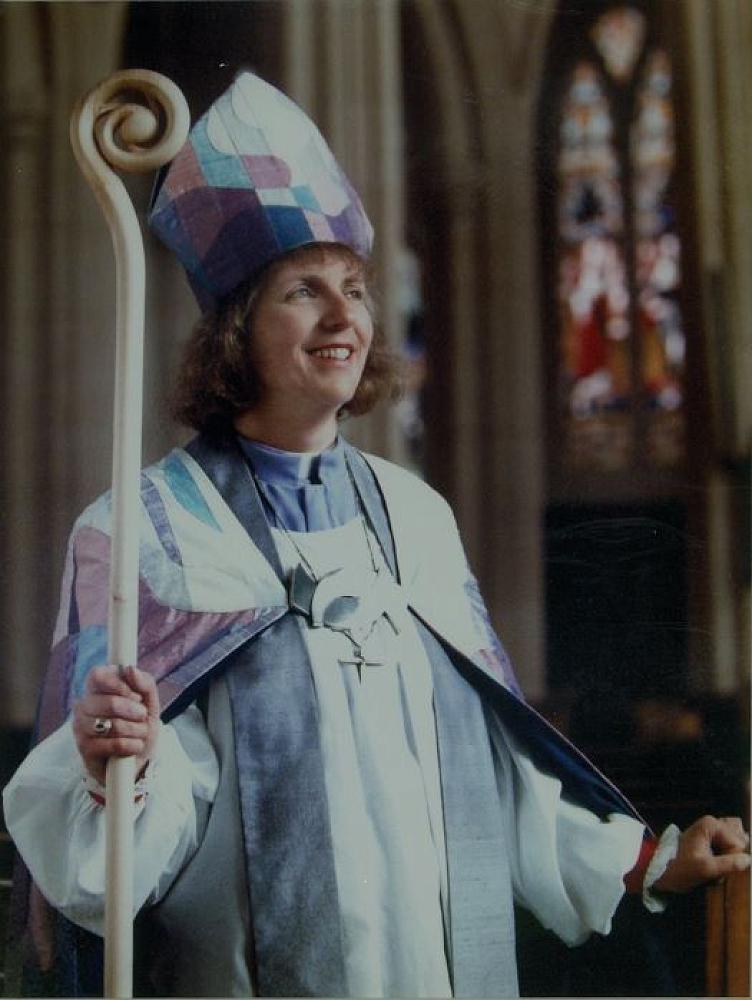
Bishop Penny Jamieson generously gave Anne her pectoral Cross to be presented to her at the ordination service. Her Bishop's ring is being held at the Cathedral... and you may have seen that her cope is being held by Toitu - Otago Settlers Museum. Both Bishop Anne's and Bishop Penny's copes are bold and distinctive...!