
GSTHW Wānanga-Plenary Sessions
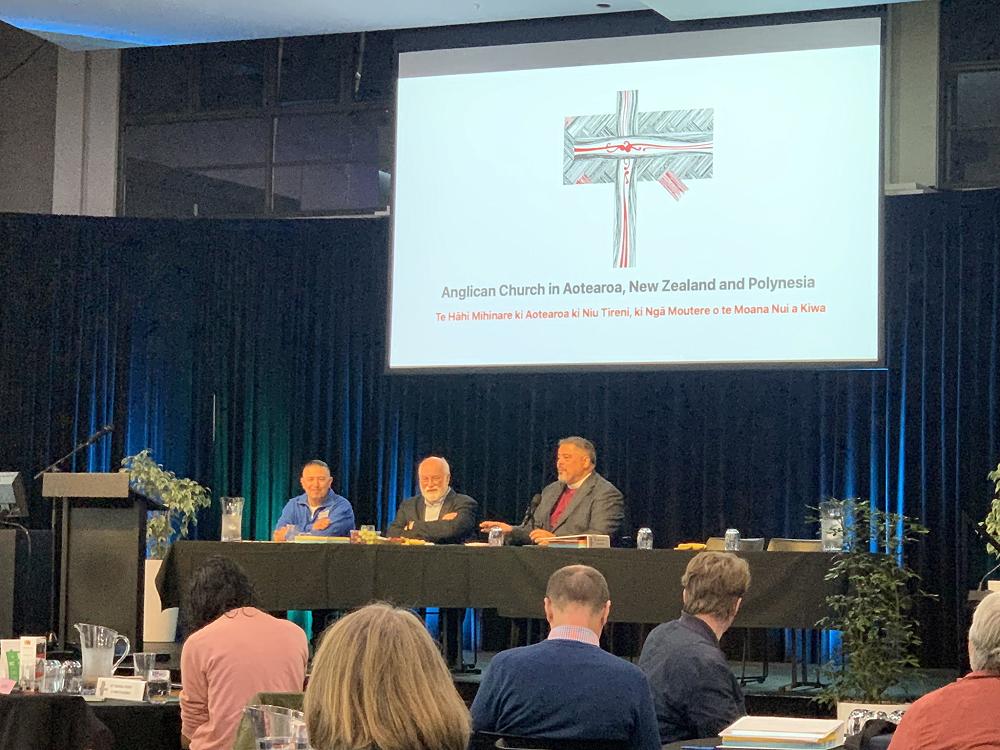
Some highlights from Plenary Sessions at General Synod Te Hīnota Whānui 2024 held in Hastings.
A Wānanga with Fr Gregory Boyle and Steve Avalos, Homeboy Ministries, Los Angeles.
This was an incredibly inspiring presentation - and you can watch it at around 25 minutes into the above video. Below are some notes taken that give an outline of some of the content.
Former gang member Steve Avalos introduced Fr. Greg Boyle with a powerful testimony of how he came to be involved in Homeboy Industries. This is the largest gang intervention in world, with an essential focus on kinship, community and love. Steve described Homeboy as being like a spiritual hospital for those who have been outcast. His own background was coming from generations of gang membership with is own father being killed before his death and his stepfather also being incarcerated. Steve joined gang as a young teenager when friend got gunned down. Thrown onto street at age 14, he fathered children when 15-16, and at 17 he was tried as an adult and given life imprisonment. Steve met Fr Greg when he was in prison. The State Governor allowed him to be paroled into Homeboy Industries, but what struck him most that although he learnt a lot in prison, he did not experience healing or love until he stepped in the door with the message "We are glad you were born… welcome home”. Steve said:
"When you have hope in your heart you can pass this onto your own family. Everything is in relationship and community – this creates kinship and community."
Fr Greg Boyle
Father Greg's message needs to be heard directly - it's not really captured in a summary. One useful (brief) glimpse of this is in the video below.
Fr Greg asked us to go from our Synod to imagine a circle of inclusion and no-one standing outside, to dismantle the barriers, standing at the margins with poor, powerless and voiceless (where dignity is denied), to stand with the demonised so the demonising will stop, to stand with the disposable so that they will no longer be thrown away.
People sometimes say for those of us who work at the margins that “you are wasting your time”. What if it was not a waste - but the most important thing we could do, as Christ did? Do we settle for a puny God who inhabits our small worlds, or to we accept the invitation to embrace an expansive God?
Fr. Greg indicated that over the years, sadly, he has buried more than 264 people (gang members). He started school for kids that no other school would take (with the blessing of the nuns who had to then find somewhere else to live): they turned the existing school convent in a new Parish school for them. Seeing work for gang members as being really important, they canvassed the community trying to find felony friendly employers. Not surprisingly, they had no luck with this, so they had to start own industries. They were given a significant gift which allowed them to start a bakery, which became the first of a number of social enterprises. Some of these were not so successful, but now they are able to provide an 18 month rehab programme, which incudes tattoo removal therapy, classes plus access to work in 13 social enterprises.
Fr. Greg said:
All who walk in behind barrier of shame and disgrace – only tenderness can get through this. All have “disorganised attachment”… they are used to being watched, but not seen or cherished. Once they experience this, then can cherish selves and others. We hold hold mirrors up – this is how God sees you.. and people grow into who God sees they really are... We need to dismantle all the shame that stops people from experiencing this kind of love. Jesuit key word (Loyola) – "agatamento"… to look at something with attention (affectionate awe). Loyola kept coming back to this for everything he did with people. The book of Acts talks about “and awe came across everyone” – we need to stand within the poor and in what the poor carry (not sit in judgment or them)."
Fr Greg asked: How willing are we to see our kinship in them – welcoming our own wounds and seeing theirs through our own?
He talked of 4 key things:
- Inclusion
- Non violence
- Unconditional loving kindness
- Compassionate acceptance.
Only the soul that ventilates with tenderness can save the world... (this is about) returning us to ourselves – there is no us and them, only us.
A Wānanga on Education
Te Hīnota Whānui gathered on its first morning for a wānanga to dig deep into the future of the Church and its theological education, using insights from the recently released Te Pae Tawhiti 2040 report.
Council of Women’s’ Studies: Women’s – Wāhine Leadership in our church
This session asked: How can women flourish in the church? A further reflection on this was maybe we need to look into our community where pain and struggle for women is a reality - not just in the church. How can we look for flourishing of all women? It was noted that in our church we have so many women whose potential have not been realised: can we make sure that this takes place for women around us?
If women flourished in our church it would have a huge impact. A Samoan proverb sums up this potential “E au le Inailau a Tamaitai Samoa” (women hold the strength and capability to achieve greatness, and by working together, we can ensure a future where their potential knows no bounds). This speaks of the power of what women can do as leaders in our communities. Several key characteristics include: inclusive leadership (at all levels of leadership); the affirmation of the Church's teachings – equality; mentoring, developing spiritually and in leadership; creating a safe and nurturing environment.
The session reflected on how it is helpful to think of different gifts and ways that women are "wired" and what women offer. What does it really look like to nurture them/us? We need to take notice of women and what they/we need to flourish for however we are wired, which can also involve calling the gifting out of others in unexpected ways. How often as dioceses do we really look at what gifts have we got out there… and how do we develop it? Could we deliberately create opportunities and mentor people into new roles, rather than women still having to assert themselves into this space?
The question was asked: where are the men in this korero? What would it be like if they were intentionally making space? During this presentation someone said:
"We as women also need to step up … if we are better suited, then be bold enough to say “I would like to be this someday… this is the route.. give me this opportunity”. We need to be more assertive of ourselves and what we want to do."
What is needed is:
- Resourcing: Having opportunities for formal education, to talk about plans for future.
- Combined conversations – being clear about we all bring to the table, action based on statements of excellence.
- Full implementation of the Standing resolution SR05 adopted at Synod in 2008: we still need to realize this throughout our Anglian organisations:
SRO 5. REPRESENTATION OF WOMEN (SR49)
This General Synod Te Hīnota Whānui encourages Tikanga and Episcopal, and parochial units to give effect to this goal, the Millennium Development Goal of equal representation of women and men in decision making at all levels – when electing or appointing representatives to governing and consultative bodies in this Church and beyond. Further to this representation in decision making, equal representation in liturgical leadership and leadership of official gatherings of this Church is also a goal. [2008, 2014]
Links to Taonga Articles
+Sione highlights Moana of Life
Bishop of Polynesia Archbishop Sione Ulu'ilakepa has charged the Anglican Church with a call to move from lamentation to hope, and to care for Creation, drawing all eyes to the Pacific Ocean and its huge impact on planetary health.
Synod welcomes Archbishop Justin
General Synod Te Hīnota Whānui has welcomed the election of the Right Reverend Justin Duckworth as the new senior bishop of the New Zealand Dioceses, and Archbishop and Primate of the Anglican Church in Aotearoa New Zealand and Polynesia.
Anglicans focus on gender equity
Gender equity came to the fore at General Synod Te Hīnota Whānui on Tuesday 21 May as the Synod joined in a wānanga on women’s leadership up to 2040, and later moved into gender caucuses for the first time.
Wānanga focuses on education
Te Hīnota Whānui gathered on its first morning for a wānanga to dig deep into the future of the Church and its theological education, using insights from the recently released Te Pae Tawhiti 2040 report.
Ōmahu hosts Synod opening
The people of Ōmahu Marae offered a generous welcome to General Synod Te Hīnota Whānui as it set off with a pōhiri and Opening Eucharist in Heretaunga - Hastings yesterday, Sunday 19 May.
Synod heads to Tairāwhiti
This coming week Anglican Church leaders and decision makers from across Aotearoa, New Zealand and Polynesia will gather in Hastings for the Church’s biennial week-long wānanga and parliamentary forum known as General Synod Te Hīnota Whānui.