
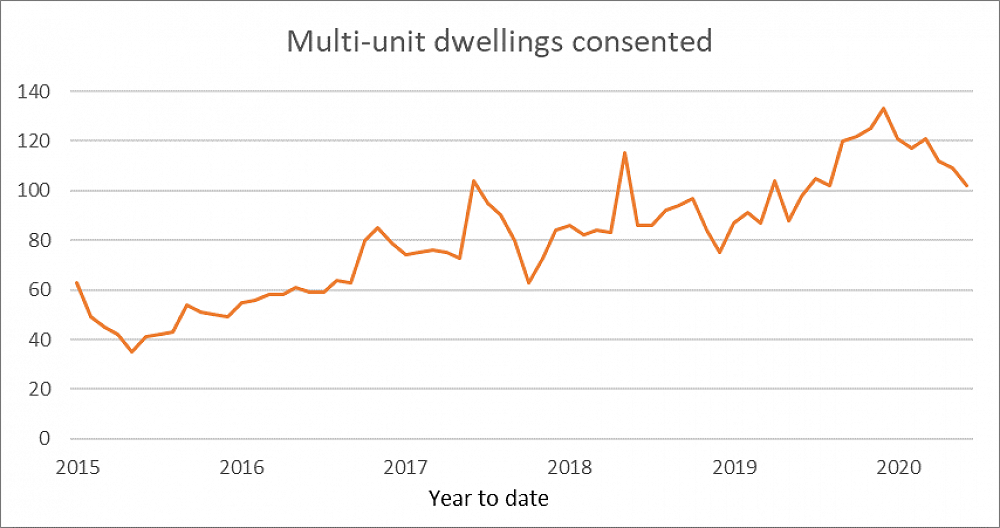
Multi-unit developments
Over the last five years or so, there has been a noticeable increase in consent applications for multi-unit developments.
While these proposals are often relatively small scale (low-rise multi-unit development on a large residential sites), we are also seeing larger developments where people are able to amalgamate sites and take advantage of new 2GP standards allowing for greater heights in the Inner City Residential Zone.
Historically, student accommodation and social housing represented the bulk of multi-unit development within the city. More recently, we have seen a wider range of multi-unit developments catering to a greater demand for this type of development particularly for the growing cohort of one and two person households who want low maintenance, high-quality housing.
Under the 2GP, consents are required for multi-unit development to ensure these types of development are designed well, as they can have adverse effects on the amenity and character of residential neighbourhoods if design is not well-considered. There are plenty of examples of both high quality and poor quality developments around the city.
DCC provides free pre-application advice for people that need resource consent, including advice from DCC in-house urban designers. We encourage people to take advantage of this service if they aren’t experienced with this type of development. We also encourage people to choose architectural professionals that have a proven track record in designing these types of development, as this can also make the consent process quicker and easier.
The DCC urban designers consider a range of matters when assessing consent applications for multi-unit developments, including:
- Does the design fit-in well to its immediate environment, especially if that environment has a consistent character? Designs should take note of the existing pattern of development and consider how to respect this by having relevant facade widths, roof pitches, setbacks and alignment so as to provide a consistent urban grain and rhythm. Does the design use high quality and contextually appropriate materials and have good window proportions and alignment? Does it include decorative elements on its façade to respond to similar features on surrounding buildings?
- For large buildings – does the design break up the building mass, for example using roof lines to provide interest or façade setbacks to avoid large areas of blank walls?
- Does the design support a good pedestrian experience? Are there clearly defined front doors, with good levels of detail? Are there pedestrian paths and amenity planting? Is car parking appropriately located to not dominate the development when viewed from the street or reduce the quality of outdoor amenity space for residents? Does the design consider how openings and balconies can maintain a visual connection between interior spaces and adjoining streets while maintaining reasonable privacy?
- Does window placement consider how to maintain appropriate levels of privacy between dwellings?
If you wish to arrange a pre-application meeting please phone the DCC on 477-4000 and ask for the planning front counter.