
Deep dive into mathematics
As part of our inquiry into teaching and learning, the kaiako | teachers have been reflecting on our maths progress and achievement. Here are some snippets about this from our Updates last year.
Part One: Maths in our kura
2 May 2021
Mathematics is a major focus for kura across Aotearoa | New Zealand. We are no different here at our kura! This year we are putting a strong emphasis on progress and achievement in maths.
To support this focus, in Term 1 each kaiako was released an extra day to test learners 1:1. This time working with and speaking with our tamariki is essential to understanding what they know and helping identify any gaps. We use two national standardised tests, the Junior Assessment of Mathematics (JAM) and Global Strategy Stage (GloSS) tests, depending on the year and curriculum level.
In addition, the junior school uses a profile document to track specific knowledge and strategies of each ākonga. The senior school complements their workshops with other standardised tests like e-asTTle.
In Term 1, we have collected e-asTTle data from our Year 4 - 8 learners to share with our kāhui ako (community of learning). This means that we can see exactly how we are tracking and develop a collective 'good practice' for teaching and learning in maths. This data will be analysed in Term 2 and will help us make decisions for the remainder of the year.
In this space, we have just appointed Angie Rayner as our Within School Leader with a focus on mathematics. This role is generously funded by Te Mana Raupō, the kāhui ako (community of learning) we joined this year. This gives the school some release time for Angie to analyse the testing results discussed above and to spend time in classrooms supporting kaiako to get the best out of their teaching and learning time. She will also work with kaiako from other kura to help us reflect on our own mathematics teaching.
We will be continuing this discussion over the following weeks, so tune in next time for more!
Part Two: Maths and reporting
17 May 2021
At the end of this term, we will be sending home the mid-year reports. These will give you an indication of how your child or children are tracking to meet the school expectations. This report is really a focus on 'progress' - how is each learner doing against their individual goals. While there are guidelines from the MOE about expected progress and achievement, these are quite broad and there is a shared understanding amongst kaiako that learners can be along that continuum and still be on track to meet the school expectation.
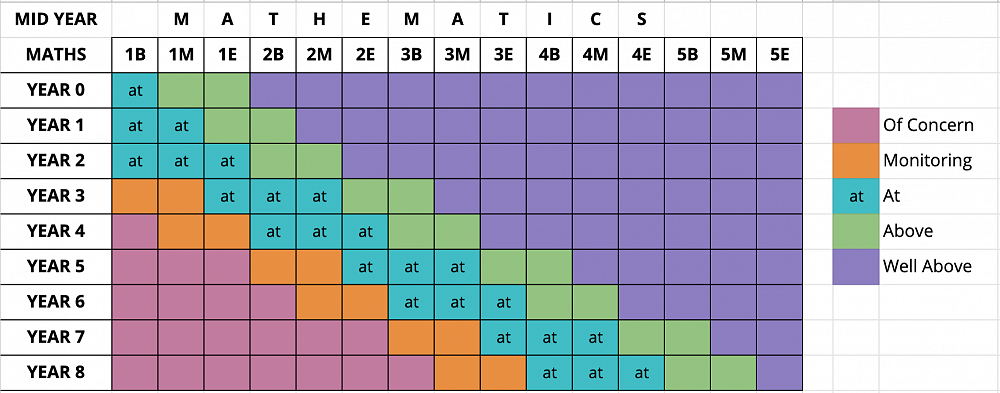
With our current focus on mathematics, the staff delved into the concept of expected progress within the curriculum. We aligned this with the PR1ME levels and plugged in how the various assessments we conduct through the year help inform our OTJ (Overall Teacher Judgement) about where learners are placed. (Click on the image to get an explanation of the jargon.)
One thing that is really important to us is that you know how your tamariki are tracking. With that in mind, if a learner is starting to fall behind (for example, they were meeting the expectations of progress, and now they're not) kaiako will always either ring you or meet with you to discuss this. Reports are not a time for surprises!
This means, too, that you are welcome to speak with kaiako at any stage about your child's progress. If you have specific questions or concerns, I recommend emailing and setting up a time to meet. Chatting at the school gate might be handy, but we can get caught on the back foot and not have all of the detailed information you might want!
Part Three: Target groups in maths
31 May 2021
As part of our focus on Mathematics this year, each kaiako | teacher has identified ākonga for their target groups. These are students who we think would benefit from a short-term intervention to bring their maths knowledge and confidence closer to meeting their year level expectation. This year we are using the High Impact Teaching Strategies (HITS) as our interventions - these are the ten instructional practices that reliably increase student learning when they're applied.
The ten HITS are:
- Setting goals
- Structuring lessons
- Explicit teaching
- Worked examples
- Collaborative learning
- Multiple exposures
- Questioning
- Feedback
- Metacognitive strategies
- Differentiated teaching
While we already do each of these things in our planning and delivery of learning, "what you focus on, flourishes". With that in mind, each kaiako | teacher is choosing one of the HITS to work on each term and really embed that best practice into teaching and learning. Over the year, we will layer these up to complement our responsive and deliberate methods of teaching.
Part Four: Reporting to parents about maths
14 June 2021
At the end of the term, each learner will receive their mid-year report to parents and whānau. In this report, kaiako | teachers will indicate how the learner is tracking towards meeting the school expectation at the end of the year. We use specific language to describe how someone is tracking:
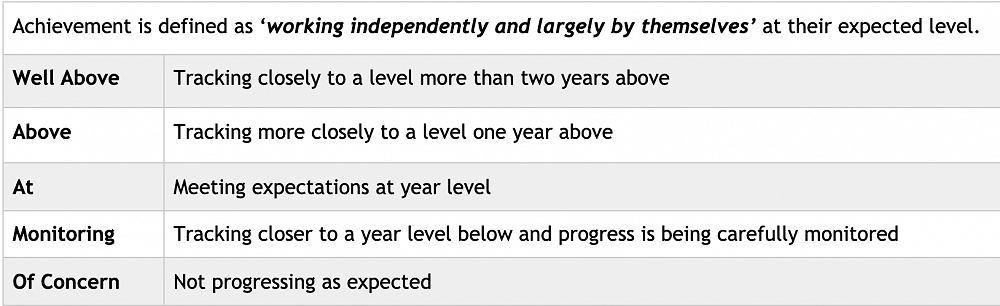
As a staff, we have many professional conversations to ensure consistency in our Overall Teacher Judgements (OTJs) so that there aren't big spikes or dips from year to year. However, we do know that children sometimes progress in bursts and sometimes plateau. In a recent Update, I shared with you how the NZ Curriculum Levels align with the year levels, and the shared understanding of these is that it can take approximately two years to complete a curriculum level. There is a lot of "grey" area, where staff are expected to make an informed decision.
Part Five: Reporting to parents about maths
28 June 2021
Last Update, I talked about the mid-year reports coming home next week and the Whānau Connect hui in Week 1 next term - these will be live next week so you can book on the app.
As I mentioned in the last Update, each learner will receive their mid-year report to parents and whānau. In this report, kaiako | teachers will indicate how the learner is tracking towards meeting the school expectation at the end of the year. As kaiako, we have worked hard over the last year to look deeply at the curriculum and ensure that our alignment with our learning expectations are robust. We have made some changes to this alignment, and some learners have been affected by this change. Where you might be used to see a lot of 'at' or 'above' school expectation, there might be more 'at' and even 'monitoring' in some cases. If there has been a change to your child’s reporting (i.e. if they are normally ‘at’ and now, against the revised expectations, they are ‘monitoring’) your child’s kaiako will be in touch to talk you through this.
Part Six: Deep dive into Mathematics
9 August 2021
While we have been conducting our own analysis of the teaching and learning of mathematics at Te Kura o Ōhinetahi | Governors Bay School, the debate is raging across NZ. At the recent NZ Principal's conference, Dr Audrey Tan presented a paper titled, "Restoring confidence in mathematics education in New Zealand". In the paper and presentation, Dr Tan outlines the "worrying low" achievement in Mathematics in Aotearoa NZ. In 2018, a national monitoring study told us that a "significant proportion (81%) of Year 4 students are meeting curriculum expectation in Mathematics... but by Year 8, that proportion has fallen away to less than half (45%)."
This is comparable to our own mid-year data from 2021. We know, through our internal review, that our students are achieving better each year as they become familiar with the routines and learning of PR1ME maths. This makes sense within the context above, where our Year 8s have had more exposure to the PR1ME programme.
As part of her Within School Leader (Kāhui Ako) role, Ange Rayner is exploring the following questions:
What is currently working and what needs to be changed?
What will help to raise student achievement in mathematics across our school?
How are other kura implementing their mathematics programme?
What might the pending Ministry of Education review of mathematics across New Zealand mean for us?
Part of this scan is an attitude survey that was conducted with tamariki. It's their learning, so their voice is really important to us.