
Principal Pānui
Tēnā koutou e te Whānau
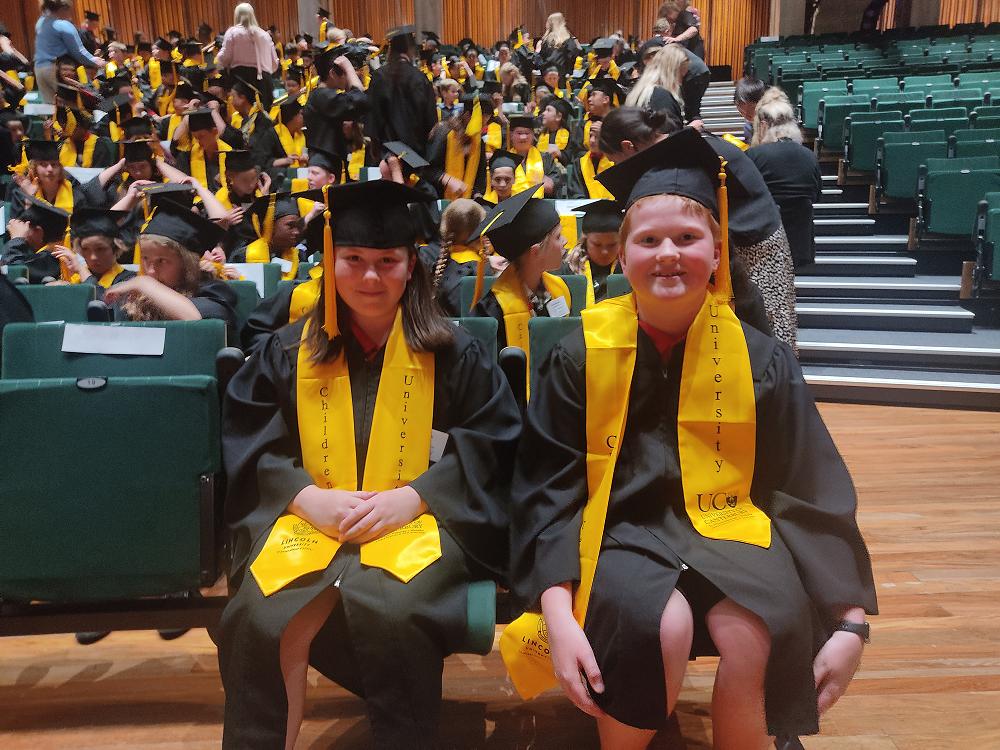
On Tuesday night, I was very fortunate to have the opportunity to attend the Children's University Graduation Ceremony at the James Hay Theatre (see above). Children’s University aims to raise young people’s aspirations for higher education and encourage lifelong learning. The University of Canterbury and Lincoln University work in partnership to deliver the programme, which is the first of its kind in New Zealand.
To graduate, the children had to complete a specific number of study hours as they work towards the completion of their Children's University passports. This year we had thirteen Year 7 students take part. They completed between 30 hours (Bronze Award) of study and 130 hours (Bronze Certificate). Congratulations to all of the students who took part in this initiative. We hope to grow participation levels in the coming years. I would like to thank Louise Ponce for her work coordinating this year's programme.
As we approach the end of the school year, I am pleased to be able to share the confirmed 2023 school structure with you (attached). You will note that we have a few changes of personnel at Te Kura o te Tauawa Halswell School next year.
Firstly, we are delighted to welcome Kirsty Hair to our Leadership Team. Kirsty is currently the Year 3&4 Team Leader at Mount Pleasant School. She has also spent time as the Deputy Principal at Mount Pleasant. Kirsty brings a wealth of knowledge and expertise to our team. She will be taking up the role of the Ōrongomai Team Leader due to Kim Lister departing at the end of the year. I would like to acknowledge Kim's contribution to our Leadership Team over the past three years.
We are also excited to welcome Miss Greta Parkes-Dolan and Mr Luke Blackie to our teaching team. Greta is relocating to Christchurch after some time away in Australia. She most recently taught juniors at Fendalton Open Air School and will be teaching in Huritini next year. Luke will be teaching in Ōtūmatua. Many of the children will be familiar with Luke as he had a very successful teaching placement in Aruhe earlier in the year. We are excited about the strengths and passions both Luke and Greta will bring to our school in 2023.
Sadly, we will be farewelling teachers Henry Smith, Alice Eastwick and Connie Palmer, who have won positions in other schools next year. We will certainly miss the passion and commitment they have brought to our kura.
Congratulations to teacher aide Amy Brown who has been accepted into the University of Canterbury to pursue a career in teaching. Finally, caretaker Gary Hancock will be departing at the end of the year to explore a career in the fitness industry.
We are grateful for the contributions all of these staff members have made to our school in recent years. I'm sure you will join me in wishing them all the best as they take up new opportunities next year and beyond.
Now that we have confirmed the school structure, to help with the transition between learning centres, the children will take part in studio visits over the next couple of weeks. They will have the opportunity to meet their new teacher(s) and classmates in the last week of this term. The 2023 T groups will be published via Hero on Monday, 12 December.
You may also notice that we once again have composite classes throughout the school. I’m occasionally asked by parents why the school is structured this way. Composite classes are a very common feature of New Zealand schools, and in some schools, it is not unusual to have three or more year levels within a class.
One of the main reasons we organise T groups into two-year level composite classes is that it allows us to maintain our preferred team structure of Years 0-2 (Ahuriri & Huritini), Years 3&4 (Ōrongomai), Years 5&6 (Ōtāwhito) and Years 7&8 (Ōtūmatua). This is a result of having to juggle the number of children in each year level with the staffing entitlement we are allocated by the Ministry of Education.
In a ’perfect’ world, we would get even numbers of students coming through each year, this, of course, is not the case, so we need to move and adjust numbers to try and get the best balance possible across the school. By having composite classes, we are often able to reduce class sizes considerably within each team.
In addition to this, there are many advantages to composite classes; they provide leadership opportunities for older children and provide many extension opportunities for younger children. Composite classes also allow us more flexibility for placing new children who arrive during the year and the ability to balance students with learning needs (on both ends of the cognitive spectrum) when T groups are being put together.
The reality is that every classroom has a wide spread of abilities regardless of the different year groups within it. One of the many advantages of having collaborative teaching spaces is that we can cater to a broad range of learning needs. This allows teachers to deliver a programme that more accurately targets the specific learning needs in their studios regardless of year levels.
In summary, like most schools in New Zealand, we have deliberately chosen to structure the school with composite classes in the past (and will continue to do so in the future) as it allows us the best opportunity to balance classes, cater for the many different learning needs of our students and keep numbers as close to, or lower than, what the Ministry of Education funds us for.
Finally, as this is the last day of November, I would like to take the opportunity to thank everyone who donated to our male staff members' Movember campaign. We were rapt to raise over $1,200 to support men's health. Thanks for your support!
Ngā mihi nui
Stuart Cameron
Principal