
Principal's Desk
Tēnā koutou e te Whānau
As you will be aware, the new Covid-19 Protection Framework (traffic lights system) comes into effect at 11.59 pm tomorrow. We have been eagerly awaiting guidance from the Ministry of Education about what the new system will look like for schools. This week we were informed that schools will be expected to operate under the same conditions as are currently in place for Alert Level 2 through until the end of the year. Unfortunately, this means large gatherings such as prize-givings and assemblies will not be able to go ahead with parents attending. Our existing procedures around gates being locked and drop-offs and pick-ups taking place outside Laearning Centres will also remain in place.
As the new system beds in, we will continue to receive guidance from the Ministry of Education and expect to have new procedures in place for the beginning of the 2022 school year. You can read more about the Covid-19 Protection Framework here.
Looking forward to next year, we are now in a position to share the full school structure with you. Please find the 2022 staff list attached to this article. You will note that we have several new teachers at Halswell School next year including Tracey Mora (currently at Banks Avenue School) who will take over from Rob Naysmith as the Years 5-8 Associate Principal.
Connie Palmer (Ōtāwhito) will be joining us from Carew Peel Forest School. We are delighted to have Ben Qauqau returning to Ōtūmatua after two years teaching in the United Kingdom. Olivia Mcfarlane (Ōrongomai) and Will Pritt (Ōtāwhito) will be starting their teaching careers with us. Last but certainly not least, former full-time teacher Renee Dunsey will be working with our specialist performing arts teachers. We are very excited to have these teachers as part of our team and know that they will bring a broad range of experiences and strengths with them.
The children will get to meet their 2022 teacher (where possible) and new classmates on Monday 13 December (the last week of term).
Unfortunately, we also have several staff departing at the end of the year. Tash Fraser has won a Team Leader position at Sumner School. Jane Wilkes will be relocating with her family to Fairlie and Brooke Young will be moving to Clearview School. One of our long-serving Teacher Aides, Joy Chamberlain, will be retiring at the end of the year.
We are also very exciting for Huritini teachers Amy Craddock and Danielle Ward who will both be going on maternity leave next year.
I want to acknowledge these departing staff members. They have all contributed very positively to our school, and in some cases, over many years. Due to Covid restrictions, we will be celebrating their contributions "in house" but know that you will join us in wishing them all the very best for the future.
You may also notice that we once again have composite classes throughout the school. I’m occasionally asked by parents why the school is structured this way. Composite classes are a very common feature of New Zealand schools and in some schools, it is not unusual to have three or more year levels within a class.
One of the main reasons we organise T groups into two-year level composite classes is that it allows us to maintain our preferred team structure of Years 0-2 (Ahuriri & Huritini), Years 3&4 (Ōrongomai), Years 5&6 (Ōtāwhito) and Years 7&8 (Ōtūmatua). This is a result of having to juggle the number of children in each year level with the staffing entitlement we are allocated by the Ministry of Education.
In a ’perfect’ world we would get even numbers of students coming through each year, this, of course, is not the case so we need to move and adjust numbers to try and get the best balance possible across the school. By having composite classes we are often able to reduce class sizes considerably within each team.
In addition to this, there are many advantages to composite classes; they provide leadership opportunities for older children and provide many extension opportunities for younger children. Composite classes also allow us more flexibility for placing new children who arrive during the year and the ability to balance students with learning needs (on both ends of the cognitive spectrum) and/or behavioural challenges when T groups are being put together.
The reality is that every classroom has a wide spread of abilities regardless of the different year groups within it. One of the many advantages of having collaborative teaching spaces is that we can cater to a broad range of learning needs. This allows teachers to deliver a programme that more accurately targets the specific learning needs in their studios regardless of year levels.
In summary, like most schools in New Zealand, we have deliberately chosen to structure the school with composite classes in the past (and will continue to do so in the future) as it allows us the best opportunity to balance classes, cater for the many different learning needs of our students and keep numbers as close to, or lower than, what the Ministry of Education funds us for.
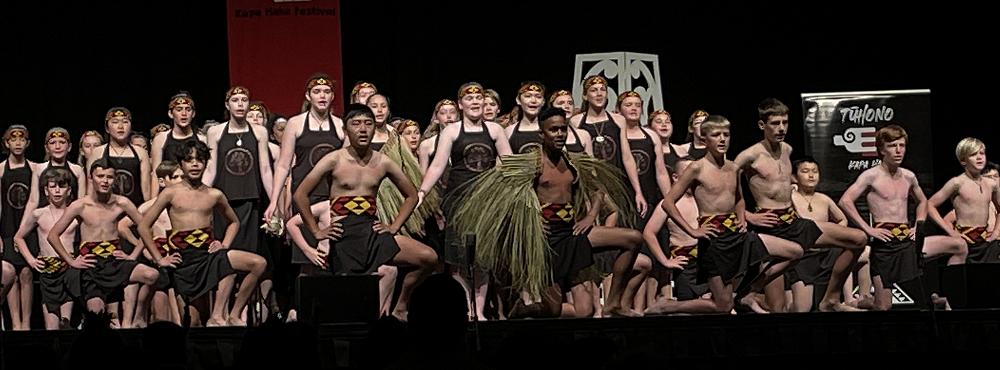
Finally, I would like to finish this week's newsletter by congratulating our Kapa Haka group (pictured above) who performed so well at the Tūhono Festival at Christchurch Arena on Sunday 20 November. We were all extremely proud of the way they represented us on stage. A huge thank you goes to our fabulous Kapa Haka tutors Matua Willy and Whaea Tania and teachers Lisa Dovey, Michael Ruffell and Fiona Virtue for their organisation and mahi behind the scenes.
Ngā mihi nui
Stuart Cameron
Principal