
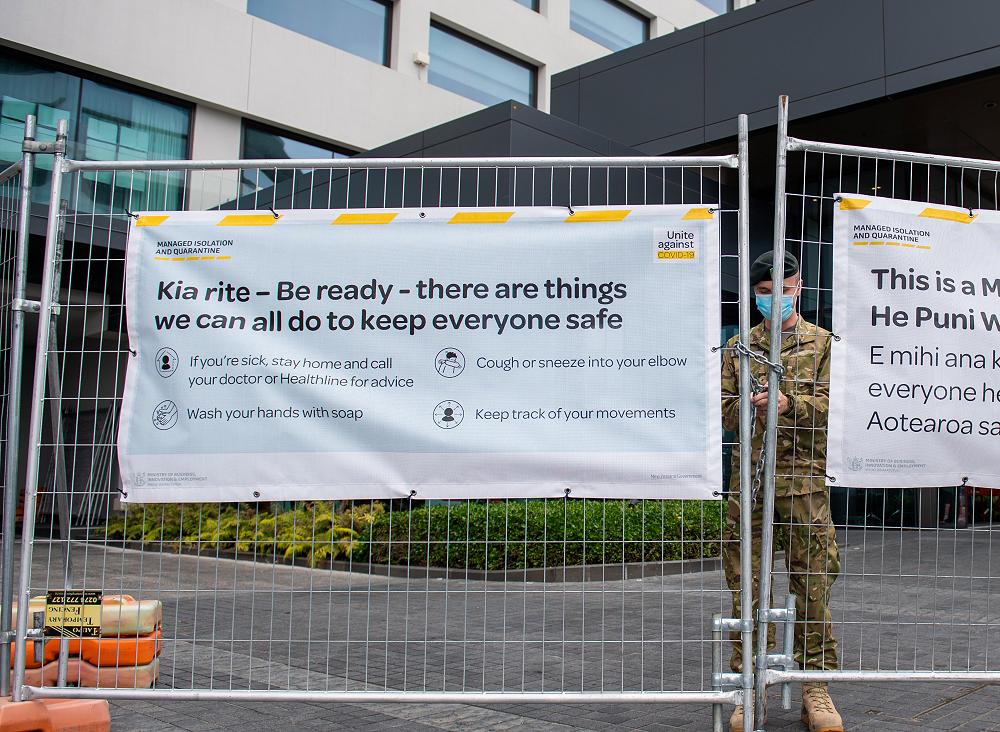
Nursing in Managed Isolation and Quarantine Facilities takes a personal toll
Ara Institute of Canterbury: The nurses working inside New Zealand’s Managed Isolation and Quarantine Facilities (MIQFs) are tasked with keeping the community safe from Covid-19 – but discrimination and social stigma mean their efforts come at a considerable personal cost.
In March 2020, shortly after the World Health Organization officially declared Covid-19 a global pandemic, New Zealand closed its borders to everyone except its citizens, residents and those granted special exemptions, such as essential workers. These arrivals have been required to spend at least 14 days in MIQFs – empty hotels commissioned by the Government – in which nurses are the key health workers.
'This unprecedented time in history presented a wonderful opportunity to conduct in-depth research into the experiences of nurses working in New Zealand’s MIQFs during this pandemic,' says Dr Isabel Jamieson, Principal Lecturer (Nursing) at Ara Institute of Canterbury.
Jamieson and her co-researchers, Dr Cathy Andrew, Associate Professor and Head of Health Sciences at the University of Canterbury, and Jacinda King, Canterbury DHB Postgraduate Nursing Coordinator, found there was little literature to guide them, with the exception of some research into nurses who were at the frontline during the 2003 SARS outbreak.
'We decided to take a qualitative descriptive approach by interviewing the nurses,' says Jamieson.
All nurses who had worked in any of Christchurch’s six MIQFs were approached using both purposive sampling and snowball sampling. Fourteen nurses agreed to participate, including both men and women who ranged in age from their early 20s to early 60s. Each was working, or had worked, in at least one MIQF for between five weeks and nine months.
'Our semi-structured interviews were conducted between December 2020 and January 2021 – the timing is important because of the rapidly changing context for MIQFs throughout the pandemic,' says Andrew. 'Our study provides a snapshot of that particular time and the months preceding it. Notably, this was before vaccinations were available for border workers.'
The research team originally intended to conduct all interviews face-to-face, but concerns were raised during the ethics approval process due to a perceived safety risk. For this reason, they were encouraged to speak to the nurses remotely, over Zoom.
'One of the concerns of nurses was being discriminated against – so in some ways saying we’d only interview them over Zoom was a further example of them being ostracised,' Andrew recalls. 'As a result, we submitted an amendment to the ethics application which enabled us to interview some participants via Zoom and others face-to-face.'
Data was analysed using a six-phase process for thematic analysis. The findings revealed that working in MIQFs had a significant impact on nurses both personally and professionally, and that they faced social stigma and discrimination as a result of their proximity to people with Covid-19.
'The same nurses tasked with protecting the community were, paradoxically, perceived as a risk to the community due to their contact with Covid-19 positive guests,' says Jamieson.
Nurses would have a Covid-19 test on their last workday for the week, and would stay home until they got their results back.
'Some hardly left the house when not working,' says Jamieson. 'The irony is that of everyone in the country, these nurses absolutely knew their Covid status.'
All nurses interviewed as part of the study described situations where they were ostracised by friends, family, non-MIQF colleagues and the community at large.
As one participant put it, 'They don’t understand how seriously we take it and how we manage it, what we do to keep ourselves safe at work…We’ve got rules and we know social distancing, we know hand hygiene, we know putting on and taking off PPE.'
Some reported being asked to leave premises or being excluded from social gatherings because they worked in an MIQF. One nurse’s husband was banned from visiting his regular sports club because of his wife’s workplace. A young nurse, who was flatting, reported that both her flatmates’ employers asked to see her swab results.
'Another participant’s flatmate was stood down, on full pay, from work at an aged care facility. The nurse felt so guilty about this, she elected to move out so her flatmate could continue to work as usual,' says Jamieson.
Adds Andrew, 'On the one hand, the aged care facility’s stance is somewhat understandable, but on the other, this had a major personal impact on the nurse.'
Fellow health professionals weren’t always understanding either.
One nurse recounted, 'The reception I got [at a health service] …was done at a volume that people around me in the waiting room, members of the public, could hear exactly what was being said. I could feel that people behind me actually were taking steps away from me.'
Through her work at Canterbury DHB, King had been involved in the initial set-up of the Christchurch MIQFs. 'I had heard about some of this discrimination, so it has been really useful to formally capture this information for posterity and to offer lessons for next time.'
While the issue of stigma was evident in the literature on nursing during the SARS outbreak, Jamieson and Andrew describe feeling shocked by some of the MIQF nurses’ experiences.
'Nursing is usually one of the professions held in the highest regard, so for nurses to be stigmatised is outside of our reality,' says Jamieson.
The researchers wish to thank MIQF nurses for protecting New Zealand during this global pandemic.
'Their efforts have been outstanding and reflect incredibly well on the profession,' says Jamieson.
- Dr Isabel Jamieson, RN, PhD, MNurse(Melb), CertAT, is currently employed by the Ara Institute of Canterbury Department of Health Practice as a principal nursing lecturer, and as a senior lecturer at the University of Canterbury. Other roles include Chair of the Department’s research committee, thesis supervisor and thesis examiner. Her research interests include health care workforce issues, clinical models of teaching and learning, nursing students' readiness to practice, as well as the graduate nurse experience. Isabel’s clinical background was perioperative nursing, surgical assisting and infection control. Contact Dr Isabel Jamieson.
- Visit Ara Institute of Canterbury.
