
Functional fashion for people with sensory needs
Tania Allan-Ross, Otago Polytechnic: Through the process of designing, manufacturing and testing clothing for people with sensory needs and disabilities, Tania Allan-Ross aims to make a difference in the lives of those who wear her garments.
Allan-Ross is a Principal Lecturer in Design at Otago Polytechnic, who also runs a small made-to-measure apparel business. Several of her clients have disabilities, and her son has autism.
“Many of my son’s sensory needs relate directly to clothing,” she explains. “He is a seeker of deep pressure, which he finds calming and regulating.”
As part of her son’s early intervention therapy as a preschooler, he was provided with a weighted vest to wear. Allan-Ross describes it as unappealing, both visually and practically.
“It was handmade and looked like a fishing vest, with lots of pockets filled with lead shot for weight,” she says. “It was effective, but it looked very unusual and I was concerned about the lead.”
To provide her son with a more appropriate garment, Allan-Ross bought him a Bob the Builder vest and added a special lining which she weighted with dry sand.
“This experience made me question the lack of functional, appealing and discreet therapeutic clothing to address specific sensory needs,” she says.
Allan-Ross started postgraduate Occupational Therapy study to gain an understanding of the neurological processes of sensory integration.
“I learnt that adjustable weight pressure is preferable to consistent weight pressure, which the wearer can become accustomed to, making it less effective over time.”
She then undertook a Master of Design Enterprise and sought to create and test an undergarment that incorporated different levels of textile tension that could be controlled by the wearer. The tester was an adolescent who benefitted from deep pressure therapy.
Allan-Ross incorporated two garment design frameworks – a functional clothing design process (Watkins, 1984 and 2015) for clothing that meets a specific need; and a model by Lamb and Kallel (1992) focused on the functional, the expressive and the aesthetic when assessing apparel user needs and wants.
“By combining these frameworks, the wearer was involved at every step of the process, ensuring the body and the garment worked together well.”
Allan-Ross worked with the Textile and Design Lab at Auckland University of Technology, where she was able to use a digital whole-garment knitting system to create her garment.
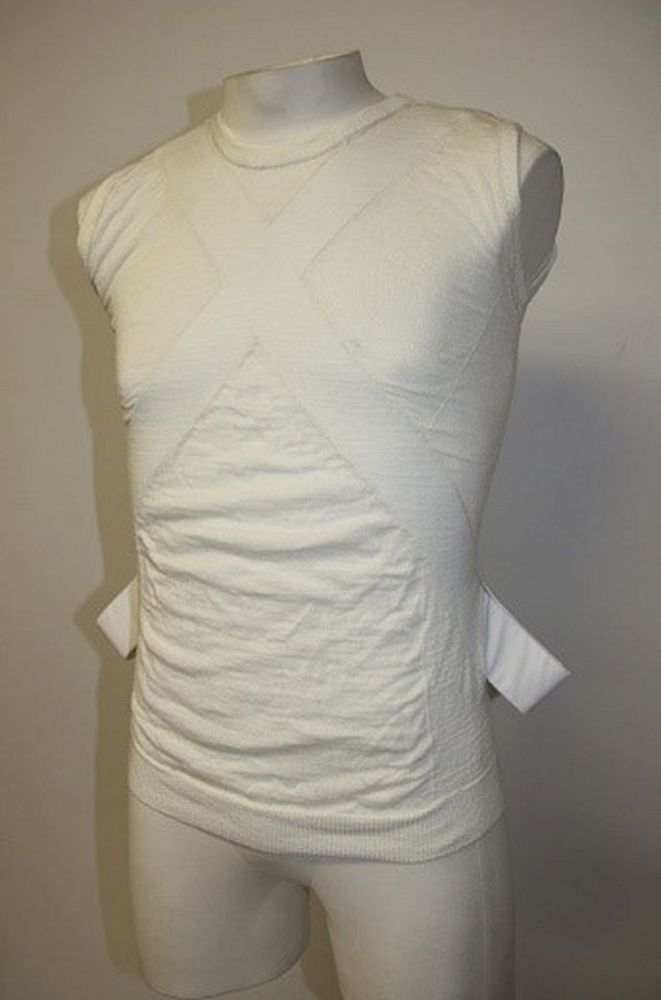
Her design was a vest made of very fine 20.5 micron merino wool. It featured knitted channels which crossed to form an ‘X’ across the front and back, with thick elastic straps inside that the wearer could pull and tighten for increased pressure.
“The elastic system was a very simple and effective solution. Unfortunately, the design meant it was impossible to knit the vest as a whole garment, so I had to incorporate shoulder seams and side seams.”
After reaching the working-prototype stage, Allan-Ross made several rounds of enhancements throughout the wearer-testing phase to ensure comfort and effectiveness. She is now interested in harnessing advances in textile technology to make further refinements and get the design to market.
Allan-Ross says she has learnt a lot from her son and her clients with disabilities.
“They often experience discomfort and inconvenience from details the majority of us don't even notice,” she says. “Clothing seams aren’t always positioned comfortably for wheelchair users, for example. Likewise, repositioning a zip can enable someone who has had a stroke to don and doff their clothing themselves, supporting autonomy and independence.”
While the fashion industry often provides an excess of clothing options, Allan-Ross notes that for many people with disabilities, choice can be extremely limited.
“While some people are born with disabilities, many more will develop disabilities throughout their lives,” she says. “Accessible clothing is an equity issue. It has a positive impact on your wellbeing if you feel good in your clothes.”
Tania Allan-Ross is a Principal Lecturer in Fashion within the School of Design at Otago Polytechnic. Tania holds a Master of Design Enterprise, and her research includes adaptive fashion, codesign and inclusive apparel specifically addressing sensory integration.
