
Augmented reality provides innovative way to support clinical learning for nursing students
Otago Polytechnic: It can be challenging to provide Bachelor of Nursing students with effective clinical experience outside of clinical placements. Augmented reality in the form of pre-recorded holograms provides a hi-tech alternative to patient scenarios portrayed by actors or hi-fidelity mannequins.
‘For first-year students especially, the live holograms can be quite dramatic, they can see a real-life patient in the room, they can hear them breathing and talking,’ says Dr Liz Ditzel, Professor, College of Health at Otago Polytechnic.
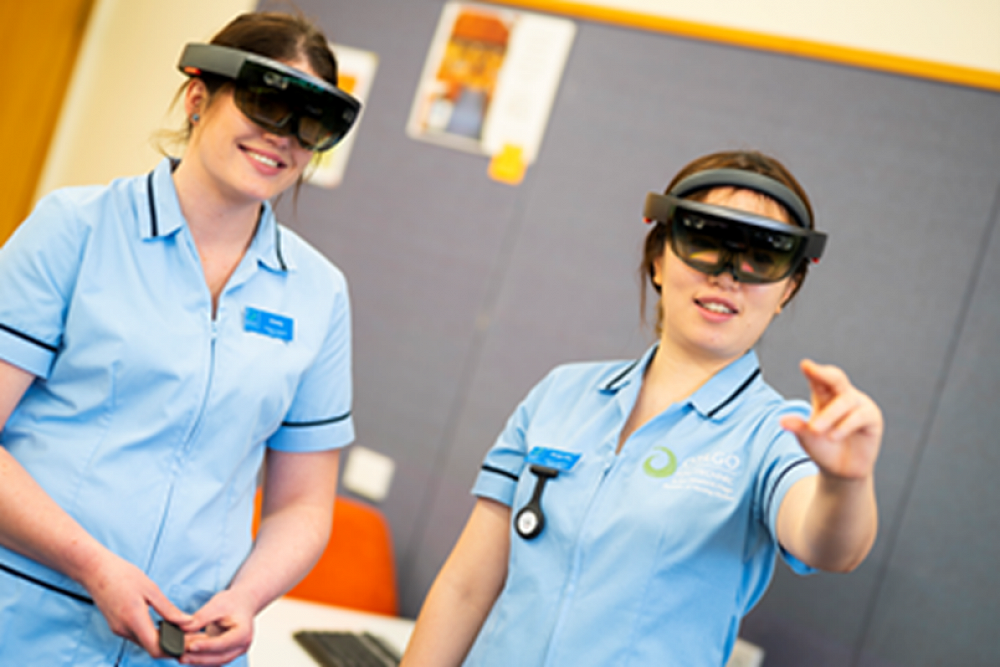
Otago Polytechnic’s School of Nursing was one of the first tertiary institutions to adopt Microsoft HoloLens headsets and HoloPatient software in New Zealand. The technology projects a hologram of a patient scenario into the students’ physical environment. Headset wearers experience a 360-degree view of the patient, they hear sounds via an internal speaker and additional information is seen by ‘air clicking’ a holographic keyboard that displays vital signs. The ability to use multiple headsets allows students to work in groups and assess the patient together.
In adopting the technology, the researchers - Liz Ditzel working with colleague Emma Collins, Principal Lecturer - wanted to ensure that it was an effective tool to assist student learning and to understand how best to use the new technology to further student understanding of the clinical reasoning cycle.
‘The clinical reasoning cycle underpins the nursing curriculum, it is a problem-solving and decision-making process by which nurses collect cues, process the information, come to an understanding of a patient problem or situation, plan and implement interventions, evaluate outcomes, and reflect on and learn from the process’, explains Ditzel.
The research was based on the application of the patient scenario, ‘Jerry’. Jerry, presented as a life-sized hologram, develops anaphylactic shock after the administration of a penicillin injection following a mountain bike accident.
‘The advantage of having the live hologram in the room is that students can literally stare without feeling self-conscious. It’s a modern and flexible way of learning,’ says Ditzel.
The research was conducted in 2019, and 91 Bachelor of Nursing degree programme first-year students took part. The study was conducted before students went on their first hospital-based clinical placement.
The research asked two questions. Firstly, when using the clinical reasoning cycle to perform a nursing assessment for Jerry what cues and information did students collect, and what nursing diagnoses, and actions were suggested? Secondly, what are the benefits and disadvantages of using holograms to teach clinical reasoning skills?
Students were split into groups of five or six. A tutorial guided them through the first five steps of the clinical reasoning cycle – look, collect, process, decide, plan – and asked them to collect cues and information about Jerry’s condition as he deteriorates across three successive film clips. Students could work together to identify the issues Jerry was experiencing before deciding upon nursing actions.
‘It is relatively rare for even registered nurses to experience the onset of an anaphylactic reaction in person, so this is a valuable way to provide that exposure,’ says Ditzel.
After the tutorial, study participants completed the survey. It asked participants to demonstrate information retention by recording patient cues, problems or diagnoses, and nursing actions for each clip. It included ten statements rated on a Likert scale with five rating options, such as ‘I felt confident about assessing the patient condition from the cues’. Participants also answered open-ended questions.
Quantitative results were reported statistically, while open-ended responses were thematically analysed.
At the conclusion of the third and final clip, students identified 17 cues, with the most common being that Jerry was limp or lethargic; had blue lips or cyanosis; or he had a low respiratory rate. In total 21 diagnoses were suggested including anaphylactic shock as well as a wound or blood infection. The most common of the 41 nursing actions suggested were preparing or administering oxygen; providing steroids or adrenaline; and dispensing antibiotics.
‘Clinical reasoning is intuitive and has to be practiced to be learnt. For this reason, the students were not briefed about Jerry’s condition as this would have restricted their data gathering as well as biased their observational and thinking processes,’ explains Ditzel.
In relation to the efficiency of HoloPatient as a learning tool, students most commonly reported a ‘sense of realism,’ ‘being able to assess the situation/patient visually,’ and that it was an ‘interactive and applied visual mode of learning’. Negative commentary was less common but included that the ‘patient or field of vision was awkwardly positioned for conducting a careful observation,’ ‘technical faults,’ and that the ‘audio was too quiet/lack of verbal responses.’
‘One disadvantage of the holograms is that they can’t talk back to you, but that is also an important teaching point. Not everyone can communicate so non-verbal communication is crucial,’ explains Ditzel.
The study results suggest that using a hologram as a learning tool assists in developing clinical reasoning skills and can provide nurses with increased readiness ahead of their first clinical placement.
‘Responses indicated on a Likert scale demonstrated a high level of satisfaction with the learning experience. Students thought that the patient appeared to be very real and were confident about assessing the patient from the cues,’ says Ditzel.
The researchers have also used a Virtual Clinical Judgement Rubric (VCJR) to measure second-years students’ understanding of the clinical reasoning cycle and compare it to the first-year student results. These results will help to evaluate the success of the holograms as teaching tools.
- Dr Liz Ditzel is a Professor in the School of Nursing, and Research Ethics Chair, Otago Polytechnic. She previously worked as a Registered Nurse in Intensive Care, Clinical Duty Coordinator, In-Service Educator in Dunedin Hospital, and as a Lecturer in Management at the University of Otago. Her research interests include using digital technologies to enhance nursing education, nurses’ mentoring relationships, job stress and burnout. Liz enjoys building knowledge through creative teaching and won an Ako Aotearoa National Tertiary Teaching Excellence Award in 2017. Contact Dr Liz Ditzel.
- Visit Otago Polytechnic.
