Cultural Exchange with Chita Middle School, Japan
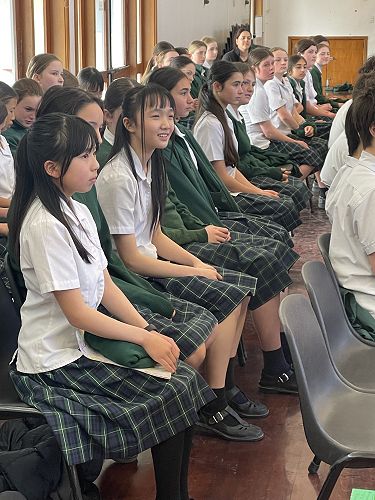
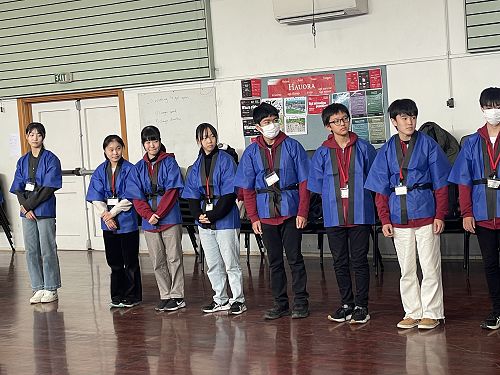
The Year 8 Kapa haka and four of our Japanese students were delighted to host Chita Middle School students, teachers, and their Principal from Japan last Monday.
Starting with the traditional Māori welcome known as Haka Pōwhiri, it began with a chant and actions of welcome performed in unison by the Heaton group. During this time, the manuhiri (visitors) were symbolically drawn onto the marae (our hall). The chant symbolised hauling a waka or canoe onto the shore.
We had speeches from Mr Griggs, Alister R6, Ritsuki R10, Ryo R12, Charlie R14, Lundon R12, and myself, Momoyo R15, to welcome our visitors and share our cultural speeches. Our Japanese students supported us well, speaking both Japanese and English. In my speech, I highlighted that our two cultures have many similarities. For example, in Japanese, walking is called “tokotoko,” whereas in Māori, walking with a cane is called “tokotoko.” The Māori word for fish is “ika”, and “ika” means “squid” in Japanese. Caves are called “ana” in Māori, and “ana” means “hole” in Japanese. The Japanese word for clapping hands is "pachi pachi", and it’s very similar to the Māori word for clapping, “paki paki”.
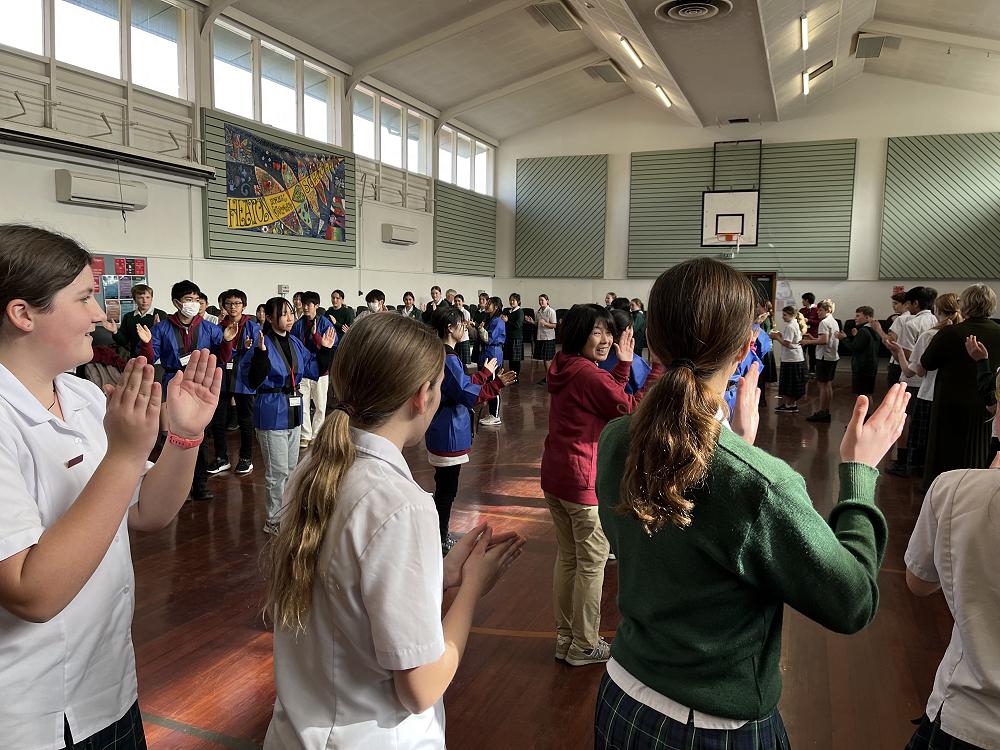
We enjoyed listening to the manuhiri, (Japanese Visitors) who shared their cultural stories and performed a dance called ‘Sanpo' from the famous Japanese film, ‘My Neighbor Totoro’. They also performed a dance called Tanko-Bushi, one of the Bon-Odori dances. Bon-Odori is a Japanese cultural dance performed during the Autumn Festival. For this, our Kapa haka students and teachers performed together with the Japanese students.
Next, as is the ritual in Haka Pōwhiri, we took time for hongi, but due to social distancing, we adapted it to the elbow touch or the ‘ihu’ wave.
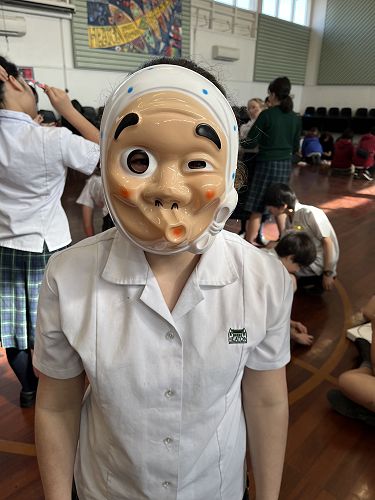
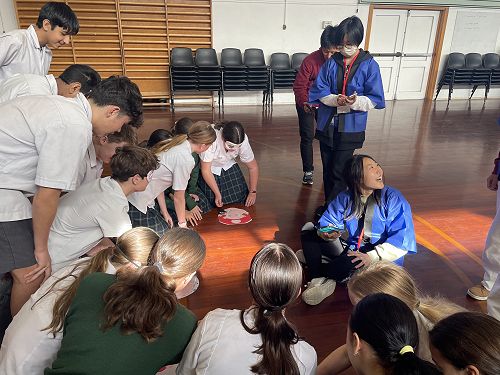
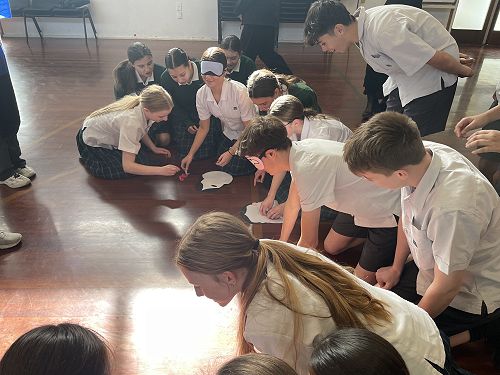
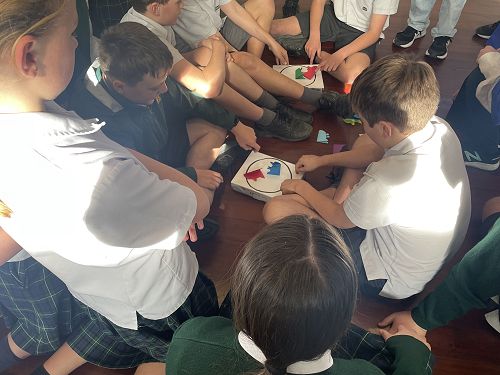
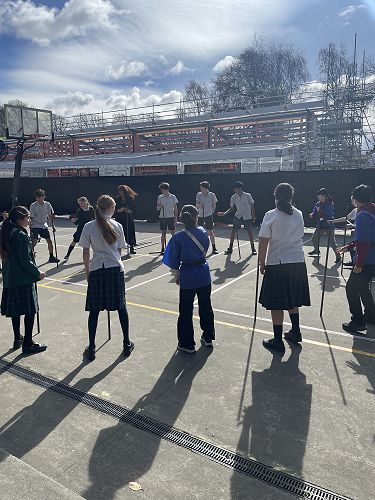
After that, we did an activity rotation. The Kapa haka leaders taught the Japanese students the rākau while the Japanese students taught us their cultural games, ‘Fuku-warai’, ‘origami’, and ‘Ton ton zumo’. Fuku-warai is a game that children often play during the New Year in Japan. ‘Fuku’ means good luck, and ‘warai’ means to laugh. So by playing this game, you will get good luck by laughing. The rules are similar to Pin-the-Tale-of-the-Donkey, but instead, you use face parts for ‘Hyottoko’ and ‘Okame’.
The opportunity to learn origami was very popular. Origami is a game where you fold colourful paper without using scissors, tape, or glue. ‘Ori’ means to fold, ‘kami’ means paper. We could choose to make a paper crane, a paper frog, or a paper shuriken (ninja star/weapon). Our Japanese visitors' final option was ‘Ton Ton Zumo’, a two-player game where you tap a paper ‘sumo’ reminiscent of Japanese wrestling!
Finally, by having this opportunity to exchange and share our cultures, we were able to deepen our understanding of one another, making positive connections. Although a short time, it was a fantastic, meaningful opportunity.
Chita Middle School has been visiting our school yearly, but unfortunately, they could not come for the past few years due to COVID-19. This year, we were lucky to be able to connect again.
Ngā mihi nui
Momoyo R15
Gallery