
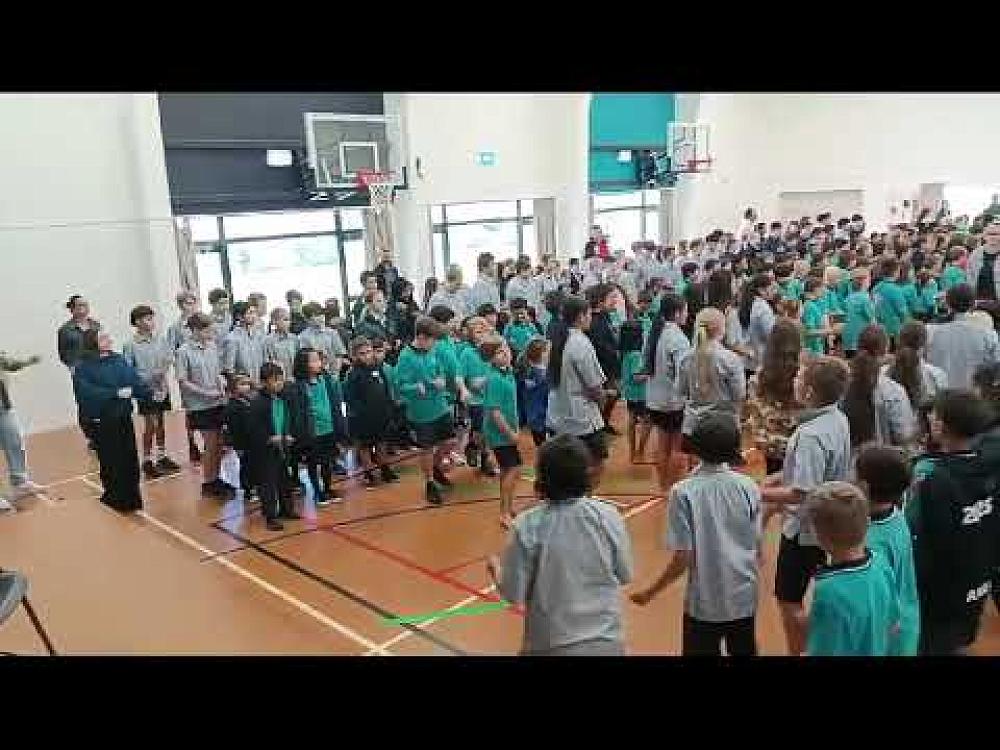
Hobsonville School - Powhiri - Term 2
On Monday 29 April, Hobsonville School started Term 2 by holding a whole school powhiri.
A powhiri is a way to welcome and acknowledge people to our school. Tangata whenua (people of the land/ school) welcome our manuhiri (guests, new students and caregivers) to the school by performing a haka powhiri - a rather powerful part of the ceremony.
It starts with having our manuhiri waiting at the gates and one of our Kapa Haka leaders (boy) will place a peace offering (leaf) for a (male) guest to accept on behalf of their group. Once this peace offering is accepted, the female leaders start to call for the guests to start walking forward by singing the karanga, with support of the whole school singing along too. Our guests walk slowly through the centre of the school to the front where they will sit.
Once our guests have been welcomed by our students with the karanga, they will be formally welcomed by our Principal, Mrs Anne Leitch, followed by the school singing Te Pou. In Māori customs it is expected that after each speaker, there is a waiata (song).
At this point, traditionally guests have the opportunity to reply by speaking and sharing a waiata. We do not force this on our new guests, and simply ask for them to stand, smile, meet with our Senior Leadership Team, and walk slowly through our school as our students sing our school waiata, Mena.
To complete our powhiri, and in line with Māori customs our Senior Leadership Team will meet with manuhiri in the staffroom with the sharing of kai (food).
Kia ora,
David Brake and Alice Stringfellow - Te Reo Māori Leaders
The lyrics and translation to our song Te Pou:
Te Pou Te Pou, Te tokotoko i whenuku, te tokotoko i wherangi, Tokia tukia.
Who are the supports you have:-
-at home/ whanau / friends
-at work / colleagues / others that are admired professionally or aspired to
spiritually /
-bodies of knowledge-professional / traditional cultural/
*Professional knowledge includes the ethics that apply to that profession.
Cultural knowledge will include the principles/ values that are part of that culture, for example, Maori traditional knowledge would include principles such as, manaakitanga, whanaungatanga, rangatiratanga.
These supports provide the ahurutanga-safe spaces. It is at these safe spaces that we are able to take stock and seek answers, solutions and plan futures.
It is integral to identify the supports we have to draw on when barriers and obstacles appear and when clarity is needed.
Ko te mumu, ko te awha, ko te manihi kaiota. Takiri panapana,
Having processes in place for when irregularities, problems, new situations arise is important.
-recognise the issue
-understand the implications
-consider the options
Ka rau i runga, ka rau i raro, Ka whai tamore i runga, Ka whai tamore i raro,
Using the pou you have, ie; Human supports, spiritual supports, and bodies of knowledge
-predict the possible outcomes
-aim for the pinnacle outcome, make a decision
Tena ko te pou, Te pou o Rongo, Mauri ora, Ka ora e