
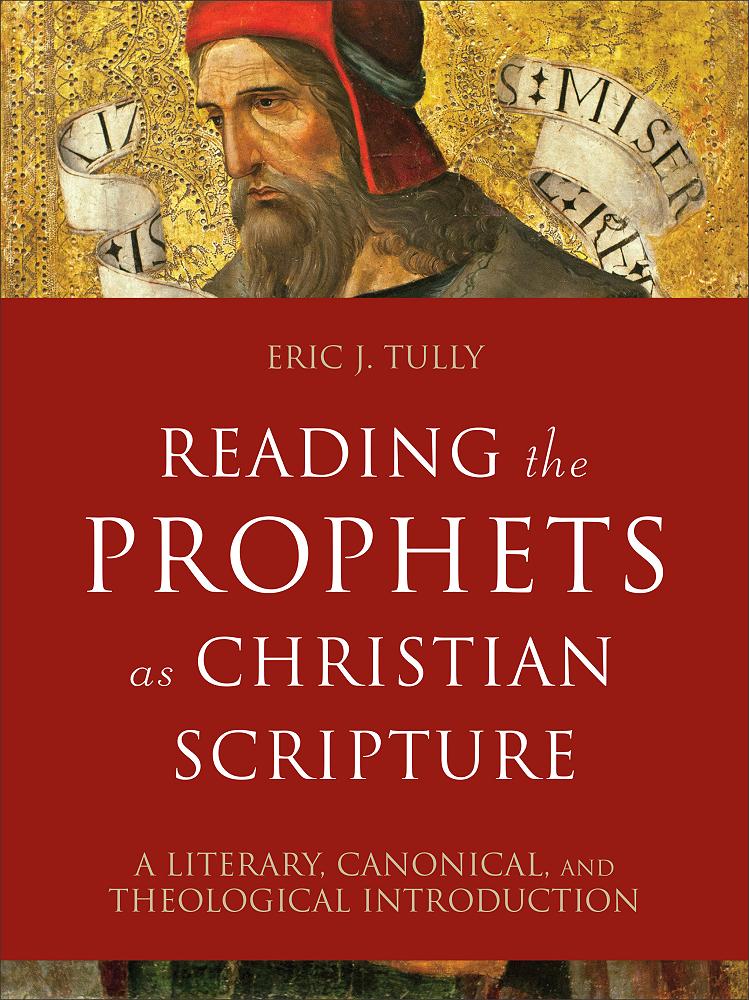
Book Review: Reading the Prophets as Christian Scripture: A Literary, Canonical and Theological Introduction.
ERIC J. TULLY, READING CHRISTIAN SCRIPTURE, GRAND RAPIDS: BAKER ACADEMIC, 2022. XV + 409 PP. ISBN 9780801099731.
How should the Old Testament relate to the New? Should the Old Testament stand on its own, and be interpreted in its own right, or does it point to Jesus as the Christ? I would often tell students that a certain passage, or text, in the Old Testament could appropriately be applied to Jesus Christ. That is, though it was not necessarily written directly with reference to Jesus, it could be applied to Jesus justifiably.
Tully is much more forthright. “The Old Testament does not become Christian Scripture through our reading it with a certain technique or according to a set of rules, nor does it become something else if read in a different way. The prophetic books of the Old Testament are Christian Scripture” (2, his emphasis). Furthermore, as one reads his treatment of the various prophets, it is clear that, while Tully wishes the Old Testament prophets to be understood on their own terms, their prophecies frequently point directly to Jesus. For example, Isaiah’s “Servant” refers to “one person” who is “later revealed to be Jesus Christ” (172). Similarly, when Zechariah speaks about “the Branch”, “[a]though Zechariah may not have fully understood it, it is clear from the New Testament that he is talking about Jesus Christ…” (371).
That said, Tully’s book is not quite what I expected to read when I requested a review copy. I thought it would be a monograph discussing why and how it is appropriate (necessary even?) to read the Old Testament prophets as Christian Scripture. Instead, the book is basically an introductory textbook to the prophetic literature of the Old Testament. As such it is a clear, straightforward, and helpful textbook, which takes a conservative, evangelical approach. While Tully discusses critical issues, he quickly dismisses more “liberal” interpretations. He makes what I think is an unfortunate distinction between “evangelical” and “critical” readings, which rather suggests that an evangelical reading is “uncritical”. This is far from true of even many of his own judgments.
The book is divided into three sections, following an introductory chapter. In “Part One: The Context of the Prophets”, Tully deals with the “theological context” where he has a useful discussion of the concept of “covenant” and details the five covenants to be found in the Old Testament (with Noah, Abraham, Israel [viz. Sinai covenant], David, and the “new covenant” [Jeremiah]). The “historical context” provides an overview of the history of Israel, as it relates to the phenomenon of prophecy, from the time of Moses through until the post-exilic period.
“Part Two: The Old Testament Prophet” (Chapters Four to Eight) provides a discussion of the role and the nature of true prophets of God, the types of false prophecy and how to detect it, the message of the prophets, and the “persuasive strategies” used by the prophets to get their message across, and lastly, the process by which a prophecy became a “written prophetic text”. The chapter on the prophetic message outlines five phases to which a prophecy may refer: past, near future (either predicting judgment or restoration), and eschatological future (again either judgement or restoration). When each prophetic book is discussed, Tully shows (especially using a diagramme) which of the five phases the prophet covers. The chapter on “Persuasive Strategies of the Prophets” helpfully describes the various ways in which the prophets got their message across, both verbally and visually (“Sign-Acts” or “visual object lessons” are an especially important mode, often referred to in the discussion of individual prophetic literature).
“Part Three: The Prophetic Books” provides a survey of all of the prophetic books, according to the Protestant Bible (though Lamentations is not included). The prophets who appear in the Former Prophets (according to the Hebrew Bible), and elsewhere (e.g. Abraham, Miriam, and Moses are also listed) are covered in the chapter in Part Two entitled, “The Role of the Old Testament Prophet”. In Part Three the Major Prophets: Isaiah, Jeremiah, Ezekiel and Daniel, and the twelve Minor Prophets all receive a chapter. Daniel is treated as an actual person who served in the Persian court and so the book is taken as covering the years 605 to 553 BCE (this means that the “contemptible person”, Antiochus IV, is a figure of prophecy; and reference to him is not an indication of when the book was written, see p. 240). Jonah also is an actual prophet; the result is that the irony and skilful literary devices of the book tend to be flattened, and the tale is a moralistic lesson on wrestling with God’s grace that extends not only to “us” but to those whom we consider beyond the pale as well.
Each book receives the same treatment. First there is an “Orientation” section which discusses the authorship, and locates the book in its historical context. Next is “Exploration”, in which the phases of prophecy to which the book relates is noted, and the structure of the book is briefly discussed. The bulk of this section is taken up with a passage by passage analysis of the content of the book. Mostly this seems to amount to a summary of the content, though Tully will also add some explanatory or interpretive comment, e.g. that the olive trees in Zechariah 4:1–14 most likely represent Zerrubabel and Joshua the high priest (369).
The final section is “Implementation”, and this is where Tully most often relates aspects of the content to the New Testament, and draws out implications for Christian belief and life today. We learn, for instance, how Jeremiah contributes to our understanding of the new covenant established by Jesus’ death. Often, however, the theological points drawn are pretty general and might as easily be applicable to the prophet’s first hearers or Old Testament (and Jewish) readers. Such matters as that “the reality and finality of the day of YHWH should inform our perspective about life in this world” (Joel, 272); or that “it is okay to wrestle with God” (Habbakuk, 338). The other way in which the New Testament is brought into the frame, is through examples (often provided in sidebars) of how certain prophetic statements are taken up and used by the New Testament writers.
As an introduction to the prophetic literature, especially for beginning students, this is a clear and helpful, and attractively presented, guide. But if one wants to wrestle with some of the issues of how to relate the prophets to Christian understandings of God and God’s actions; or whether and how Matthew’s use of Hosea 11:1 in Matthew 2:15 is appropriate and applicable, one may start here (see sidebar, 258) but perhaps go elsewhere for further analysis.
Derek Tovey is the book review editor for Stimulus.