
Transforming Worldview in Mark’s Gospel: Restorying, Resymboling, and Reritualing the Passover
The sudden ending of Mark’s Gospel appears to question the disciples’ authenticity: “Was their worldview transformed by Jesus?” The disciples' incredulity and unbelief are evidenced by Mark, as well as the pursuit of their own agenda.
Moreover, denial, fear, bewilderment, and silence are the paramount sentiments, as he concludes his story.[1] All have abandoned Jesus, even the few women who had remained.
However, the very existence of Mark’s Gospel says much more. Mark’s audience knows the answer to the question posed above. The disciples’ worldview was indeed transformed, and their allegiance has turned to Jesus Christ, the Son of God (1:1). They no longer seek the power of empire, nor fear it.
In today’s world, transformation too frequently does not reach the deep worldview level of people’s lives but remains fixed within values and behaviours. Tom Steffen writes that worldview is fully transformed through “the replacement of formerly held symbols, stories, and rituals with rival ones. This resymboling, restorying, and reritualing results in much more than changed observable behavior, it results in the deep-level alteration of the heart; it results in a new worldview script.”[2] Is this seen in Mark’s gospel? Is this the way Jesus transforms his disciple’s worldview and changes their allegiance?
This topic of worldview transformation within Mark’s Gospel is vast, so the focus will be on Jesus’ use of the Passover meal to foster change,[3] with consideration to the corresponding narrative thread that winds its way to that point in Mark’s story. To establish a starting point, first, we will take a brief look at the existing Jewish worldview, and cultural beliefs and practices around meals. Thus, we will explore how Mark portrays Jesus as transforming his disciples’ worldview, briefly applying it to the task of making disciples today to bring an equally deep level change in worldview.
The Prevailing Jewish Worldview[4]
Worldview is defined as “the story-based grid through which one “sees” and interprets all aspects of life.”[5] As in all cultures, for the Israelites, their stories, symbols, and rituals formed, informed, and reinforced their worldview.
Stories[6]: Their sacred Scriptures detailed their origin and history; were recorded in writing, translated, and interpreted; taught and discussed in the synagogues; and passed on orally. Other more recent Second Temple texts also shaped their narrative.[7]
Symbols[8]: Circumcision, the law (including food laws), and the temple, set them aside as a special people. Such objects as bread, wine, water, and many other things had significance beyond their physical reality.
Rituals[9]: Sabbath, sacrifices, festivals, and fasting were some of the rituals that reminded them of how God had previously rescued them from subjugation and bitterness, provided for them, and made requirements of them.
Like the narrative of old, when Jesus entered their lives, the Jews were a subjugated people. They were a people under the authority of outsiders, the Romans. Galilee had experienced the devastating impacts of Roman brutality. Thousands of people had been enslaved within their living memory.[10] As with people everywhere, different factions reacted differently to their suppression.[11] However, their underlying narrative or worldview was built on three fundamental beliefs:
Yahweh was King of Israel and Ruler of the universe,
Things were not as they should be, and
God will do something about it.[12]
Their expectations were for a liberator, a warrior king, who would come “in violent force to resolve Israel’s problems.”[13] In line with Jewish history and the way of surrounding empires, a powerful figure, who would overthrow their enemies, was the key hope for the restoration of Israel.
In the meantime, kinship and networks were a crucial element of protection. In a world of inequality where power was distributed by extremes, the ordinary person did not survive on their own ‘merits’ but through being connected to networks of family, friends, brokers, and patrons.[14] Individual identity was formed in terms of the groups in which one was embedded.[15]
Survival in first century Palestine depended on the equilibrium of these relationships. Meals were a symbol of these relationships. “Meals in the ancient world were occasions that depicted and reinforced social solidarity, so people ate common meals with others who shared their socioeconomic status or who were of the same household.”[16] Hence, eating together implied a solidarity of principle and philosophy.[17] For the people of Jesus’ day, the “microcosm of the meal is parallel to the macrocosm of everyday social relations.”[18] Therefore, the table of fellowship was reserved for those tied by the bond family, friendship, or patronage and excluded those who were outside those bonds.
The Last Supper
One of the most obvious points in Mark’s Gospel of restorying, resymboling and reritualing, is Jesus’ actions centred around a meal, the Last Supper. The Last Supper composes a beautiful picture that transforms the existing ritual of the Passover.[19] Jesus places himself at the centre of Israel’s historic Passover,[20] but this is not done in a vacuum, it is the culmination of many narrative junctures already passed in Mark’s account.
The Passover was celebrated every year and was a night-time observance. The Pesahim, a tractate of the Mishnah, provides some insight into what likely happened during the Passover at the time of Jesus.[21] It describes how earlier in the day, family representatives would sacrifice a lamb at the temple before the priests. As witnesses to the sacrifice, they provided “a tangible remembrance of the first Passover.”[22] They would then take the roasted lamb back for a meal together. More than any other meal this was a family meal.[23] As well as the lamb, the meal consisted of unleavened bread, lettuce, bitter herbs, haroseth (a chutney), and wine.[24] A cup of wine would mark each step in the proceedings. After the second cup of wine, a child asks the question: “Why is this night different from other nights?”, and the patriarch recounts the history of Israel’s deliverance from Egypt by God.[25] It was a highly symbolic ritual. According to Joel Marcus, of importance, are the words voiced over the bread which probably went something like this: “This is the bread of affliction which our fathers ate in the land of Egypt. Let everyone who hungers come and eat; let everyone who is needy come and eat the Passover meal.”[26]
Eating Together
The first aspect of the disciples’ worldview change was around participation. Jesus challenges the disciples' perception of who could partake. Mark has already storied Jesus as challenging the relational partiality and reciprocity of meals. Jesus rewrites the rules of social engagement, as one of overwhelming generosity.
The first significant scene that challenges the social norms is Jesus’ feast with Levi the tax collector and his friends (2:13-17). This is no ordinary everyday meal provided by Levi but a special occasion,[27] and it clearly confuses the expectations of those around. Jesus is joining a meal with people outside his social status. It was generally understood that the presence of such sinners among God’s people contributed to the reason God had not returned to redeem Israel.[28] Like Jesus, the Pharisees wanted the tax collectors and sinners to repent but their method was exclusion. Jesus’ example to his disciples is not exclusion but embrace.[29] He eats with them.
Unlike Jesus, the Pharisees want external compliance to their culturally constructed and restrictive purity laws before eating (7:1-5), [30] but Jesus points out that it is not those external things which makes a person unacceptable to God, but evil things that come from the heart. It is evil from within that defiles a person, not any food that is consumed (7:15). But for Jesus even the presence of evil in the heart does not exclude someone from the table.[31] Even more controversially, Mark points out that Jesus is declaring all food clean (7:19). This stunning statement, blurs the line between Jew and Gentile, challenging one of the distinctive symbols of what it meant to be Jewish.[32] This will mean that both Jews and Gentiles can eat from the same table.[33]
This is put to the test in the approach of the Syrophoenician woman seeking healing for her demon possessed daughter (7:24-30). She is asking for help from Jesus. Falling at someone’s feet was a gesture that sought favour from a patron.[34] Relationships of reciprocity were the norm in Jesus’ time.[35] When something is given, fidelity is bestowed in return. But this woman has nothing to offer Jesus. She is a Gentile woman, dealing with the unclean demons of her daughter, causing her probable ritual impurity, and so she has nothing of value to bargain with.[36] In addition, Jesus is seeking to escape notice. She is seemingly the wrong person at the wrong time. Nevertheless, despite this, Jesus engages her in conversation, albeit apparently insulting and a denial of help, [37] and then humbly admits her legitimacy to eat bread from the table. She is included.
When Mark comes to the table of the Last Supper, we see fully the radical nature of Jesus’ inclusion. Mark places the story of Jesus sharing this most profound meal with the disciples between accounts of their treachery and desertion.[38] Jesus, fully aware of Judas’ betrayal, and the disciples’ future unfaithfulness, chooses to share a meal of such extraordinary significance with them. The intimacy of a meal is both impacted and jarred by the image of the betrayer dipping his bread in the same bowl as Jesus. This is the “deepest violation” of the “most intimate form of fellowship”.[39] Judas and the other disciples have become the ones who are patently unworthy of table fellowship with Jesus. “The notes of grace and the faithfulness of Jesus to his disciples in this passage are overwhelmingly beautiful.”[40] No one is excluded from the table. All are embraced.
The Bread
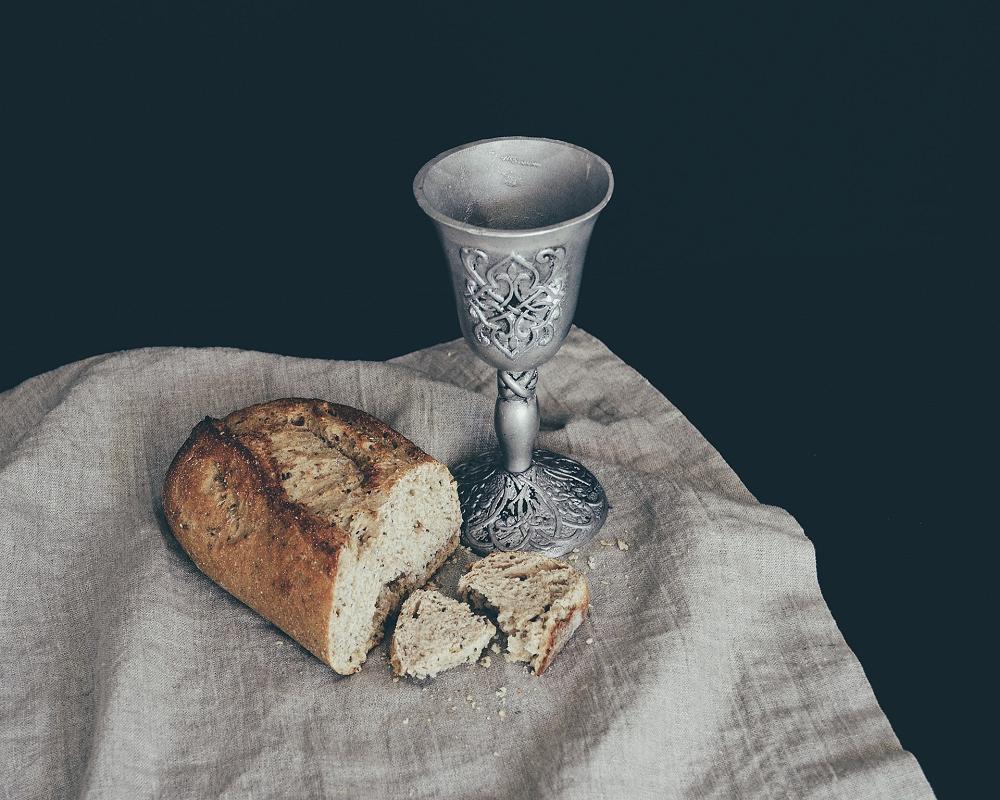
Breaking, and blessing the bread was a common occurrence by the head of the household at mealtimes,[41] and at the Last Supper, bread plays a significant part at the meal. Jesus uses it to symbolize his body (14:22). It perhaps would have been more natural to associate his flesh with lamb, rather than bread.[42] However, Jesus takes not the ‘special’ element but the ordinary everyday element of the meal. He takes a familiar daily symbolic event, the blessing and sharing of bread that unites family and friends in fellowship,[43] and enlarges its meaning.
The breaking of the bread is reminiscent of the feeding of five thousand men in the wilderness. Here the power of God is seen not in vanquishing enemies but in providing sustenance for the hungry.[44] The power of the miraculous is not to be underestimated in transforming worldview. There is power also in the symbolism. Jesus calls the people “like sheep without a shepherd” (6:34), which possibly alludes to Num 27:17 where God leads Moses to a new leader for Israel, Joshua, a military hero who would lead Israel’s forces to war.[45] Bereft of Godly leadership, Israel’s hopes were for such a shepherd again.[46] However, Jesus’ compassion, teaching, and feeding on green pastures (6:39) speaks more gently of the good shepherd of Psalm 23, not a violent military hero.[47] In Jesus’ provision there are echoes of Moses in the wilderness and manna,[48] and Elisha’s multiplication of bread (2 Kings 4:42-44).[49] His actions are kind and compassionate. The disciples, however, are blind in their part, preferring to leave the people to fend for themselves. They act with sarcasm when Jesus asks for their solution (6:37), but Jesus does not give up on them. He makes them agents of his provision.[50]
In 8: 1-9, Mark recounts a second feeding miracle that follows the same pattern of Jesus taking the bread, giving thanks, breaking it and giving it to the disciples to distribute. As Susan Miller says, “In the feeding narratives abundance comes from brokenness, and everyone eats and is fully satisfied (6.42; 8.8).”[51] However, unlike the Syrophoenician woman, the disciples do not understand the significance of the bread (6:52; 8:14-21).[52] For her bread is a symbol of the blessings of Jesus’ ministry.[53] She can grasp Jesus’ meaning. It represents healing and wholeness for her daughter, and she has faith to see that just a scarce little crumb can heal her daughter, but the disciples are repeatedly blind, deaf, and hardened to the meaning of the abundance of 12 baskets and seven baskets (8:21).
The significance of the bread in Mark is generosity, healing, and plentiful provision. It is a symbol of God’s faithfulness to all. At the Last Supper, Jesus extends the meaning further, and transforms the significance of the breaking of bread, in the traditional Passover, to represent not the ‘bread of affliction’ of Egypt, but his physical life given to the disciples.[54] Nevertheless, it remains a symbol of the generosity of God in extending an open table available to “everyone who hungers” and “everyone who is needy” to come and eat.[55] Although it is not complete without the resymbolizing of the wine.[56]
Drinking the Cup
With the cup, at the Last Supper, Jesus inaugurates a new covenant, which is again reminiscent of the Exodus and in particular the covenant presided over by Moses after Israel’s liberation from Egypt which is sealed with blood (Exod 24:3-8).[57] Even in Moses’ time, blood was the language of sacrifice, it meant vicarious suffering.[58] However, Jesus gives a new meaning to the cup also, as his blood poured out for many (14:24).[59] So the cup, in Mark, symbolizes suffering (14:23-24, 36).[60] It refers to the “witness of suffering at the hands of the powers” and for the disciples, it will come to mean “solidarity with and participation in the way of the cross, embodied in Jesus”[61]
Before the Last Supper, Jesus speaks three times in Mark about his future suffering (8:31-32; 9:31; 10:33-34). Each time the disciples misunderstand and respond outrageously. The portrayal of the disciples throughout Mark’s Gospel is one of completely missing the mark. Their blindness to Jesus’ meaning increases as the story progresses. In the third prediction, Jesus calls them to open their eyes, “idou” (look, behold), and he tells them quite explicitly what is coming.[62] However, James and John, immediately request positions of power in Jesus’ future kingdom. Their appeal smacks of a desire for clout and influence alongside the victor.[63] Their worldview is still fixed on a liberator, a warrior king, who would come and resolve Israel’s problems with violent force. They were “confident that they will do gloriously in the war ahead and deserve these places.”[64] Jesus seeks to turn their minds back to his passion prediction and invites them to share in his cup and his baptism. He invites them to a way of servanthood (10:42, 45). For, servants at ceremonial meals in the renewed Israel, are the great, and the first will have the status of a slave.[65]
Ironically, the disciples, although they physically drunk from the cup at the Last Supper (14:23), and ate the bread, they do not share in his suffering within the story of Mark.[66] In fact, Mark portrays them as failing spectacularly. They are nowhere to be seen during the suffering of Jesus, apart from Peter’s denial (14:66-72). They do nothing but abandon Jesus, not even claiming his body after his death, contrary to John’s disciples (6:29).[67] The disciples did not recognise that partaking in the Lord’s Supper would symbolise participating in Jesus’ suffering.[68]
Finally, Jesus points to another feast in the kingdom of God (14:25) where he will anew celebrate the Passover, where the elements will take on a different meaning again. Thus, the meal is both cruciform in character and eschatological in emphasis.[69] In Jesus’ prophetic and symbolic action he proclaims the meaning of his death,[70] and provides hope for the future.
Transformation of Passover
In the account of the Last Supper, Jesus’ restorying reaches a point of consolidation in his resymboling and reritualing of the Passover Feast. It solidifies what he has been showing and teaching them. In the Last Supper, Jesus shares with his disciples a sacrament that tells a new story, a story that he has been forming in the lives of his disciples.
That sacrament or ritual teaches that “God’s kingdom is a scandalously inclusive reality, constituted by all those who call upon the name of the Lord.”[71] The disciples did learn this, although it took a vision (Acts 10:10-16) and further acts of God (Acts 15:8-11), and a false start (Gal 2:11-13) for them to have a transformed worldview and no doubt they never reached perfection. But the disciples’ underlying narrative is radically changed so that later Peter will write:
Above all, keep loving one another earnestly, since love covers a multitude of sins. Show hospitality to one another without grumbling. As each has received a gift, use it to serve one another, as good stewards of God's varied grace: whoever speaks, as one who speaks oracles of God; whoever serves, as one who serves by the strength that God supplies—in order that in everything God may be glorified through Jesus Christ (1 Peter 4:8-11).
The disciples mindset is transformed from exclusion to embrace. Down through history, regrettably the church has not always held fast to this lesson.[72]
Secondly, the sacraments of Jesus’ contextualized Passover were taken up by the disciples (1 Cor 11:23-25). Preserving the meal represented a mammoth change in their worldview. Jesus brought restoration but a restoration that was not consistent with the disciples’ old worldview. In the Lord’s Supper, Jesus would become massively present but his presence “is not manifested in a way that eliminates weakness, suffering, and death from the lives of community members, any more than it shielded the life of Jesus himself.”[73] The disciples did share in Jesus’ suffering as he had predicted (13:9-13).[74] The bread and the cup reminded them that Jesus did not come to conquer with force and violence but invited them to participate in his different kind of renewal through suffering, sacrifice, and ultimately glory. Peter’s words continue from above:
Beloved, do not be surprised at the fiery trial when it comes upon you to test you, as though something strange were happening to you. But rejoice insofar as you share Christ's sufferings, that you may also rejoice and be glad when his glory is revealed (1 Peter 4:12-13).
Looking back at Mark’s account of Peter’s rebuke of Jesus in 8:31-33, these words of Peter represent a deep level transformation. For the disciples, the process of worldview change was slow, but their eyes were opened, and no doubt the creation of a distinctly Christ-centred sacred space and time, aided that process immensely.
Transformation Today
When the gospel is shared in a new locality, rival narratives already exists. Robert Strauss explains,
The local and regional stories are deeply embedded in the lived experiences of local people. For the most part the local stories are trusted. They are retold again and again. From them people find meaning and direction for the future.[75]
These narratives shape their hearts, their sense of reality, and what is important.[76] To be transformed by God’s worldview script, a new disciple of Jesus must reshape their cultural imagination.[77]
Unfortunately, we sometimes neglect a person's local cultural stories: beliefs about origin, a common history, shared values about family and relationships, and other core worldview assumptions. Our focus has been on words, but words “alone are often not enough to communicate deep values and emotions.”[78] The creation of sacred space and sacred time speaks to the heart, allowing the work of the Spirit. Patience is needed to restory, resymbol and reritual.
A Christ-centred life develops slowly in conjunction with the creation of meaningful rituals.[79] Rituals “have the unique ability to drive meaning ‘deeply into the bone’.”[80] However, they are most meaningful when the symbols are significant to the participants. The bread has taken many forms over the years, as has the wine, but the meaning stays the same. In Asian and Pacific cultures with no symbolic connection to bread and wine, a coconut can be far more evocative symbol. A machete breaking open the coconut is an emotive act, and the milk and flesh are eloquent substitutes. But meaning does not need to be confined to a formal ritual. It can become an everyday ordinary ritual, which is by no means less sacred. In a village north of Bangkok, followers of Jesus remember his sacrifice every time they eat or drink, whether it is a cup of coffee or a bowl of rice.[81] Surely teachers and theologians have the task, not of prescribing, but of listening to the leading of the Spirit of truth and what God is doing.[82] “Scripture tells us that regardless of how we experience (the Lord’s Supper), regardless of our interpretation, regardless of how we feel, God promises to meet us at the Table (1 Cor. 11:23–26).”[83]
Conclusion
Jesus’ disciples, as Israelites, had an existing worldview. Israel’s whole existence was defined with reference to war and peace, and all of history was viewed through the lense of their own story.[84] They were looking for a great warrior who would end suffering through the infliction of suffering.[85] Nevertheless unlike the narratives of old, Jesus did not lead the people to a war of liberation or conquest. “Jesus had a different and unique agenda—world rule through love, service, humility, suffering, and others-centeredness, even to the point of death.”[86] Even when the disciples continually hold to their old way of seeing the world, Jesus does not abandon them and even when they betray or desert him, he still offers them a place at the table. And along the way, Jesus reshaped his disciples’ worldview, opening their eyes. David Rhoads et al, say that Mark’s narrative “seeks to shatter the readers’ way of seeing the world and invites them to embrace another.”[87] This is true. Jesus turns the world upside down. However, in Mark, we see that the process of change is gentle. It takes a long time. Jesus is patient with his disciples,[88] continually restorying their expectations through his actions, his words, and his attitudes. His teachings often focus on a new way of seeing and feeling.[89] He takes existing and familiar symbols, and the Passover ritual, and infuses them with a new meaning, that will form, inform, and reform their worldview over and over again, long after he has risen. The disciples’ allegiance becomes planted firmly with Jesus their Saviour. Restorying, resymboling and reritualing play a substantial part in the transformation of the disciples in Mark’s Gospel. Today, also, they are vital to effective discipleship that affects a deep-level transformation.
Wendy Taylor is the co-principal of the Nations Course for World-Outreach International, with her husband, Malcolm. Nations is a course designed to launch people into effective cross-cultural ministry to unreached people groups. When not teaching, researching or studying, she works on their small farm, where they raise South Suffolk sheep. She has five children and three grandsons.
[1] Assuming the traditional ending of 16:8. See also 14:71-2
[2] Tom A. Steffen, Worldview-Based Storying: The Integration of Symbol, Story, and Ritual in the Orality Movement (Richmond, VA: Orality Resources International, 2018), 34.
[3] 14:12-26
[4] There is some discomfort in generalizing a culture’s worldview as every family and potentially every person has their own nuances, although the big picture usually is collective in nature.
[5] Robert Strauss, Introducing Story-Strategic Methods: Twelve Steps Toward Effective Engagement (Eugene, OR: Wipf and Stock, 2017), 44.
[6]According to Steffen, story constructs worldview, and every human is located in a story. Steffen, Worldview-Based Storying, 206.
[7] Ben C. Blackwell et al., eds., Reading Mark in Context: Jesus and Second Temple Judaism (Grand Rapids: Zondervan, 2018), 35–39.
[8]“Symbol is a pictorial conversation, possibly extending for generations, centered on associated relationships defined in social time and space.” Steffen, Worldview-Based Storying, 165.
[9] “Ritual is repetitive reenactments designed to reinforce specific realities and relationships.” Steffen, Worldview-Based Storying, 241.
[10] Richard A. Horsley, Hearing the Whole Story: The Politics of Plot in Mark’s Gospel (Louisville: Westminster John Knox Press, 2001), 33–34.
[11] Different factions included the Sadducees, the Pharisees, the Zealots, the Essenes, and the Sicarii.
[12] Karl Allen Kuhn, The Kingdom According to Luke and Acts: A Social, Literary, and Theological Introduction (Grand Rapids: Baker Academic, 2015), loc. 222.
[13] Mark J. Keown, Jesus in a World of Colliding Empires, Volume One: Introduction and Mark 1:1-8:28: Mark’s Jesus from the Perspective of Power and Expectations, Kindle Edition (Eugene, OR: Wipf & Stock, 2018), 140.
[14] Kenneth C. Hanson and Douglas E. Oakman, Palestine in the Time of Jesus: Social Structures and Social Conflicts (Minneapolis: Fortress, 2009), 65.
[15] Bruce J. Malina, The New Testament World: Insights from Cultural Anthropology (Louisville: Westminster John Knox Press, 2001), 62.
[16] Timothy G. Gombis, Mark, SGBC NT2 (Grand Rapids: Zondervan Academic, 2021), 493.
[17] Bruce J. Malina and Richard L. Rohrbaugh, Social-Science Commentary on the Synoptic Gospels (Minneapolis: Augsburg Fortress, 2003), 381.
[18] Malina and Rohrbaugh, Synoptic Gospels, 381.
[19] Mark emphasises the importance of the Passover by repeating it four times in the narrative (14:12, 14, 16). Gombis, Mark, 486.
[20] Blackwell et al., Reading Mark in Context, 46.
[21] Amy Peeler, “Mishnah Pesahim and Mark 14:1-25: The Passover Tradition,” in Reading Mark in Context: Jesus and Second Temple Judaism, ed. Ben C. Blackwell, John K. Goodrich, and Jason Maston (Grand Rapids: Zondervan, 2018), 217–18. Peeler notes that although there is no guarantee that the Mishnah describes the actual practices at the time of Jesus, it is likely, and the Pesahim’s description of the Passover “remains one of the only possible parallel texts for illuminating the ritual’s timing, preparation, and meal” (218).
[22] Peeler, “Mishnah Pesahim and Mark 14:1-25: The Passover Tradition,” 220.
[23] Malina and Rohrbaugh, Synoptic Gospels, 211.
[24] Peeler, “Mishnah Pesahim and Mark 14:1-25: The Passover Tradition,” 220.
[25] Mark L. Strauss, Mark, ZEC (Grand Rapids: Zondervan, 2016), 623.
[26] Kim Huat Tan, Mark, New Covenant Commentary Series (Eugene, OR: Cascade Books, 2015), 194. Quoting, Joel Marcus, ed., Mark 8-16: A New Translation with Introduction and Commentary, AYB (New Haven: Yale University Press, 2009), 964.
[27] Strauss, Mark, 130. This is indicated by the fact that they are reclining rather than sitting.
[28] Gombis, Mark, 84–85.
[29] Gombis, Mark, 85.
[30] “The Mosaic law did not require these measures for everyone in everyday life, but only for the priests before eating in the temple rituals (Num 18:8–13) and before offering sacrifices (Exod 30:18–21; 40:31).” Gombis, Mark, 239.
[31] 14:20, 27
[32] Tan, Mark, 94.
[33] Keown notes that it is a long time and many controversies later that the new church comes to grip with this. See Acts 10, 15: Gal 2:11-14. Mark J. Keown, Understanding Mark’s Gospel, TTS (Eugene, OR: Wipf & Stock, 2021), §Clashes over Purity (7:21-23).
[34] Malina and Rohrbaugh, Synoptic Gospels, 177.
[35] Commonly called patron/client relationships.
[36] See R. T. France, The Gospel of Mark, NIGTC (Grand Rapids: W.B. Eerdmans, 2002), 298.
[37] Culpepper points out that the people of Tyre relied on the Jewish production of grain and literally took the bread from Jewish tables in times of famine. “As a result, the Jews of the area resented the Gentile “dogs” for taking the bread of the children of Israel. R. Allan Culpepper, Mark, SHBC (Macon: Smyth & Helwys, 2007), 239.
[38] Gombis, Mark, 489. Gombis points out that the phrase “with my disciples” (v14) is only used here and stands out as a remarkable act of grace.
[39] Ched Myers, Binding the Strong Man: A Political Reading of Mark’s Story of Jesus (Maryknoll: Orbis Books, 1988), 361.
[40] France, The Gospel of Mark, 492.
[41] Tan, Mark, 85.
[42] Blackwell et al., Reading Mark in Context, 222.
[43] See Myers, Binding the Strong Man, 362. Myers is quoting from Joachim Jeremias, The Eucharistic Words of Jesus (London: SCM, 1966).
[44] If there was military intent in the gathering of a 5000 strong army then Mark plays it down, focusing on Jesus’ compassion and teaching. France, The Gospel of Mark, 261.
[45] Keown, Jesus in a World of Colliding Empires: Vol 1, 191–92. Quoting James R. Edwards, The Gospel According to Mark. PNTC. (Grand Rapids: Apollos, 2002), 191. See also Gombis, Mark, 213.
[46] Tan, Mark, 84–85. Num 27:17; 1 Kings 22:17; Ezek 34:5-16; Zach 13:7
[47] Tan, Mark, 83. See also Gombis, Mark, 217. France, The Gospel of Mark, 267.
[48] Not surprising considering this is the Passover meal that they are celebrating.
[49] France, The Gospel of Mark, 262.
[50] Gombis, Mark, 216–18. Gombis points out that the disciples had just returned from ministering themselves and had seen the power of God.
[51] Susan Miller, “The Woman Who Anoints Jesus (Mk 14.3-9): A Prophetic Sign of the New Creation,” Fem. Theol. 14.2 (2006): 230.
[52] France, The Gospel of Mark, 296.
[53] France, The Gospel of Mark, 296.
[54] Tan, Mark, 194–95.
[55] As mentioned above, at the Passover, the “words uttered over the bread…probably went like this: ‘This is the bread of affliction which our fathers ate in the land of Egypt. Let everyone who hungers come and eat; let everyone who is needy come and eat the Passover meal.’” Tan, Mark, 194. Quoting, Marcus, Mark 8-16, 964.
[56] Tan, Mark, 195.
[57] Horsley, Hearing the Whole Story, 200.
[58] France, The Gospel of Mark, 570.
[59] This also alludes to Isa 53:11-12. See France, The Gospel of Mark, 570.
[60] Blackwell et al., Reading Mark in Context, 171.
[61] Myers, Binding the Strong Man, 362.
[62] Gombis, Mark, 368. Gombis points out that the NIV leaves idou untranslated, but ‘sight’ is so important in Mark as illustrated in the contrasting story of Bartimaeus that follows, highlighting the disciples’ blindness (10:46-52).
[63] Mark J. Keown, Jesus in a World of Colliding Empires, Volume Two: Mark 8:30-16:8 and Implications: Mark’s Jesus from the Perspective of Power and Expectations, Kindle Edition. (Eugene, OR: Wipf & Stock, 2018), loc. 2486.
[64] Keown, Jesus in a World of Colliding Empires: Vol 2, loc. 2499.
[65] Malina and Rohrbaugh, Synoptic Gospels, 193.
[66] Myers, Binding the Strong Man, 362.
[67] Horsley, Hearing the Whole Story, 94.
[68] Keown, Jesus in a World of Colliding Empires: Vol 2, loc. 6522.
[69] Gombis, Mark, 490.
[70] Malina and Rohrbaugh, Synoptic Gospels, 211.
[71] Gombis, Mark, 257.
[72] The Donatist controversy would be one of many.
[73] Marcus, Mark 8-16, 78.
[74] Myers, Binding the Strong Man, 362.
[75] Strauss, Introducing Story-Strategic Methods, 5.
[76] Justin Ariel Bailey, Interpreting Your World: Five Lenses for Engaging Theology and Culture (Grand Rapids: Baker Academic, 2022), 5.
[77] Bailey, Interpreting Your World, 5.
[78] W. Jay Moon, Intercultural Discipleship: Learning from Global Approaches to Spiritual Formation (Grand Rapids: Baker Academic, 2017), 208.
[79] Moon, Intercultural Discipleship, 107.
[80] Moon, Intercultural Discipleship, 92.
[81] From interview with Nok P, 2019.
[82] Simon Chan, Grassroots Asian Theology: Thinking the Faith from the Ground Up (Downers Grove: IVP Academic, 2014), loc. 352.
[83] Bailey, Interpreting Your World, 131.
[84] Keown, Jesus in a World of Colliding Empires: Vol 1, 56–57.
[85] Keown, Jesus in a World of Colliding Empires: Vol 1, 138.
[86] Keown, Jesus in a World of Colliding Empires: Vol 2, loc. 7485.
[87] David Rhoads et al., Mark as Story: An Introduction to the Narrative of a Gospel (Minneapolis: Fortress Press, 2012), 1. Karl Kuhn says something similar. Kuhn, The Kingdom According to Luke and Acts, loc. 178.
[88] Possibly with the exception of his rebuke of Peter, but even then, the rebuke is directed at Satan.
[89] Dyrness, The Facts on the Ground, 159.