
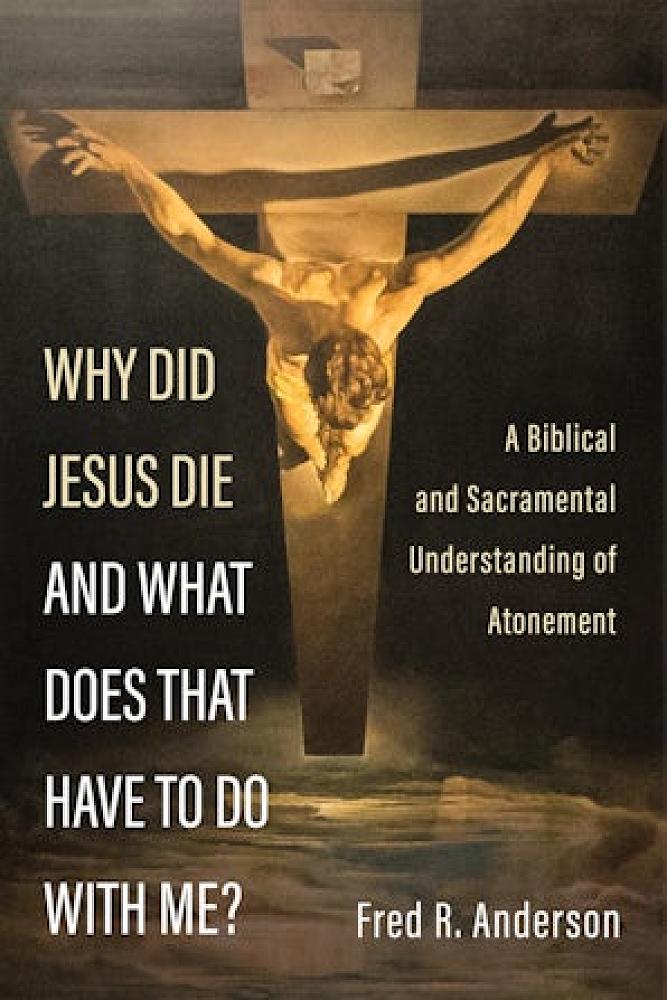
Book Review: Why Did Jesus Die and What Does That Have To Do With Me? A Biblical and Sacramental Understanding of Atonement.
FRED R. ANDERSON, EUGENE, OR: WIPF & STOCK, 2022. XVII + 330 PP. ISBN 978-1-6667-5099-7.
This is a smorgasbord of a book, covering as it does such topics as the biblical accounts of the Lord’s Supper, the development of the sacraments of baptism and Holy Communion through the church’s history, the meaning of sacrifice in the Old Testament, and the New, an overview of theories of atonement from the post-apostolic period until today, as well an examination of the Genesis accounts that show why atonement is needed, and a brief account of the development of Israel’s covenantal relationship with God.
Anderson’s main argument as regards atonement is that the death of Jesus is in no way a matter of taking punishment for sin, or taking our place, nor it is to be understood as payment to God, or propitiation of a wrathful God. Rather the atonement is an expression of God’s love for us, as in Christ, God absorbs into Godself sin and death in order to purge, extinguish, eradicate and take them away (see 214, 222). Jesus’s sacrifice was his voluntary self-offering of himself to God to deal with sin (118). Anderson is particularly concerned with rejecting penal substitutionary atonement (a theory that became fully formed in the Reformation period) and a view of salvation which is expressed as “accepting Jesus as my personal saviour so I will go to heaven when I die.”
In the first chapter, “The Question”, Anderson lays out a series of questions about atonement and salvation through Jesus’s death that he will address in the remainder of the book. Then he states for whom the book is intended (it is mostly directed at pastors, church leaders, and laypeople, as well as “agnostics” and those who have left the church). He writes about the language he uses, especially non-gendered language for God. And finally he provides quite an extensive autobiography of himself.
Chapter Two’s heading is “Where to Begin?” Anderson begins with the Last Supper. This is important because he sees the death of Jesus as a new Passover, and he will return to this theme later in the book. Anderson surveys the accounts of the Last Supper in 1 Corinthians and the Synoptic gospels (Anderson also treats the eucharistic imagery of John 6), making the point that the Lord’s Supper is a “participatory commemoration” (27). This is important, as Anderson understands salvation to involve participation in the death of Christ. Furthermore, the sacraments, both baptism and Holy Communion, have an important place in his argument. However, this chapter ends with a discussion of the meaning of kaphar/kippur (variously meaning “to wipe, cover over, expiate, or purge). Anderson makes the point that kaphar is a place–the “mercy seat” (kapporeth) or better, “the place of atonement” on the ark of the covenant. He also states that sacrifice in ancient Israel was not for the purpose of appeasing or propitiating God but to purge and purify the people from sin.
In Chapter Three, Anderson looks at the meaning and development of ideas about baptism and the Holy Communion in the church over the centuries. He discusses baptism as growing out of Hebrew rites of purification, but sees Christian baptism as a much broader experience of being united with Christ in death, putting on Christ, and receiving the Spirit. His discussion of Holy Communion, the Eucharist, or Lord’s Supper includes discussion of the understanding of what happens to the bread and the wine in the sacramental ritual, including reformation debates about transubstantiation, consubstantiation, the “real presence” of Christ, and more modern discussions such as that found in the WCC document, Baptism, Eucharist and Ministry. At heart the Lord’s Supper is “sealing the forgiveness of sins [offered] to the world in Christ”, a participation in the salvation it promises, and “God’s means of nurturing us with Christ and maturing us into Christ” (65–66).
Anderson then turns to the question of why we need atonement (Chapter Four), surveying the story of the creation and “the fall” of humans in Genesis 1–3. The nature of sin is seen as the grasping after, or desire for, power and control away from the authority of God. Human disobedience leads to the inability to distinguish good from evil, “or confusing one for the other” (81).
Anderson next examines sacrifice in the life of ancient Israel, describing the various types of sacrifice. All types of sacrifice were a means of “providing closer communion between God and God’s people” and so were all at some level a sacrifice of atonement, “a means of entering God’s holiness and presence on God’s terms” (102). The biblical witness never saw sacrifice as the way to placate or propitiate an angry deity, rather “[s]acrifice was a means of rejoicing in God’s presence, giving thanks for God steadfast love and forgiveness in the face of disobedience when one had somehow violated or fallen short of God’s stipulated expectations for being a member of God’s people” (106).
Turning to the “New Testament Application of Sacrifice to Jesus” (Chapter 6), Anderson makes the point that Jesus is never spoken of in the Gospels as a sacrifice, and if Jesus is a “scapegoat” [Tyndale’s term for the goat Azazel] it is important to remember that the goat was not sacrificed but carried away Israel’s sins. Anderson discusses the use of the Greek noun hilasterion and the related term hilasmos, stressing that these mean “expiation” rather than “propitiation”, and that hilasterion it is best understood as “place of atonement”, so that Jesus is the “locus” where sins are removed, enabling reconciliation with God. It is important to remember that other uses of sacrificial language in Hebrews and Paul are largely metaphorical, and concern Christ’s reconciling work, done in conjunction with God.
There follow four chapters that deal with various theories of atonement that have developed over the centuries, beginning with notions of ransom, satisfaction of God’s honour, recapitulation (“God in Christ doing over, improving, and expanding humanity into the fullness of God’s intentions”, 138), the model of Jesus as a moral example, through to the development of penal substitutionary atonement under “Dutch Calvinist successors” of Calvin (149). Various Enlightenment and twentieth century writers on atonement are surveyed, some supporting sacrificial and substitutionary views, others taking other approaches (I found Anderson’s summary of Moltmann’s understanding particularly compelling). Anderson concludes (Chapter Ten) by outlining the feminist-liberation theology perspective of Kathryn Tanner.
Anderson’s final three chapters (Eleven to Thirteen) deal with what God in Christ has done for us, and what this means for us. Here Anderson returns to the Last Supper as a new covenant for the forgiveness of sins. The death of Jesus (and his resurrection) act as a new Passover, which opens up a new exodus to a new land of promise and a new humanity. Jesus dies to make a difference for all humanity, and dies in solidarity with humanity and for humanity, not in humanity’s place (see 231). We become a new creation, reconciled and brought into right relationship with God. Now we are being transformed through the Spirit into the image of Christ, and various “sacraments” or “means of grace” are ways of (continuing) At-one-ment. These are such things as hearing God’s Word and responding to it (the capital to evoke the Word/Jesus), baptism as union with Christ, remembering or entering into Christ’s death through Holy Communion, and engaging in “sacramental worship”. Finally, “[a]tonement is realized and actualized as we become one with Christ who became one with us, so that we could become one with God in him” (279, italics original).
Though Anderson’s discursive and digressive style sometimes makes the main threads of the argument get lost, or difficult to follow, this is a book that repays a close reading.
Derek Tovey is the Book Review Editor for Stimulus.