
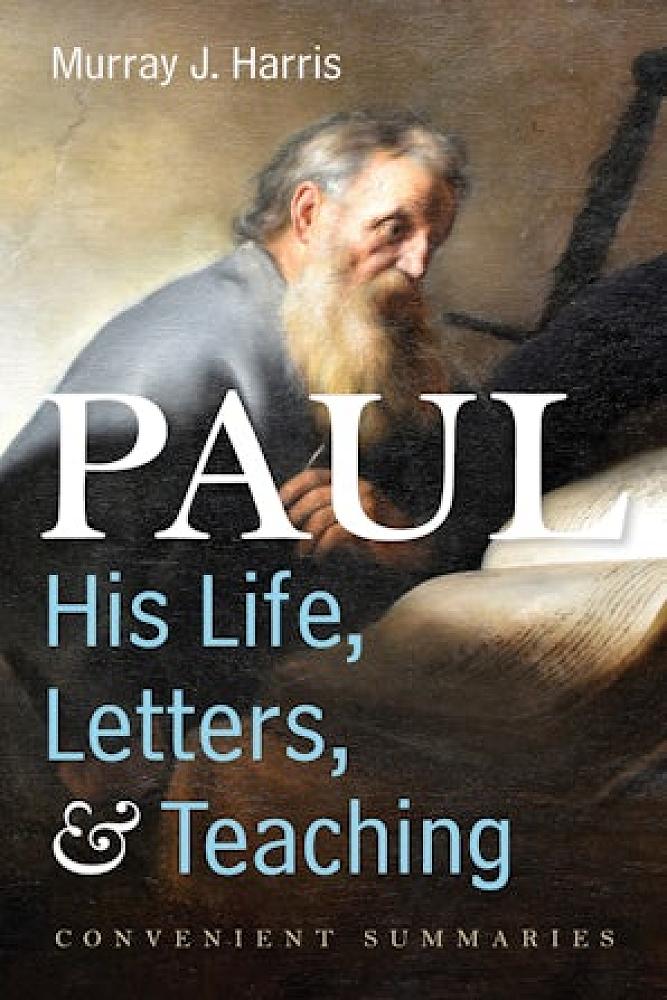
Book Review: Paul: His Life, Letters and Teaching.
MURRAY J HARRIS, CONVENIENT SUMMARIES, EUGENE, OR: CASCADE, 2022; XVIII + 109 PP. ISBN 978-1-6667-3822-3.
In his Preface, Harris writes of his many years of experience teaching in academic and church settings and says, “One thing I have learned from that rewarding experience is that students of all ages warmly appreciate a comprehensive overview (or ‘convenient summary’!) on any topic they are studying.” This was his impetus for writing the present book. As the series title suggests (and hopefully, there will be more to come), the book is a convenient summary of the life, letters, and teaching of Paul.
Aside from the front matter (including a seven-page Table of Contents), the book comprises just 109 pages. There is a brief list of abbreviations, a few footnotes and no indexes or bibliography. There are four maps, three covering Paul’s three missionary journeys and the fourth giving the route of his final journey to Rome. Apart from the opening paragraph of the Introduction, every paragraph is numbered, and this numbering down to three levels is included in the Table of Contents.
Part One is an Introduction (1–13) that comprises two main parts: the sources for reconstructing the life, letters and teaching of Paul (1–10), and a suggested chronology of Paul’s life and letters taken from F. F. Bruce’s Commentary on the Greek text of Acts (11–13).[1] The sources are the Acts of the Apostles, written by Luke, Paul’s travelling companion on some of his journeys, and all thirteen of Paul’s letters.
Part Two (14–67) is the major part of the book covering the “Life and Letters of Paul.” Harris divides Paul’s life into seven parts, from his birth to his conversion (AD 33) and his release from house arrest in Rome (AD 62–64/65). In around fifty pages, he surveys Paul’s life that he reconstructs from Acts, interspersed with information about the letters that relate to the events Acts recounts. For example, pp. 30–38 cover Paul’s second missionary journey from Acts 15:36–18:22. He sets out the route the journey covered (with a map on p. 31), gives a few brief highlights, lists Paul’s travelling companions, and then gives one or two paragraphs on significant events that took place at the various towns and cities Paul visited. He concludes this summary of the journey with a discussion of the Thessalonian letters. By comparing 1 Thess 1:1 and 2 Thess 1:1 with Acts 18:5, Harris proposes that both these letters were written from Corinth in AD 50.
Harris’s reconstruction of Paul’s final years is interesting. On pp. 58–61, he proposes that Paul was released from house arrest in AD 62 (see Acts 28:30; 2 Tim 4:6, 17–18) and spent two to three years in “undisclosed movements in the eastern Mediterranean, especially the Aegean Sea, and possibly a visit to Spain” (58). During that time, Paul wrote the Pastoral Epistles (1 Timothy, from Macedonia, possibly in AD 63, Titus, perhaps from Ephesus, also in AD 63,[2] and 2 Timothy, from Rome [2 Tim 1:17], probably in AD 64, “shortly before his martyrdom”). He is uncertain about the visit to Spain, although he sees it as a distinct possibility from Clement’s comment that Paul “reached the extreme West” (1 Clem. 5:7)
This Part ends with two brief discussions. He considers Paul the missionary statesman, listing several features of Paul’s missionary strategy that were normative for him but not for others, as well as those that are normative for all believers. The second discussion lists four low points in Paul’s career, noting how, in three of these, “God the Father or the Lord Jesus intervened directly to bring the needed comfort and strength” (67).
Part Three (68–109) is a forty-page summary of the teaching of Paul, clearly the fruit of Harris’s many years of reflection on Pauline theology. It has twice as many footnotes (14) as Parts One and Two combined (7), several of which are to his own works. After a summary of the sources of Paul’s theology, Harris embarks on a 13-page examination of his theology of the Godhead (69–80). He considers the Trinity, God the Father, the person and work of Christ and the work of the Spirit. His summary of the work of Christ is one of several succinct statements in the book (endorsing both penal substitution and Christus Victor):
As the result of Jesus’s bearing of God’s wrath against human sin in the place of sinners and as an act of propitiation, God declares believers in Jesus to be righteous in his sight, the principalities and powers are defeated, the universe is reconciled to God, and sinners receive the forgiveness of sins and are adopted into God's family as his sons and daughters (77).
Following this, Harris deals with Paul’s theology of humanity, the church, Pauline ethics, and (individual, but not cosmic) eschatology (13 pages in length, including a (somewhat intrusive) comparison of Paul and Plato on immorality drawing on an earlier work).[3] He proposes that the final state of the unrighteous is “[e]ternal retribution” rather than annihilation (97–98), and he summarises the final state of the righteous with six adjectives: embodied, localised, personal, corporate and active, permanent “enjoyment and service of God forever” (99). Following this are brief discussions of Paul and the law (where he affirms “reacting nomism”, along with “acting legalism,” 100), Paul and Israel (giving the translation options on Gal 6:16 and Rom 11:26, but not expressing a preference), Paul and Jesus, and the development in Paul’s thought. He concludes with fourteen modern images of Paul (106–7), and a brief discussion of the centre of Paul’s teaching, which he proposes is “God the Father’s salvation accomplished through his son Jesus Christ the Lord and applied by God’s Holy Spirit” (108). Moreover, Paul is to be seen as “the herald of God the Father’s gracious salvation through Christ” (109).
I read this book while I was reading slowly through Acts, as well as preparing three sermons on different chapters from Acts. True to its description, it proved to be a convenient summary. I opened it several times, finding the maps to be particularly useful (although the printing quality could have been better).[4] This is not a book to sit down and read; it is a reference book that students and pastors working with Acts and Paul’s letters would refer to often. Having said that, however, there were several times when I longed for an alphabetical Index of Subjects at the back. The Table of Contents partially fulfils that function, but an Index would have added to the book’s usefulness.
Philip Church is a Senior Research Fellow in the School of Theology, Laidlaw College.
[1] F. F. Bruce, The Acts of the Apostles: The Greek Text with Introduction and Commentary (Grand Rapids: Eerdmans, 1952). Bruce was Harris’s doctoral supervisor.
[2] Did the Ephesian church leaders see Paul’s face again, after all (Acts 20:25, 38)?
[3] Murray J. Harris, Raised Immortal: Resurrection and Immortality in the New Testament (Grand Rapids: Eerdmans, 1985), 201–5.
[4] They are reproduced from the Holman Book of Biblical Charts, Maps, and Reconstructions (Nashville: Broadman and Holman, 1993).