
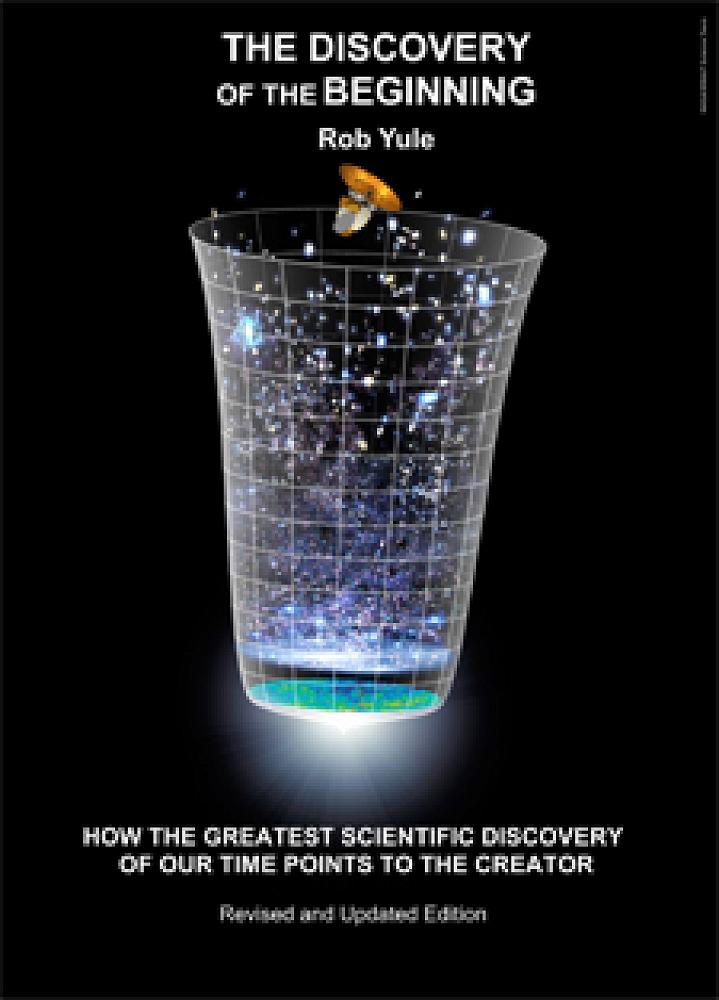
Book Review: The Discovery of the Beginning.
ROB YULE, AUCKLAND: CASTLE, REVISED AND UPDATED, 2023, 46 PP. ISBN 978-0-473-69055-7. $9.95.
This is a gem of a book. In just thirty-five pages Rob Yule surveys the past century of cosmology and, with it, the scientific discovery that the material history of the universe traces back to a singular point in time, that of the ‘Big Bang’, before which time, space and matter did not exist. As the author states – “all other controversies between science and religion are trivial when compared to the concept of a beginning”. A beginning implies a Beginner.
Science has long recognised that all things within the universe are contingent. Science has now come to understand that the universe itself is contingent and finite. Its causal origin lies outside of this universe and that, the author states, tallies with the first sentence of the Bible “In the beginning God created the heavens and the Earth”.
Yule is a theologian not a scientist, but this brief survey of cosmology covers all that needs to be stated with an accuracy and clarity that will be accessible to all readers. It is a complex field, but Yule has got a firm hold of the events, ideas and discoveries leading up to our present understanding of the universe. The achievements in physics and cosmology are simply astonishing. Humankind, standing on the surface of planet Earth, aided by a few instruments and the power of mathematics, has been able to trace cosmic history back to the first moment of the Big Bang. This history includes the formation of fundamental particles, the assembly of atoms and molecules, the formation of galaxies and the ignition of stars, the generation of heavy elements in those stars as they age, and the formation of the heaviest of elements in the collision of neutron stars. All these events have left their imprint on our universe which scientists have finally been able to decipher and assemble into one grand narrative. It is a narrative that relies on an incredibly fine balance of all components – our universe is astonishingly improbable. And there, at the singular moment where this narrative begins, we have the ultimate question mark – what or who was the cause of that beginning and of that fine, knife-edge balance. Yule quotes St Augustine: “We look at the heavens and the Earth and they cry aloud that they were made” (2).
The story starts, of course, with Einstein whose theory of General Relativity inevitably implies a universe which is expanding outwards from a singular beginning. The astronomer Edwin Hubble, by studying the retreat of distant galaxies, confirmed that expansion. The discovery in 1965 of the remnant radiation of the hot Big Bang in what is called the cosmic microwave background (CMB) essentially clinched the truth of the Big Bang hypothesis. Much of the rest since then has merely been tying up loose ends and placing astonishingly accurate bounds on key numbers such as the age of the universe (13.72 ±0.02 billion years).
Cosmology is complicated, but the reader need not be anxious about that. The author tells his story in straightforward, easy-to-understand ideas. What is most interesting is the shift in viewpoint of some of the protagonists. Some, like Fred Hoyle, were firmly against the very idea of a beginning to the universe – he could see the potential religious ramifications and he was a staunch atheist. Not only did he eventually accept the idea of Big Bang cosmology (he actually invented the term) but he shifted over time to a deist view of creation. Hoyle’s expertise was in the synthesis of elements in stars, and it was he who discovered a remarkable coincidence that enabled the stellar synthesis of carbon, without which, of course, life could not exist. In light of this he famously stated: “A common sense interpretation of the facts suggests that a super intellect has monkeyed with physics, as well as with chemistry and biology, and that there are no blind forces worth speaking about in nature” (11).
Thorough, well-researched and accessible, this booklet has as appendices a timeline of key dates over the past century, a glossary of terms and an extensive bibliography for those who want to read further. There are many books on this subject, but Yule’s Discovery of the Beginning compellingly points us to the Beginner and provides a short introduction to what is a big subject which can be read in an evening. Are there gaps in the narrative? Of course in a short booklet, and inevitable for a layperson – but very few. That timeline could have included the launch of the Hubble Space Telescope in 1990 and likewise the launch of the James Webb Telescope in 2021 – both of which have produced spectacular images of galaxies at the very edge of the observable universe.
The subject also warrants a discussion of the so-called ‘multiverse’ – an attempt to account for the unlikely fine balance of our own universe. The idea here is that, if multiple universes could spontaneously pop into existence one after another, then within an infinite set of universes one, or even many, will surely have the fine-balanced conditions that we see in ours. There are problems for the multiverse narrative. It is not yet clear that the theory will work. And then a theory does not create a reality. Stephen Hawking nicely articulated this when he wrote “what is it that breathes fire into the equations that makes a universe for the equations to describe?” Further, it is not yet clear whether a ‘multiverse generator’ needs in fact to be more fine-tuned than the fine-tuning of our universe that it seeks to explain.
Yule finishes his book with a chapter entitled “A beginning points to a Beginner”. It is an excellent conclusion full of marvelous quotes from some of the scientists who contributed to the discovery of ‘the beginning’. Here is one from Arno Penzias who co-discovered the CMB: “Astronomy leads us to a unique event, a universe which was created out of nothing, and delicately balanced to provide exactly the conditions required to support life. In the absence of an absurdly improbable accident, the observations of modern science seem to suggest an underlying, one might say, supernatural plan” (30). Yule concludes: “at a time when most twentieth century theologians had given up on natural theology, when many Christians had turned their backs on science, and when popular Christianity has emptied faith of reason and evidential support, it is a supreme irony, a truly master stroke, that God should pull creation from His left sleeve and use science to win Himself praise” (35).
Jeff Tallon is Professor of Physics, Victoria University of Wellington.