
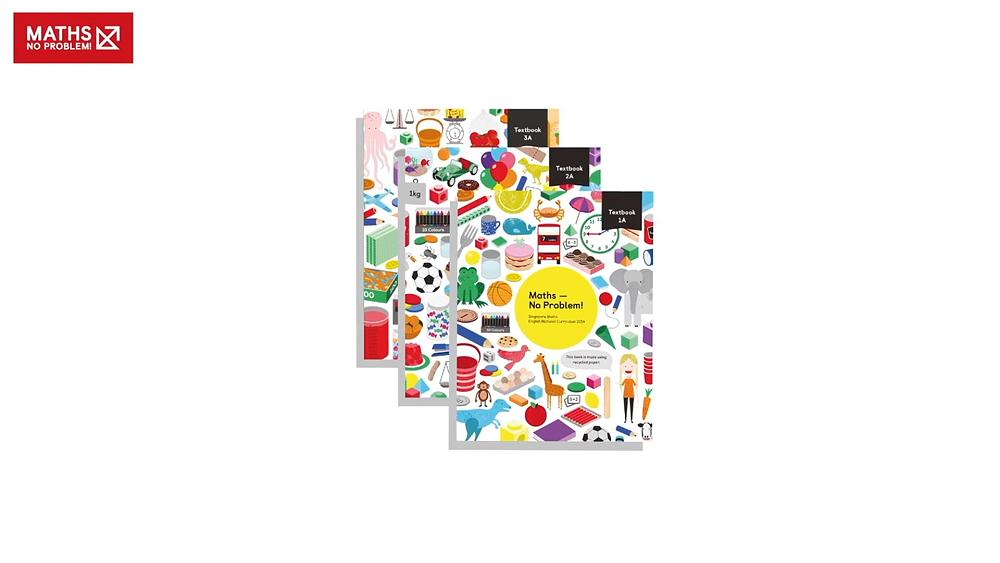
Introducing Maths No Problem
This year, we have adopted a new Mathematics programme to help us implement the new Refreshed Mathematics and Statistics Curriculum. The programme is called Maths — No Problem! Below is an outline of the approach including what the programme may look like in the classroom and what you can do at home to support your child's maths development.
What will be different ?
We will use lots of equipment (cubes, ten frames, number discs) to explore word problems.
Tasks are designed to be accessible to all learners. The whole class will learn the content together, with built in extension opportunities for advanced learners to develop a deeper level of understanding and continually be challenged in every lesson.
Each lesson carefully builds on the previous one, creating small steps to build a mastery level understanding of concepts and confidence.
Every lesson has opportunities for the students to work collaboratively and independently.
The collaborative components help develop your child’s ability to effectively communicate their mathematical thinking and further develop their ideas through conversation. The independent components help your child consolidate and apply the concepts they have been learning during the lesson.
We will challenge children to use a number of methods to show that their understanding of a concept is in-depth. Multiple representations help students develop an understanding of the relationships mathematical concepts have to each other and will build their critical thinking skills.
For advanced learners, rather than getting them to do more of the same, we want to enrich their understanding of a mathematical concept by providing them opportunities to explore a concept in more depth. Opportunities for enrichment are built into every lesson and are an expectation for the students every lesson.
Built on research, the maths problems are carefully chosen and subtly varied as they move through the lesson. Each example challenges and further develops the student’s knowledge and understanding, providing a strong foundation.
All concepts are covered in depth, including both number, geometry and statistics. It meets all the requirements of the New Zealand curriculum with opportunities to go beyond them at all year levels.
What does MNP look like at home?
Ask lots of questions. Instead of telling children if they got the answer correct or not, help them develop the skills to check for themselves: 'How do you know?', "I'm not sure how to do it, could you explain it to me?" 'My friend thought this, would that be helpful?’ ‘What do you notice about... ? What's the same and different about... ? Do you agree with... ?
Build your child’s confidence in maths by encourage productive struggle and viewing mistakes as valuable learning opportunities. Making mistakes is an important part of developing problem solving and thinking skills in mathematics.
Help your child develop critical thinking skills: Uncle says that you need to... do you agree with him? Why? Why not?
Encourage your child to demonstrate their understanding in a variety of ways - explaining or orally, making a physical model, making a visual model.
Encourage your child to think of their own word problems using every day contexts within the home and local community
Playing games, particularly card games, is great for helping with maths. They don’t have to be number-based, as most games ask children to follow rules –
look for patterns, make connections and match things – which are all important mathematical skills. And they are FUN!
Ask your child to ‘show’ you how to solve a problem related to the activities they are doing at school. Pretend that you don’t understand as you did it differently when you were at school. If they get stuck, try and give them an opportunity to work it out themselves by offering helpful hints rather than showing them ‘how you might do it’.