How do we represent and use mathematics on a daily basis?
The importance of being explicit in the ways we use mathematics in our daily lives will allow children to not just view mathematics as something you do at school but rather something you need for life.
I use the term Maths Eyes on a regular basis as well as asking myself - "What is the meaningful and purposeful mathematics?" You like me may well have sat through mathematics at high school and wondered when you might ever use some of the thinking and ideas. The Theorem of Pythagoras takes on new meaning if you are a builder, surveyor, farmer, fencer to name a few occupations - little did I know!! I often wish I had been taught maths the way we are teaching today with emphasis on purpose and relevance instead of relying on a good memory and rules.
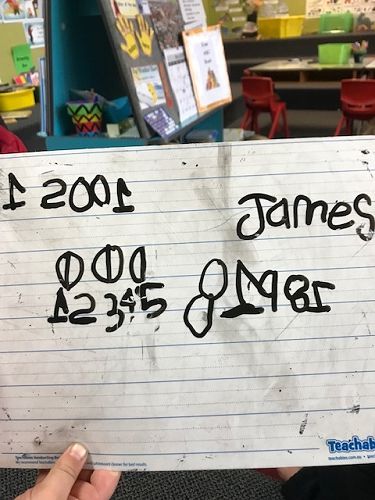
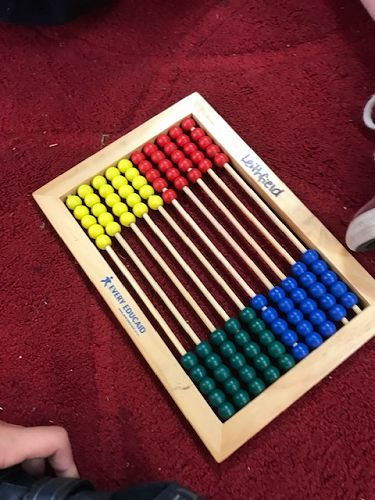
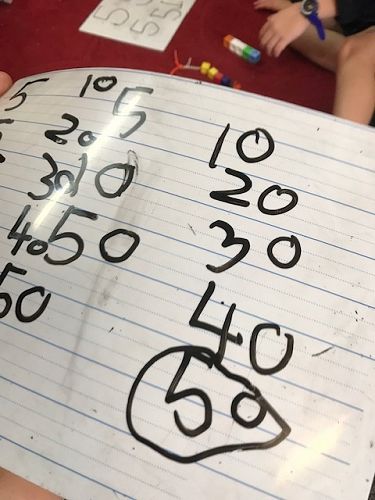
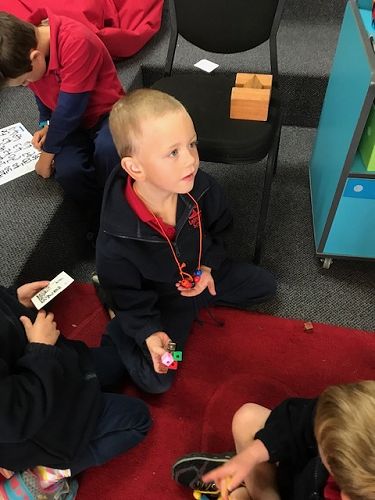
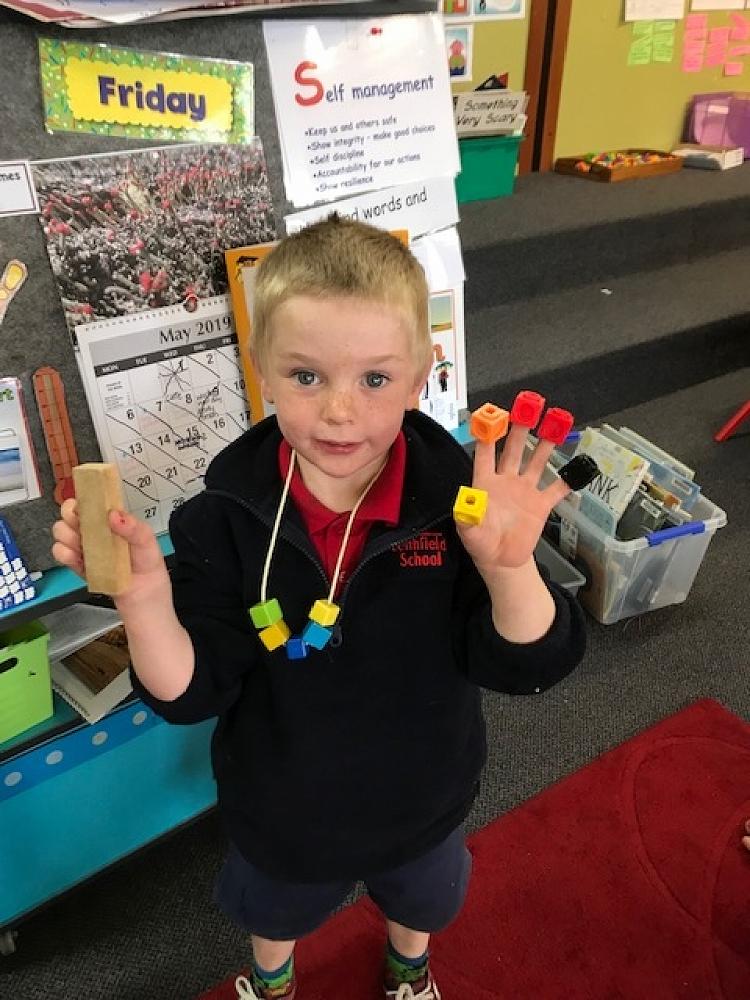
Children learning about numbers must be exposed to many different representations. In the photos Kiwis have developed their understandings of five in different ways. Callum and Dev are showing us five fingers, a five necklace, and a block that is five cubes long. James has shown five using his name that has five letters along with circles showing five halves. The children had a great deal of fun identifying the children in Kiwis whose names have five letters - Lucas, James, and Louis, An extension of our 5 thinking has included 50. Hunter has used the bead frame to show 50 as groups of 5. Children are also beginning to develop an understanding that 50 is also 5 groups of 10 - 10,20,30,40,50
The concepts associated with proportional thinking - fractions, sharing, division, decimals and percentages have been identified by Year 9 Mathematics teachers as an area of weakness. It is never to early to begin to utilise the concepts of sharing and fractions - children very quickly understand the need to have equal shares to make it fair. Understandings associated with percentage and an Ipad or phone being charged make percentages very relevant indeed.
I challenge you all to have the mathematical conversations with your children. That way it will become relevant and useful. Mathematics is a gate keeper subject - all children have the ability to understand and apply their thinking with your help and enthusisam
Sue Graham
Gallery