Parihaka Day- November 5th
Do you know the story of Parihaka?
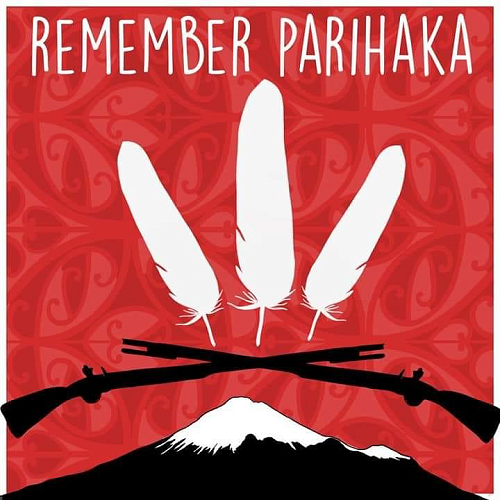
Tuesday 5th November is an important day of remembrance in our country. On the 5th of November, 1881, 1600 armed constabulary and volunteers took part in the invasion of Parihaka, a settlement in Western Taranaki which had become the symbol of protest against the confiscation of Māori land by British invading forces and become of concern to the government as a possible site for the reignition of Māori opposition to pākeha 'progress'. The invasion was led by then native minister John Bryce who had previously described Parihaka as 'that headquarters of fanaticism and disaffection’.
As they entered the village more than 2000 inhabitants of Parihaka sat quietly on the marae while their children greeted the force with waiata. They were given food, their horses were watered. They faced no resistance from those they arrested.
Leaders Te Whiti-o-Rongomai and Tohu Kākahi were arrested without trial and exiled from Parihaka for 16 months. During this time they were taken on an enforced tour throughout the South Island, designed to demonstrate the 'progress' and 'power' of pākeha society. They were reportedly entirely unimpressed by what they witnessed.
In the aftermath of the invasion, the prosperous village of Parihaka was systematically razed, homes were looted and burnt, crops destroyed and livestock slaughtered.
The people of Parihaka were forcibly driven out and left homeless, facing a bleak future of extreme hardship, the settlement was virtually wiped out of existence; maps were redrawn and history was redefined in the attempt to obliterate the memory of the invasion of Parihaka and the mistreatment of its inhabitants.
Many of the women and children of Parihaka had no option but to follow those arrested to Ōtepoti/Dunedin.
21 of those taken from Parihaka died in Ōtepoti, forced into labour and buried in unmarked paupers graves in the northern cemetery.
Te Whiti and Tohu were allowed to return to Parihaka in 1883.
“Just as night is the bringer of day, so too is death and struggle the bringer of life”
- Te Whiti o Rongomai and Tohu Kākahi
This has been shared by:
Mel Jewiss
Kaihoe Mātauraka
Te Arahou Māori Achievement Collaborative (MAC)
(Mel was formerly the Principal of Portobello School and Halfway Bush School before that)
Have you driven past the Rongo Stone at Andersons Bay and wondered what it is about?
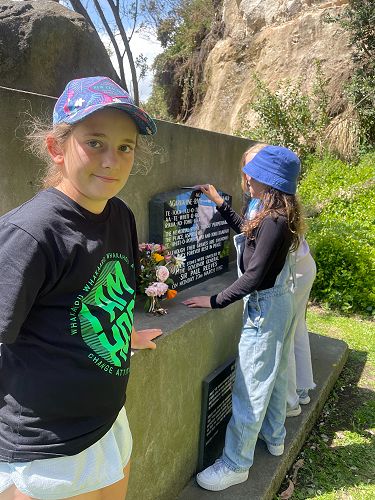
Last year a group of our tamariki did a hikoi (walk) to the Rongo stone at Anderson's Bay as part of a local history research project they had been doing. Every year on November 5th there is a commemoration for the prisoners from Taranaki and Parihaka that worked on the stone walls and roads around Dunedin between 1869-1879.
We plan to hikoi to the Rongo Stone again next year!
Gallery