
What to do about the Blue Cod in the Marlborough Sounds
Year 12 students and Environmental Sustainability students Amelia Boyce and Jess Beamsley have been busy researching about the decreasing number of Blue Cod in the Marlborough Sounds.
Read about their findings in the article below. There is also a link to hear your feedback and thoughts on the article.
In our Environmental Sustainability class at Marlborough Girls College we have been researching the health of the blue cod population in the Marlborough Sounds, and we found the results disheartening.
We discovered that blue cod are being fished far quicker than the reproduction rates of the species, and they can’t keep up.
Overfishing of blue cod has been a relevant issue for a long time. Between 1995 and 2001, blue cod stocks in the Marlborough Sounds decreased by one third to a half due to recreational fishing pressure.
Throughout our project, we were lucky enough to talk to Eric Jorgensen, an expert in Blue Cod and associated fishing issues. He described the blue cod fishing conditions in the Marlborough Sounds as “a race to catch the last fish if we don’t take different actions than those used to date”.
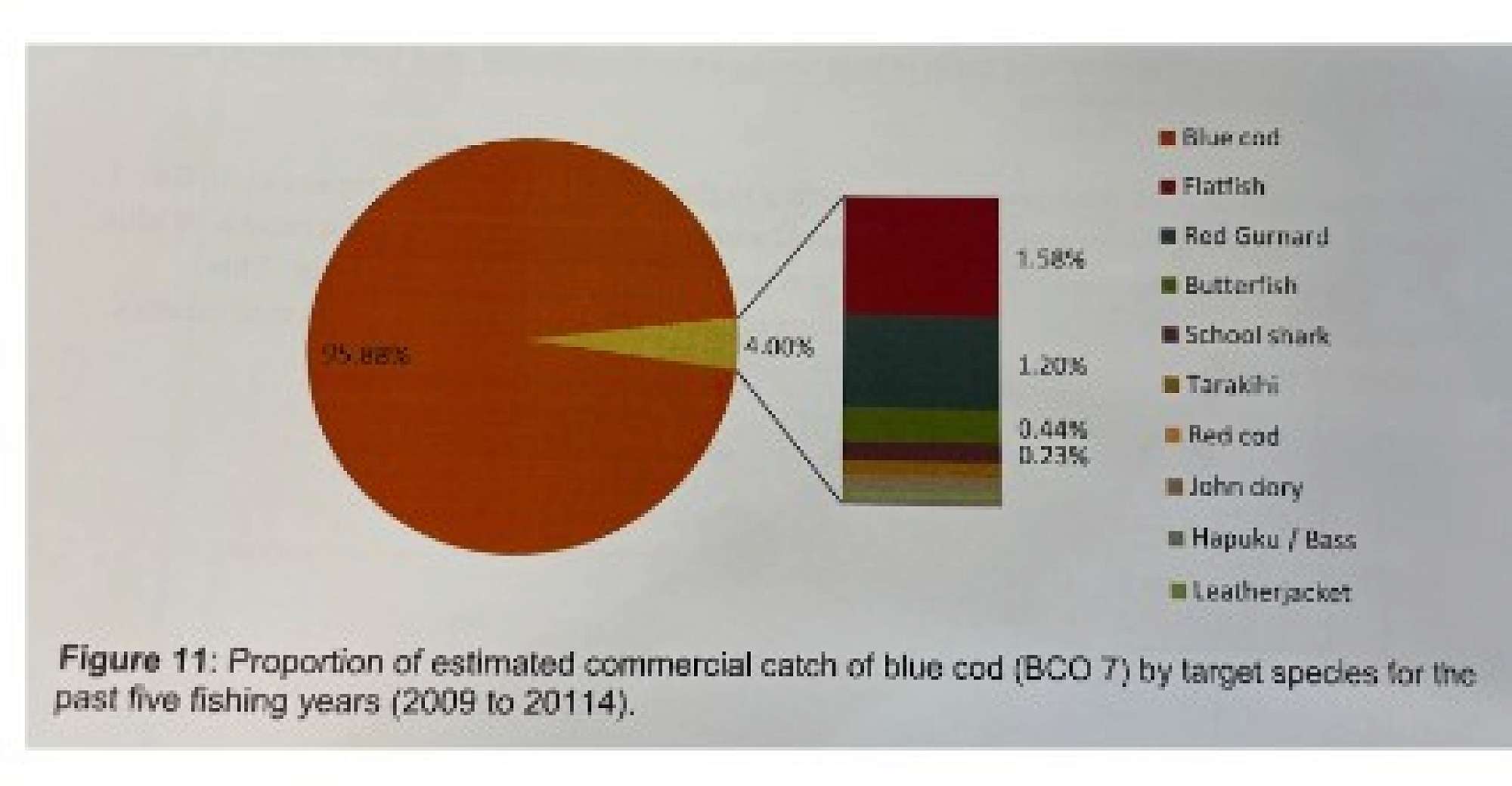
This graph shows almost 96% of reported commercial catch of blue cod has been taken by the blue cod targeted fisheries within 2009-2014. The other 4% is bycatch of 9 other targeted fisheries, which include Flatfish, Red Gurnard, Butterfish, School Shark, Tarakihi, Red Cod, John Dory, Hapuku and Leather Jacket. Shown from the graph commercial fishing catches a lot of blue cod, however they do have strict limits on the amount they are able to catch unlike recreational fishers who have a combined maximum daily bag limit of 20 for finfish.
Blue cod, not actually a cod but a type of perch, are territorial fish that do not stray far from their established habitat. They are capable of changing sex. They are opportunistic feeders, meaning they will eat practically anything that comes their way. This, combined with being territorial, make the species especially susceptible to overfishing.
We also found that there are multiple stressors on the blue cod population that have contributed to the depletion of the species. These include climate change impacts, sedimentation, dredging and loss of habitat, however evidence points to the main cause of depletion of blue cod in the Marlborough Sounds being recreational fishing.
As well as the catch levels, a significant impact of recreational fishing impacts on the blue cod fishery is the removal of dominant (large), typically male fish. The removal of dominant males prompts the sex change among the females. Over 50% of the female blue cod in a group will change sex to make up for the lost male. One survey conducted in 2021 found that 76% of the blue cod sampled were male. This uneven ratio is harmful as it hinders breeding.
We are seeing that blue cod in many areas are being heavily fished with sizes decreasing and males dominating the fishery. This means the productivity and reproduction of blue cod is decreasing, as smaller fish and fewer females have fewer eggs, and these are less likely to survive (lower fecundity). .
Another significant way recreational fishing impacts blue cod is by generating “other mortality” especially of fish needing to be returned to the sea, the majority of which is undersized fish. It is estimated that about 40% of all returned fish in the Marlborough Sounds could be falling victim to predation from species like barracuda and shags, and that’s not counting the fish that die from injuries from hooks. Other estimates are that 4 Blue Cod are caught for every one retained. This represents a significant number of fish being removed from the fishery and prevented from breeding, that are unaccounted for.
.
So what can you do about it? As a recreational fisher you can:
Learn to use circle hooks. They are more likely to effectively hook the fish in the mouth, and due to their size and shape are not likely to be swallowed or left in the fish, allowing fish to be returned unharmed. Importantly, do not ‘strike’ when getting bites.
Stop targeting blue cod. Utilise the many other species available in the Marlborough Sounds such as snapper and gurnard (which there happens to be an abundance of at the moment) - there’s plenty of other fish in the sea.
If you’re out fishing and constantly catching undersized fish, move to a different fishing location.
When returning undersized fish to the ocean, distract nearby shags. For example you could make a throwing motion and splash in the opposite direction before lowering the fish into the water quietly.
Stop fishing for the day once you have a feed, mortality of returned fish is a major issue.
Other potential solutions to this problem include initiatives that can be applied by authorities such as the Ministry of Fisheries. These could include the implementation of rotational bans on blue cod fishing throughout the year, an extension of the September - December ban (to account for the influx of blue cod fishers due to tourists and the holiday season) and longer term closures of important habitats to fishing. Between 2008 - 2011 a ban on recreational blue cod fishing in the inner Marlborough Sounds (the area most popular among recreational fishers) was put in place. This had a significant impact: (even after three years, it was lifted one year early), and for the first time since 2001, blue cod were larger and more abundant in the inner sounds than the outer sounds. This demonstrates the impact that fishing has on the inner sounds and is evidence of how a ban on blue cod fishing for an extended period of time can help improve stocks and length. However it was found that as soon as the ban was lifted blue cod numbers quickly dropped again.
This poses the question: would you support a short term ban on Blue Cod fishing while more comprehensive solutions are developed and put in place like identification of
important habitats for longer term closure?
We would love to hear your feedback and thoughts on this article. Please help us out by completing this survey: survey
“Don’t fish for a freezer, fish for a feed”