Structured Literacy - How does reading effect the brain?
Learning to read is hard work!
The Science of Reading Basics, Part 1: The Reading Brain
Which parts of the brain are involved in reading?
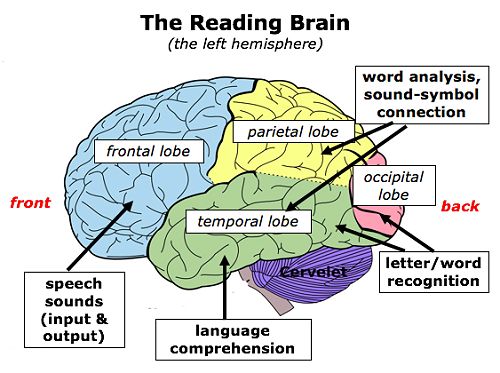
There is no specific place in the brain that we use to read. Reading involves multiple processes that tap into different regions of the brain.
- The parietal-temporal region (towards the back) which does the job of breaking a written word into its sounds (i.e., word analysis, sounding out words).
- The occipital-temporal region (at the back) where the brain stores the appearance and meaning of words (i.e., recognising letters and words and language comprehension). This is critical for automatic, fluent reading so that a reader can quickly identify words without having to sound each one out.
- The frontal region (at the front) which allows a person to speak (i.e., processing speech sounds as we listen and speak).
Many different parts of our brains need to work together to be able to read fluently and accurately.
The Brain Changes as We Learn to Read
Every child’s brain has to change the way it functions as the child learns to read. Direct instruction and practice at school and at home has been proven to “train” the regions in the brain to learn to read.
Beginning readers show more activity in the parietal-temporal (the area of the brain that breaks down words in to individual sounds) region while more experienced readers become increasingly active in the occipital-temporal (instant word recognition) region. Areas of our brains are physically changing and strengthening every time we read!
Can we rewire the brain through instruction for early and struggling readers?
The good news for early and struggling readers is that their brains will “rewire” themselves if reading instruction is provided that explicitly teaches phonological awareness and decoding skills. The brain has plasticity through our lifetime, which means our brains are able to change in order to learn new things. Experts suggest that two variables contribute to strengthening pathways in our brain to allow students to become strong and successful readers:
- Deliberate practice. Students need to hear and read many different kinds of texts as often as possible.
- Specific instruction. In order to prepare the brain for the increasingly complex texts they will encounter in school, most students need specific instruction of foundational reading skills — like phonemic awareness, phonics, fluency, vocabulary, and text comprehension.
The Structured Literacy Approach has been scientifically proven to be the most effective method of learning to read. Our brains do not have the natural ability to read, but rather need to be explicitly taught with consistent and regular practice.
https://keystoliteracy.com/blog/how-the-brain-learns-to-read/
Gallery