
Hope Amidst the Horror
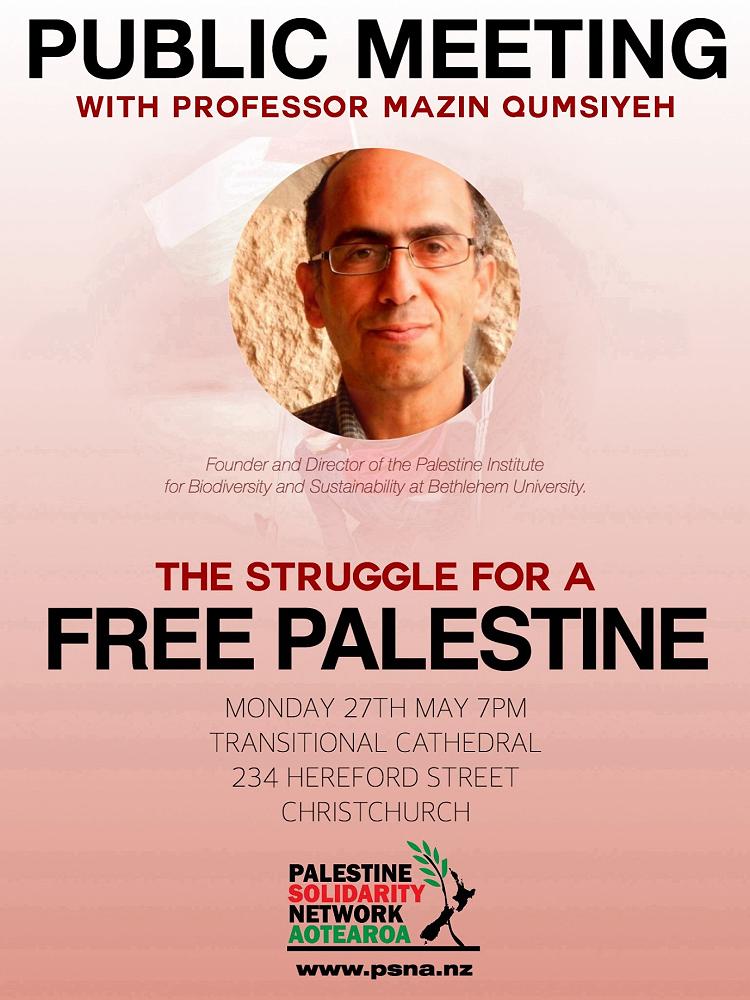
Recently Professor Mazin Qumsiyeh, a renowned Palestinian scientist and human rights activist from Bethlehem University in the Occupied West Bank, toured New Zealand.
Prof Qumsiyeh shared his views on hope and empowerment in the Middle East and explained why Israel’s war on Gaza is no solution for peace and security in the region. Working for environmental justice and for human rights is key to peace and sustainability globally.
On Monday 27 May people of all ages and ethnic diversity gathered at the Transitional Cathedral In Ōtautahi to hear Prof Qumsiyeh share insights about the current state of the middle east and its global impact. The presentation was one of many given at university campuses and community venues throughout the country over a two-week period.
During a hectic 24-hour stay in Ōtautahi, Prof Qumsiyeh delivered three lectures. He also visited the Al Noor Mosque, the scene of a terrorist attack in 2019 that resulted in the deaths of 51 people, and he met many people keen to show their solidarity for Palestinians. He and his wife were hosted by the Palestine Solidarity Network Aotearoa (PSNA). In Christchurch they were accompanied by National Chair John Minto and Will Alexander, a former Shortland Street actor, and member of the PSNA, who was nine days into a hunger strike as a protest against government inaction and its failure to take practical steps to stop the war in Gaza.
Promoted as a “safe space for all people with varying knowledge on the situation”, the presentation promised to “provide a great depth of learning and empathy for everyone”. In opening Prof Qumsiyeh expressed how honoured and blessed he was to be there, saying to the people assembled, “It would have been nice if you could have come to our place as a visitor. But I come to you from halfway around the world to share with you this journey of freedom and liberation and to talk about what is going on in Palestine. I hope you will take away memories and messages of hope from our people.”
He reiterated the importance of the Holy Land, as a sacred place for Palestinian Christians and for all people, for its geographical position as a passage for migration between Africa and Europe, its fertile land, rich in flora, fauna and many other resources, and the renowned historical significance of the region. For thousands of years. Palestinians representing multi ethnicities, cultures, races and religions lived harmoniously in the region, existing in union with the environment and the diverse people living there.
Colonisation and Ruination
The concept of creating a Jewish state in Palestine, was rejected by all when proposed. Subsequently, as with all colonised populations, the imbalance of power resulted in disaster for the indigenous population. Prof Qumsiyeh compared the history of the power shift with the genocide and violence that has occurred in many countries including South Africa, Australia and North America. The transformation of Palestine from a multi-ethnic, multi-cultural multi-religious state to a "Jewish state" has led to the destruction of human and natural communities.
Violence common to all global colonisation scenarios has unfolded in Palestine with an average of 40 Palestinians killed for every one settler. Over the past 20 years – and five wars – genocide has accelerated as the Israeli army has killed civilians in their thousands. In referring to the Hamas attack on Israel on 7 October 2023, Prof Qumsiyeh said, “In one day Israel felt the fear and violence that Palestinians have felt for 76 years.”
Slides showed graphic images of the devastation to the region and its people since 1950 - scenes of ecocide and genocide; dead children and entire families killed, wholesale civilian slaughter, targeting of journalists, the deliberate destruction of hospitals, schools and universities. Bombings of mosques, churches and significant historic structures, huge swathes of land deforested and planted with pine trees - a practice that is devastating environmentally and poses the added danger of burning – deliberately poisoning and polluting rivers and fertile farmland. Prof Qumsiyeh called the meticulous and methodical destruction “a deliberate and sustained effort to destroy the lives and livelihoods of the indigenous population”.
Prof Qumsiyeh cited examples of hope around the world where decolonisation is happening as colonisers learn to coexist, moving from genocide to coexistence. “In Palestine, we are still in the age of colonisation”. He says the most important thing is to show resistance, not violent resistance but popular, non-armed resistance. “Existence is resistance. Everything we do in Palestine is a focus on non-violent resistance. Living there, going to school, drinking the water, getting married … “
His closing message was one of hope. “Jesus was born in a place called Palestine. He was a Palestinian. He called out oppression and the oppressors. Be like Jesus and help us. Despite the suffering and the oppression, when we leave Palestine we feel like fish out of water. We are calling for a global uprising, as with South Africa. We are optimistic that this nonsense cannot go on forever. In war, nobody wins, only the cockroaches.“
Concluding the presentation, Will Alexander said, “As I listened the thought would not go away. We are being told three words; anger, hope creativity. We must transform anger into hope.“
Bio Notes
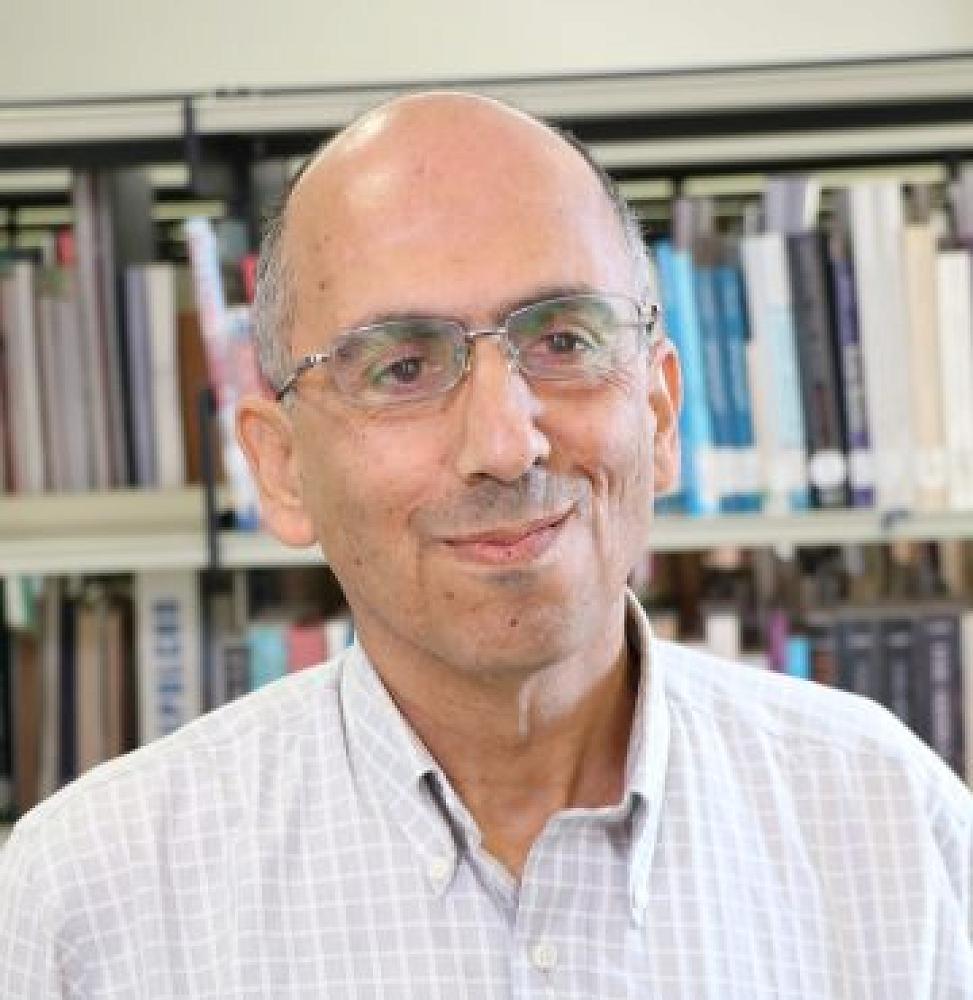
Prof Qumsiyeh is the founder and volunteer director of the Palestine Institute for Biodiversity and Sustainability (PIBS) and the Palestine Museum of Natural History at Bethlehem University (http://palestinenature.org). The entities were established to research, educate people about and to conserve the natural world, heritage and culture and to use the knowledge to promote responsible human interaction with the environment. . Prof Qumsiyeh has previously served at several US universities including Tennessee, Duke and Yale. He has published over 180 scientific papers, more than 30 book chapters, hundreds of articles, and several books.
Footnote
Will Alexander ended his 19-day hunger strike on 5 June following pleas from Palestinians in Gaza, and on advice from his doctor. Just four days later, on 9 June Israeli forces launched a vicious land and air strike at Nuseirat refugee camp on the Gaza strip. The attack that killed 274 Palestinians and wounded 700 others, freed 4 Israeli hostages. One Israeli commando was killed in the raid. For Israel, the strike bought nationwide elation. For Palestinians, it was another day of horror in a war that has raged on for 76 years and escalated over the past eight months.