
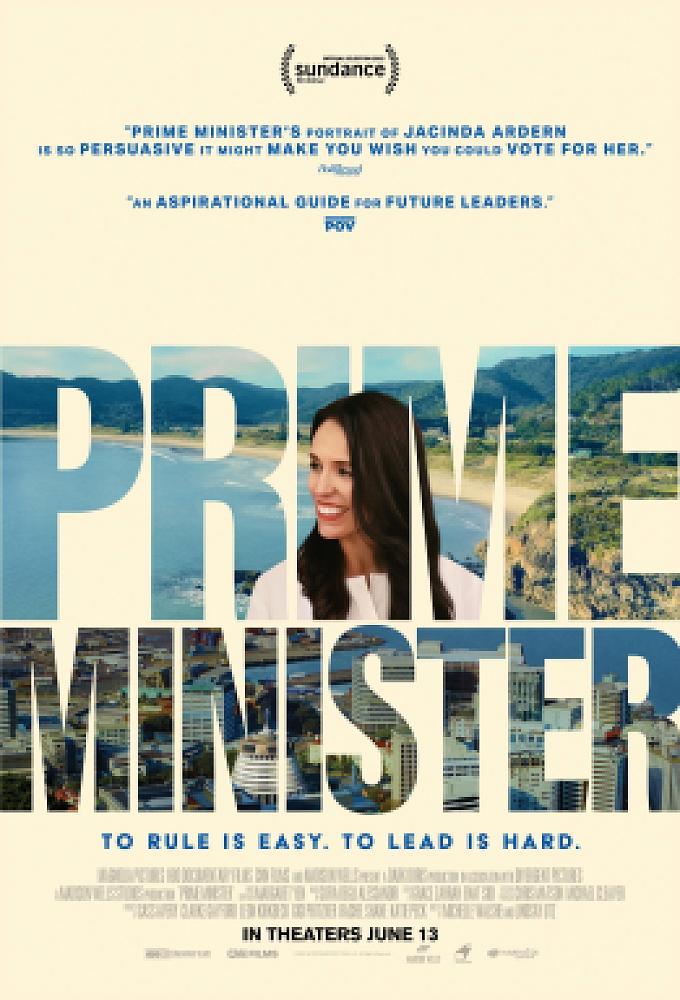
Prime Minister
Leadership is hard. Leading through a global pandemic and a nation’s worst mass shooting is harder still. Prime Minister reminds us that our leaders are human, and their families are precious.
Prime Minister has proved as divisive as Ardern’s time in politics. One online reviewer called it “the worst documentary” they had ever seen. At the other end of the scale was the Audience Award won at the 2025 Sundance Film Festival. Such polarities seem to say more about the oppositional nature of politics, amplified by the echo chambers of social media, than the quality of the documentary.
The credits feature three directors. Each makes unique contributions. Michelle Walshe brings her local documentary experience. Lindsay Utz, an American Oscar-winning editor, provides an international perspective. Clarke Gayford brings home movies of family life. “When I suddenly found myself in a position we didn’t expect, he just decided to capture it,” commented Dame Ardern at the Prime Minister’s premiere.
A key resource is oral history. Since 1987, staff at the Alexander Turnbull Library have conducted regular interviews with politicians. The New Zealand Political Diary Oral History Project provides insight into the workings of government and political events, such as general elections.
Around these recordings, the movie cleverly splices media reports and Gayford’s home movies. As a result, Prime Minister stars a family of three. Watching Ardern tell Gayford he is mansplaining is hilarious. Seeing protestors interrupt family holidays is disturbing. But it is always the Ardern/Gayford family looking out. Prime Minister has no “looking in” hard questions, analysing policy, or evaluating impact.
Instead, the movie turns to the history of Sir Ernest Shackelton’s Antarctic expedition. We see footage of Ardern admiring the lifeboat in which Shackleton sailed 800 miles to save his stranded crew.
“But when I look ahead up the white road
There is always another one walking beside you”
(T S Eliot, The Waste Land, 1922)
The use of Shackleton felt decidedly odd. Yes, the Antarctic expedition is one of the most popular case studies at the university where Ardern currently teaches. Harvard Business School offers a course on Resilience Leadership, where Professor Nancy Koehn applies insights from Shackleton’s life to teamwork and leadership.
At the same time, Shackleton’s story is one of self-induced disaster. Why use the story of a failed white adventurer who ignored the warnings of others as a narrative to frame a movie?
Curious, I searched to see if Shackleton had been a theological resource. I was surprised to find that Shackelton described invisible companions. “When I look back at those days, I have no doubt that Providence guided us … it seemed to me often … there was another person with us."T S Eliot referenced Shackleton in The Waste Land as he wrote of there being “always another one walking beside” in the bleakness of the “white road.”
Ardern does not reference invisible companions as she walks her Prime Ministerial “white road.” Instead, she has the confessional comfort provided by Gayford’s camera.
What results is an intimate account, not of prime ministerial policy but of a Prime Minister’s family. A more robust documentary of an extraordinary time in our history awaits us further up our nation’s “road.”
Rev Dr Steve Taylor researches contemporary church life as Director of AngelWings Ltd. He writes widely in theology and popular culture, including regularly at www.emergentkiwi.org.nz.