
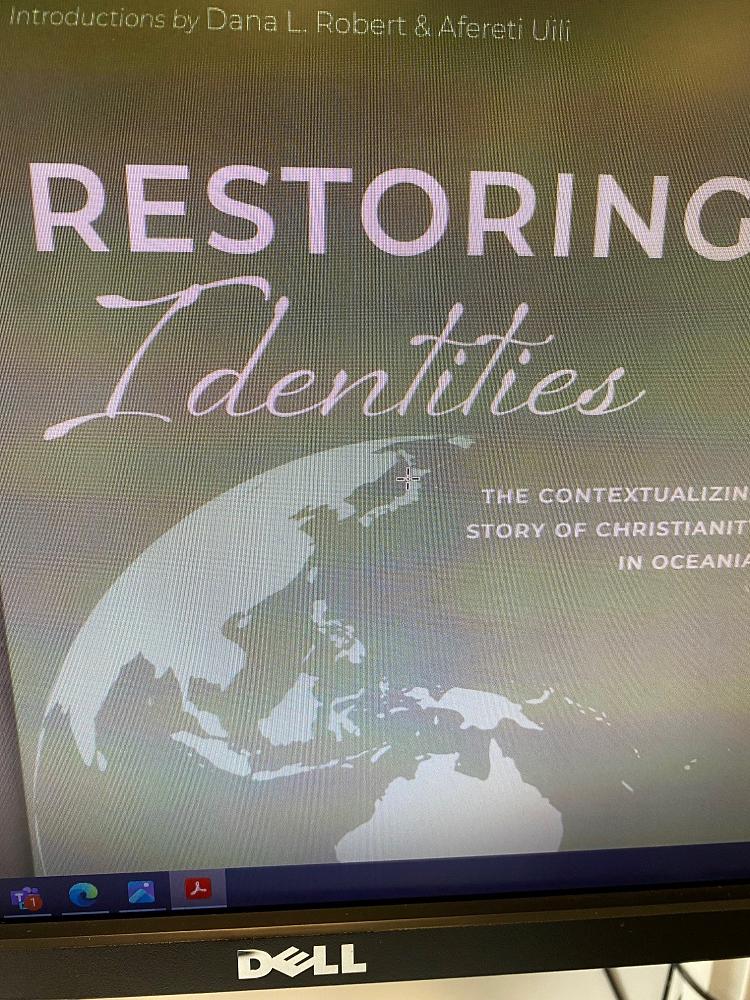
Restoring Identities: The Contextualising story of Christianity in Oceania.
Editors: Upolu Vaai and Mark LamportPublisher: Cascade Books, Eugene Oregon. 312pp. Published 2023.
Restoring Identities is the Oceania volume of the Global Story of Christianity. Readers will enjoy chapters which unfold the church history of Australia, New Zealand, and Oceania and those aware of challenges faced by Pacific nations will appreciate contributions by Pasifika scholars. Three chapters will especially resonate with New Zealand Pasifika.
Katalina Tahaafe-Williams is part of the Oceania diaspora. The Tahaafe family have moved from Tonga, to Auckland, to Australia. Katalina, now Minister of the Uniting Church, has served with the WCC in Geneva. She celebrates the diaspora that has taken Pasifika to every corner of the globe. Pasifika who received the gospel in centuries past are now bearers of the good news to a 21st century secular world. Mainstream congregations are enlivened by Pasifika families. There are challenges: Pasifika can be greeted with caution and racism, or relationships of cooperation and collaboration can be brokered.
Climate change is urgent for Pacific nations and these nations are at the forefront of bringing the issue of their survival to the attention of the global community. Seforosa Carroll is uniquely positioned to bring gospel and climate change, science and Indigenous knowledge together. Seforosa is Rotuman, born into a family relocated to Fiji, trained and ordained into the Uniting Church in Australia. She plays a lead role in the WCC’s Care for Creation programme. She has worked with political leaders and villagers in countries impacted by rising sea levels. This experience comes together in “Changing perceptions of faith and climate change in Oceania”. This is contextual theology at its best.
Mercy Ah Siu-Maliko, writing on “Gender Justice”, finds a pathway into a topic not easily talked about. She is married to a Samoan Minister. Both did Otago PhD’s in Theology. Mercy’s topic was “Public theology, core values, and domestic violence in Samoan society”. Her point of entry for fieldwork and chapter is talanoa. Groups of women came together in safe environments to tell and reflect on stories. Mercy’s work is grounded in scripture and feminist theory, but informed by the stories of Samoan women. This comes together, vividly, in the lived experience of “Ala”, “Amata”, and “Faletui”. Mercy is a strong and gentle advocate for equitable partnerships between men and women.
Restoring Identities is important for us as we rekindle the Vā of Papatūānuku.