
Principal's Message - Coping Skills and Resilience - how do we react when our children face adversity?
I'm a parent, and I freely and frequently admit to all and sundry that for most of my children's lives, I've only just felt one step ahead (and sometimes one step behind) in how to grow them into independent, confident, and resilient adults. Parenting is the hardest job of all at times!
My own girls are now 25 and 16, so perhaps the main part of my active parenting is nearly over. There have been times when things seemed easy and times when they were very, very hard! I always think that parenting doesn't necessarily get easier as children grow, it's just a different kind of hard. I can remember times when I have tried to smooth the path ahead or problem-solved FOR my children. Whilst it was a quick fix, it didn't teach them anything except that they needed me to solve things for them, and that in some contexts, they were powerless to move themselves forward.
But I do think about how different my childhood was from theirs. Years ago, with my three siblings, we often disappeared out the door to play and didn't get back until dinnertime. We built tree huts, dug holes, set a couple of things on fire (with magnifying glasses), and got dirty, tired, and scratched. If we hurt ourselves, we got a plaster, stuck it on, and disappeared out the door again. On occasion, we needed our parents to help, but it wasn't often.
While I can look back fondly on these memories, I also acknowledge that, as children, our resilience and coping skills were mostly top-notch. So, how do we empower our children today with the same skills whilst bringing them up in a completely different world?
Dr Meghan Walls, a pediatric psychologist in America, writes, "As parents and caregivers, it is not our job to solve a child's problems for them. Instead, our job is to provide kids with the support they need and help them develop their own problem-solving tools. Like most parents, I want to alleviate our children’s suffering by doing whatever I can. We hate to see our children worry and struggle. With the best of intentions, we think we are being helpful by trying to solve our kids’ problems for them. As a pediatric psychologist, I know that taking this path often leads to our kids feeling more worried the next time something difficult happens. In fact, by solving our children’s problems for them, we interfere with our children’s ability to develop the effective coping mechanisms needed to deal with these challenges."
If you would like to read the full article, please see this link.
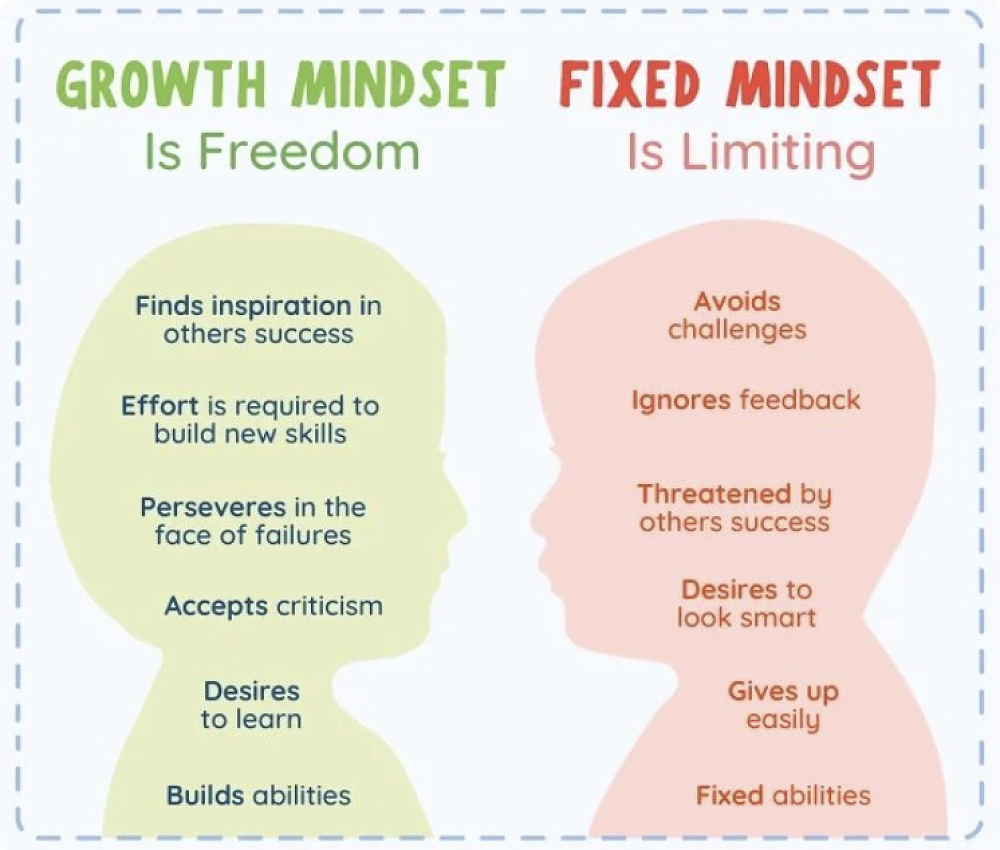
One fantastic strategy for children today is to empower them to have a "growth mindset". Dr Carol Dweck's work is research-based and involves the development of children's mindset to believe that they can get better at something by dedication of time, effort, and energy. Working on one's flaws, and the process—not the outcome—are the most important components. With time and practice, people with a growth mindset believe they can achieve what they want. Part of our role as parents and teachers is to praise children's efforts and progress, not their fixed ability to be intelligent/clever/smart. Along with learning and effort comes failure (and its accompanying uncomfortable emotions) but with a growth mindset, children also learn to deal with stress, anxiety, and disappointment. A growth mindset can also help develop resilience, which is key for our children to head into an unknown future!
- Resilience is the ability to bounce back after challenges and tough times.
- Resilient children can recover from setbacks and get back to living life.
- Resilience develops when children experience challenges and learn to deal with them positively.
- Strong relationships are the foundation of children’s resilience.
No one is expecting our children to survive everything on their own, however, as teachers (and as parents), we can take steps to develop our children into resilient and confident adults by empowering them to cope with small, age-appropriate personal and learning-based challenges. Once again, I lean into the PYP Learner Profile attributes of being: a risk-taker, a thinker, knowledgeable, a communicator, open-minded, caring, an inquirer, principled, balanced, and reflective. These dispositions are the ones that will help our children fulfill their potential and become useful, compassionate, capable, and action-focused members of society. But we need to teach these, and give opportunities to our children to experience situations where they can practice these; it won't happen on its own.
Congratulations to all of our parents - you are amazing people doing a job that didn't come with a "how-to" manual!
Our Principal, Lucy Naylor, is in Wellington this week, representing Milford School and advocating for all primary schools in Auckland, with the Ministry of Education and other groups. Thanks, Lucy, we know you are doing a wonderful job with the Auckland Primary Principals Association and for the future of our schools and students.
Kia pai tō rā whakatā
Sara Baker