Getting Open




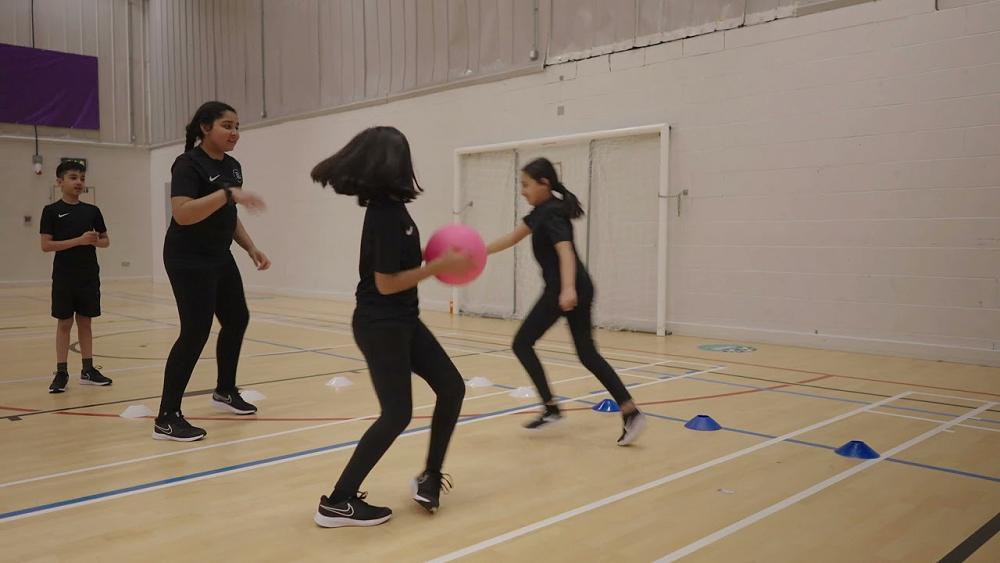
Set up a defined area with cones/dots. In group of 3, one person is "in" and the other two people work together passing the ball to try to tag them. If you have the ball, you can't move your foot position.
Variations:
Change the number of players on teams eg 3v3, 5v5 or overload.
Count the number of tags in a certain amount of time eg 30 seconds.
COLLECTIVE PLAY - NO OPPONENTS
Groups of four with one ball, spread out around the gym.
Players throw the ball to whoever they choose. Everyone is constantly in movement: the ball has to be caught in movement and played again as quickly as possible. No balls on the floor! One of the players is the worker for 30 seconds and must run at high speed, receiving the ball back after each pass. After 30 seconds, someone else takes over. In which group does the ball never touch the ground?
the ball may only be played to players who make a short sprint towards the passer.
players continue to play the ball around but now they are only allowed to receive a pass after a movement away from the ball into space.
the pass may only be given to players who have either made a clear movement towards the ball or have moved away into space.
with a veering off movement. Players first move towards the ball, stop after a few paces and run in the other direction to receive the pass.
Add defenders
RUNNING IN WITH DEFENCE
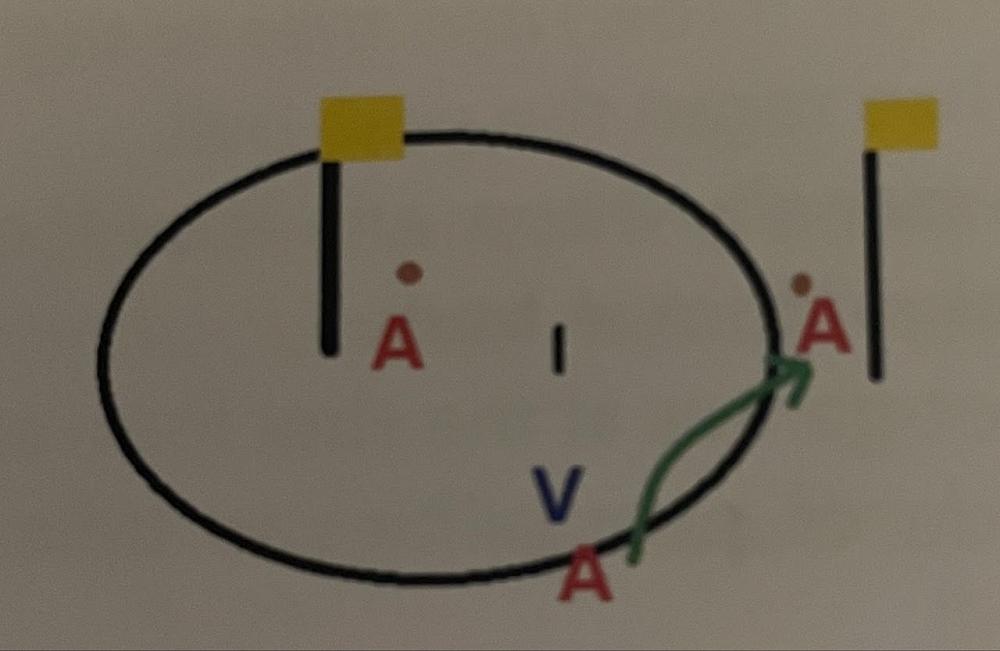
There are 2 baskets at a small distance from each other. The attacker walks up and down in front of the korf with a defender. At a self-determined time, the attacker takes a pass (they can choose at which hoop). The attacker tries to cross the defender's running line and takes a pass for a shot.
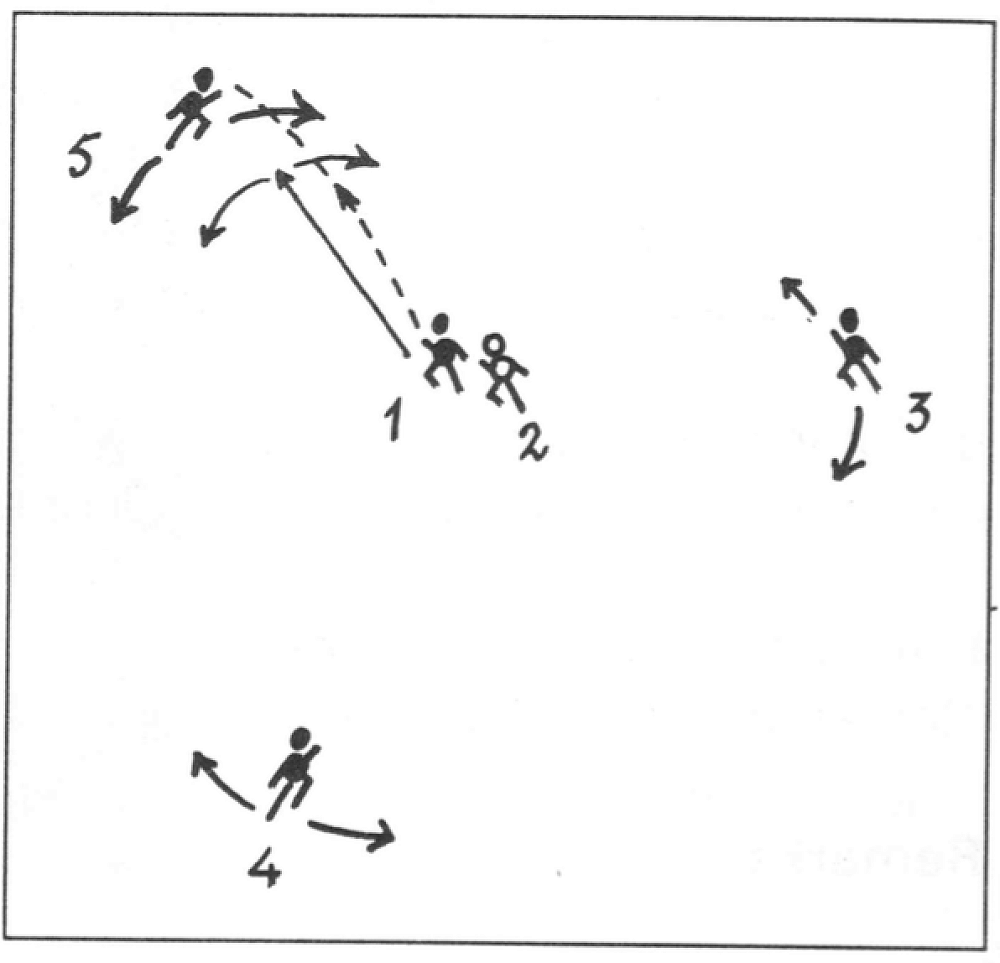
BREAKING FREE IN GROUPS OF FIVE
A ball for each group of five, with a space of 20 x 20 metres. The players are numbered.
A. Number 1 is the attacker, Number 2 defends and Numbers 3,4 and 5 assist the attacker. Everyone may move freely within the space. The attacker always gets the ball back from his/her team mates. The defender is free to try to intercept the ball. After 30 seconds, change the roles, and repeat until everyone has tried both roles.
B. As A, but now the instruction is that the attacker must always turn away from the defender. In this way, the ball can easily be played to a team mate or a pass received. This is sometimes called “keeping the defender behind your back.”
C. As A, but now the assist players stand in a triangle 15 metres away from each other. This makes the exercise more difficult for the attacker.
D. It becomes even more difficult if the attacker is required to pass the ball in a given order to his/her team mates. The attacker now has to run a circuit and the attacker knows where the ball is going and the movement of the attacker. Now lots of balls will be intercepted or at least touched.
ROTATION
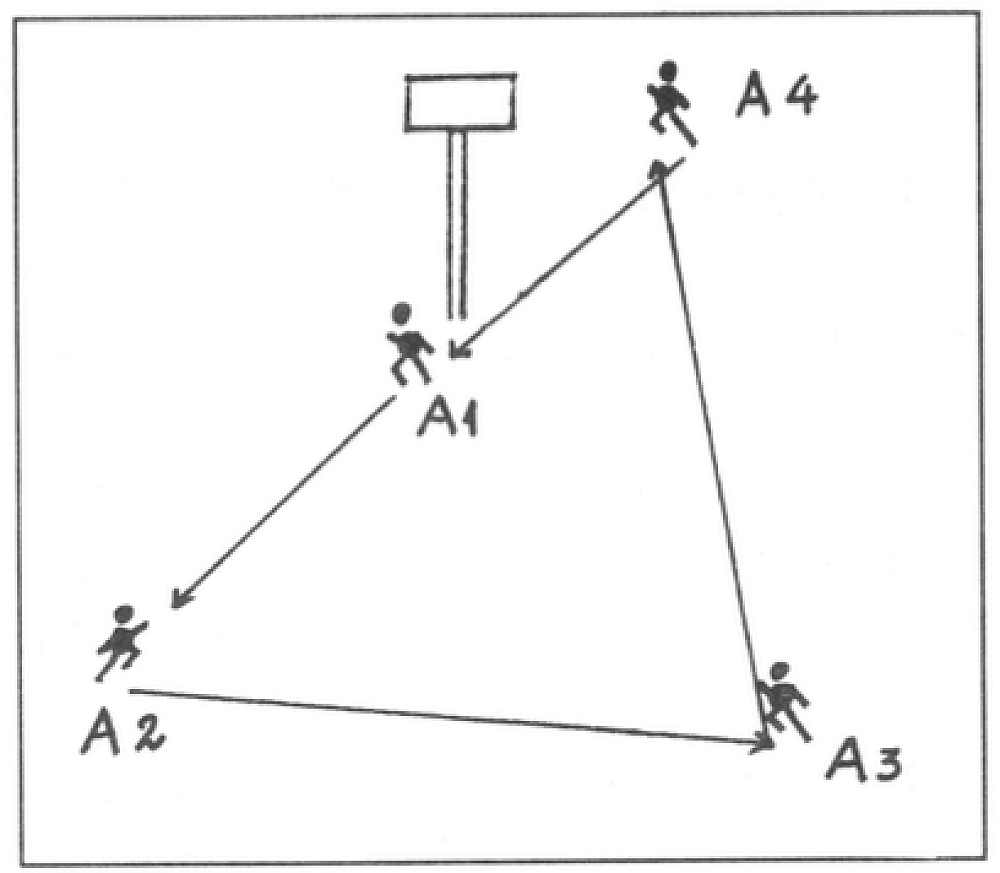
Four players and a korf. The four players form a Y: there is a support player under the korf (A1) and one behind the korf (A4) and there are two attackers (A2) and (A3) in front of the korf.
The rotation is continuous: A1 takes up the position of A2 after playing the ball, A2 moves to A3, A3 to A4 and A4 to the starting point of A1.
A. A2 has the ball (in the game this would have been received from the defence division). The ball is played to A1 who has moved away from the korf. A4 enters from behind the korf and receives the ball on arriving at a strong assist position in front of the post. A3 takes a running in shot. A4 turns quickly after giving the assist and rebounds.
B. “Switch situation.” If A3 and A4 are of the same sex, there may be a switch situation if A3 takes a running in shot. After giving the assist A4 moves away from the korf, receives the ball back from A3 and shoots.
C. Same as A but instead of a running in movement, A3 makes a veering off. In this exercise, it is assumed that A3 does not break free and so plays the ball to A2 who is in front of the post. A2 shoots from distance. The rotation then takes place.
D. Shooting after moving away: if A1 is not immediately followed by their defender, then they are free and can shoot with a half turn. Thus A2 plays to A1, who turns and shoots. A4 rebounds the ball and everyone moves to the next position.
MONOKORFBALL WITH FOUR KORFS
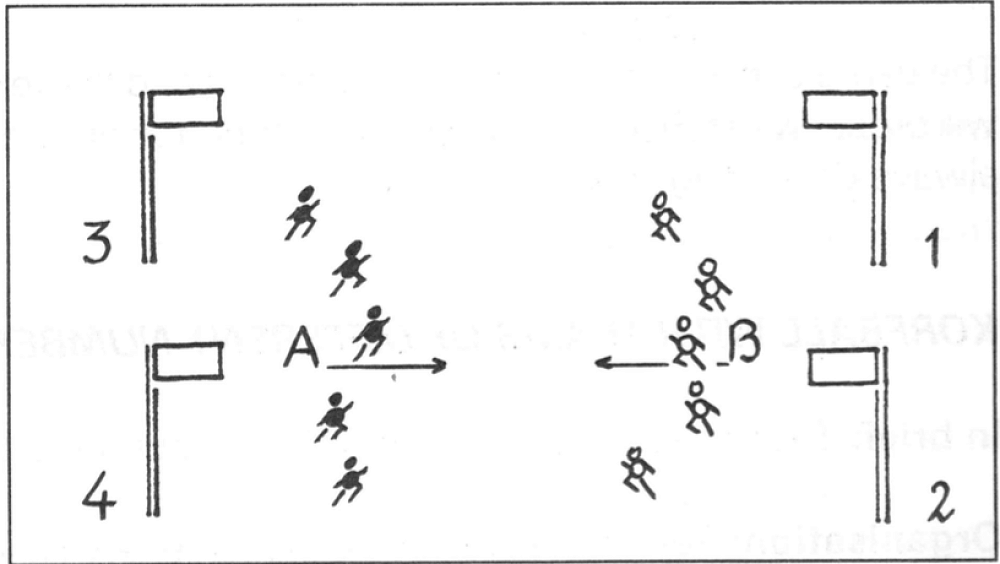
An area of at least 12x20 metres but preferably bigger, such as 40 x 20 metres. See the diagram for the organisation of the korfs. There are two teams, each with four to eight players. Team A attacks korfs 1 and 2, team B attacks korfs 3 and 4. Otherwise normal korfball rules are applied. This style is meant to improve appreciation of space.
The attackers are required to spread their attention over more korfs. Defenders cannot defend simply “one to one” as staying between the attacker and one post gives the attacker an easy chance to score at the other post. Other skills such as switching, giving long passes etc; are required in this form.
TRIANGLE MONOKORFBALL
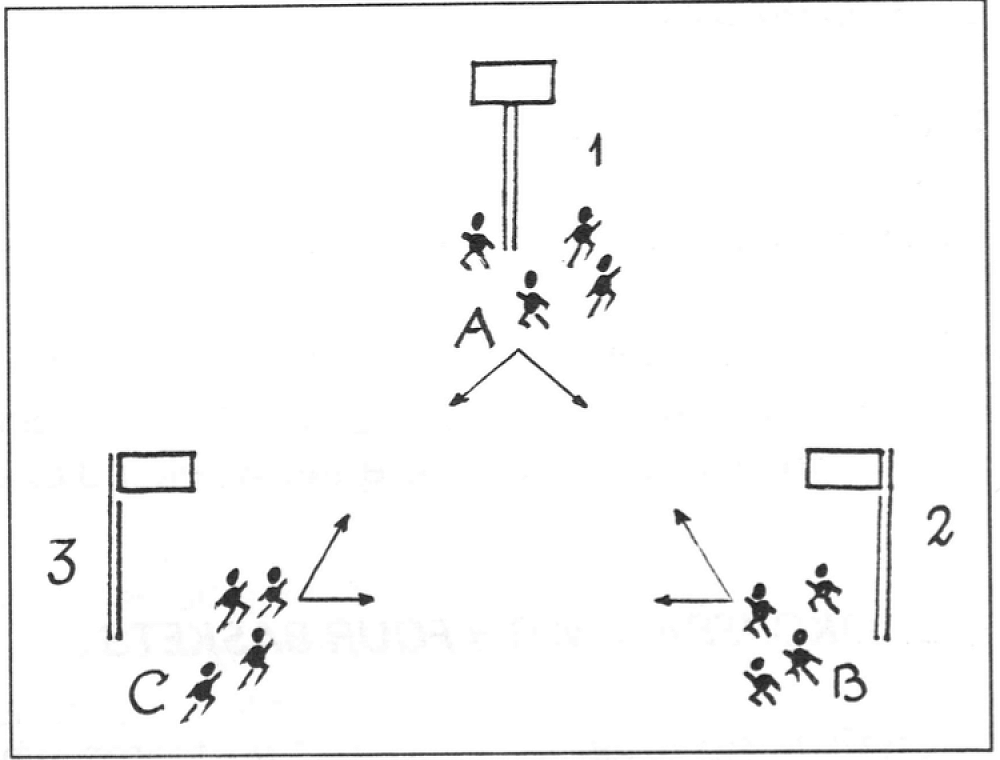
Three teams of about four players. See the diagram for the organisa¬tion.
Team A defends korf 1 and can shoot in korfs 2 and 3. Team B defends korf 2 and can shot in korfs 1 and 3, while team C defends korf 3 and can score in korfs 1 and 2. Otherwise nor¬mal korfball rules.
A continuation can be square korfball with four posts and each of the four teams can attack in three and defends one.
The game can also be played with two balls and the teams can be bigger.