
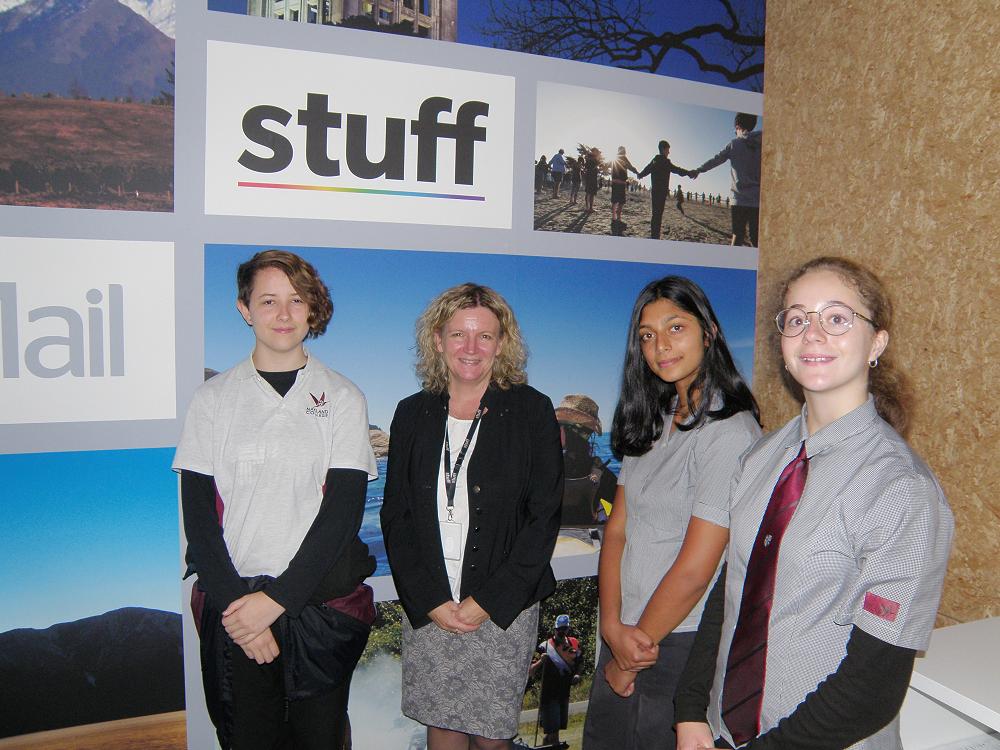
Newsroom visit yields plenty of 'stuff'
After school a couple of Mondays ago, a few of us journalism students hopped into Ms King's trusty jeep and left to go check out our local Nelson newsroom.
On arrival, regional editor Victoria Guild greeted us. She takes care of The Nelson Mail, the Nelson and Tasman Leaders, and stuff.co.nz in the Nelson region, a list of responsibilities that prove she does deserve some credit - even if she is a former Motueka College girl! A keycard beep later, and she led us inside.
Though perhaps not the most realistic of daydreams, I'd be lying if I said I wasn't a little disappointed as we walked into a space that was decidedly not filled clackety typewriters or loud overflowing printers. Instead, a sharp, sleek room greeted us, filled with people typing away behind computers and analytics of articles currently being read displayed on a screen across the wall.
Ms Guild spoke to us about her time in the journalism industry, the contrast between when she first started out and had to take around and check her paper articles with 10 more pairs of eyes, to now, when everything can be done through the touch of a few buttons. She spoke of issues the journalism industry is set to face, and the ones it already faces.
One problem is the decline in print newspaper readership - because 50% of readers are aged 65 and over, reader numbers are literally "dying". Another interesting point was the ratio of good news to bad news articles - though news outlets often receive complaints about always only reporting on the tragedies in the world, the fact is they're what people click on, despite what journalists might actually want to write about.
Same goes for the ratio of pulp articles to ones of substance - weight loss stories do extremely well, whereas sometimes stories that the writer has put a great deal of thought into get very few reads. But though this can be extremely frustrating, she said, there's not much anyone can do. "No matter how much goes into an article you've written, it's not like you can force people to read it."
It's not all bleak though. The job seemed really very interesting after an anecdote combining a nudist camp, arson and a moral about the value of making connections. Having to use a great deal of sarcasm to deal with the pedantic complaints about slight errors in grammar, or sickly sweet business people hungry for some free advertising also sounds like a lot of fun.
Especially exciting is that there might even be an opportunity for us aspiring journalists to gain some experience in the industry through a potential youth column or internships. But in the end, Ms Guild made sure to note that being a journalist means you hold a lot of power. "You're telling people's stories, shaping people's views. You need to be careful with that."
As the doors closed behind us, I was left mostly with curiosity. There's a lot of uncertainty in the journalism industry right now. Though I might head into it with dreams of exciting work in the field, revealing shocking stories to the public and writing articles that I truly feel proud of, chances are that my reality will not live up to this, and I'll be left with only instability.
But what if all these challenges the industry is facing only bring more opportunities? What if there is now demand for new, original approaches, approaches that only fresh eyes can deliver? Perhaps one day, hopefully not with my head banging on a computer keyboard out of frustration, I'll find out that these questions weren't just optimistic nonsense.
Gallery
