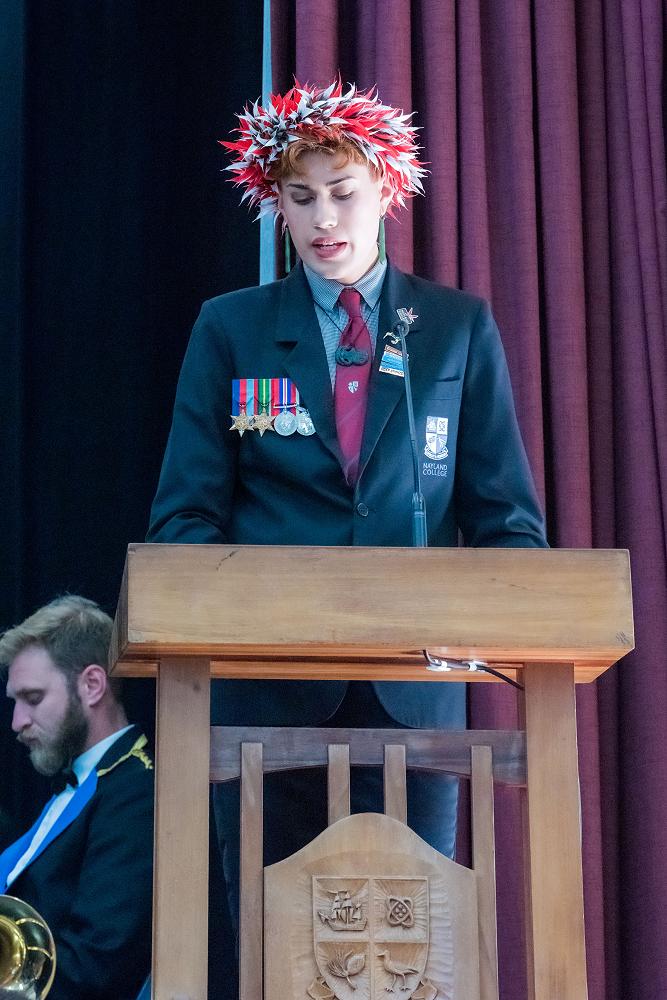
Student leader Lani Kalapu shares his reflections at ANZAC Day service
Talofa lava, ‘o a’u o Lani Lo’utoto Feti’i Fa’aopoopo Kalapu, I am Lani Kalapu a Student Leader at Nayland College.
I have been to an ANZAC Day service every year since I was little. My memories used to be of a cold dawn service, getting to wear smart clothes and shiny medals, and going through the McDonald's drive-through after. Now that I am older, I find the day more reflective.
We all have a connection to the armed forces. For myself, it is my Great-Grandfather Andy Beattie. Today I am proud to wear his medals that he earned while in the Air Force fighting in the Pacific. Grandad served for a total of 5 years and 206 days, training at Woodbourne Airbase in 1940 as a Flight Mechanic, before being promoted to a Flight Sergeant, then a Flight Engineer. He was then posted to the Solomon Islands flying Catalinas around the Pacific doing reconnaissance. When he was discharged, his work continued through the RSA, serving as President of the Nelson RSA for three years, as well as becoming a life member and earning a Gold Star. As well as Grandad Andy, I also remember my Grandfather Feti'i Kalapu, an immigrant from Samoa who was in the territorials for 14 years from 1973 to 1987.
I spend this time today reflecting on those who have given their service, and their lives for Aotearoa. Veterans whose service is often forgotten about are the Pacific Island soldiers, especially those who served in WWI. Although the population of these islands are small, over 1000 soldiers volunteered to join the New Zealand Military Forces, and out of them, 107 died of disease or enemy action, 73 were wounded in action, and three became prisoners of war.
Many of these soldiers came from places annexed by Britain or New Zealand. The Cook Islands and Niue had been annexed by New Zealand in 1901 and most Pacific soldiers came from there. Like many other soldiers, they were motivated to enlist through feelings of patriotism or a sense of adventure. But unlike Pākehā, they were not always accepted being 'natives.’ This changed as the war went on and New Zealand required more soldiers.
They went through the same struggles as other soldiers but also had to deal with other disadvantages. Such as, having to wear boots as many were not used to wearing footwear, many did not speak English being dependent on their comrades to explain what was happening, they had trouble adjusting to the army diet needing more fruit and fish and their counterparts, but the main danger was the European diseases many did not have immunity against. This was especially relevant for Niuean soldiers because of the isolation of their island. An example of this is the Influenza Pandemic of 1918 where both Samoa and New Zealand had the same number of deaths, around 9,000 casualties. For New Zealand, that was 0.00078% of the population, while for Samoa it was 22% or a fifth of their population. When becoming sick, they were often the only Pacific soldiers in the entire hospital, becoming isolated and unable to communicate with those around them.
I hope this ANZAC Day, you can spare a thought for the Cook Islanders, Niueans, Samoans, Tongans, Tuvaluans, and Kiribati people who served for New Zealand in WWI, for the Pacific nations who suffered the impacts of bombing and warfare in WWII, and for the many other Pacific and Māori veterans who have served and continue to serve in other major conflicts for Aotearoa.
Fa’afetai tele lava mo le outou fa’afofoga’aga
Gallery