
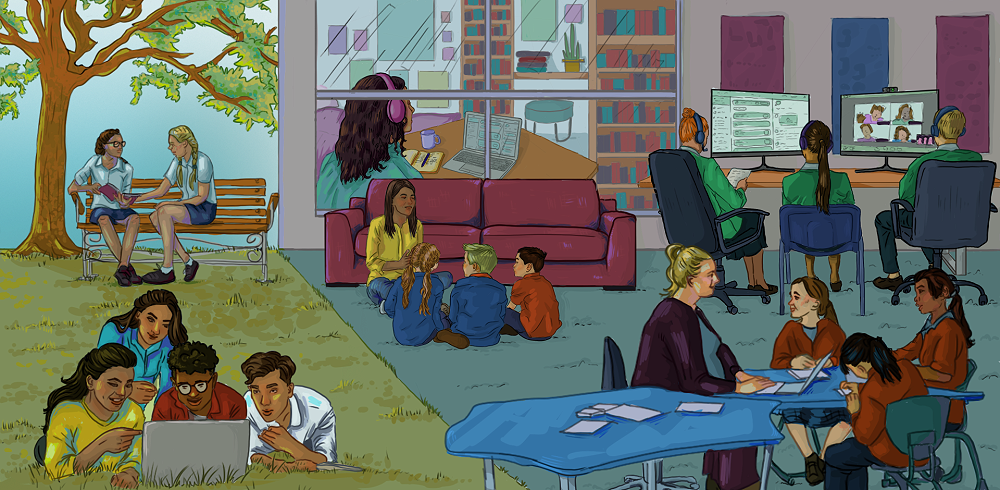
The Benefits of a Hybrid Approach to Learning with NetNZ
As educators, we constantly seek to balance the evolving needs of students with effective teaching methods. In recent years, hybrid learning has emerged as a powerful way to engage learners, particularly those in senior years.
The hybrid approach blends online learning with in-person instruction, allowing students to manage their learning schedules while still maintaining critical face-to-face interactions with their teachers and peers. It's a mode that allows students to learn in a manner that reflects the flexibility they will need for their futures.
However, there are some important questions and concerns about how a hybrid learning environment functions. As a teacher with over 45 years of experience recently pointed out, this method brings benefits but also presents challenges, particularly regarding student engagement, teacher workload, and adolescent development. These are valid concerns, but with careful planning and thoughtful implementation, a hybrid model can be a powerful tool for education in the 21st century.
Increasing Teacher Workload—Myth or Reality?
The idea that hybrid learning increases teacher workload is common. It’s true that initially, setting up a hybrid course requires careful preparation. Teachers need to create an engaging, coherent online environment that students can access easily. But once that’s in place, it’s about ongoing refinement, much like any course. Over time, teachers find that hybrid teaching can actually reduce the need for repeated in-person explanations and logistical challenges.
For example, students can review course material and key concepts at their own pace, which allows in-class time to be used more efficiently for deeper discussions or practical work. In the long run, the careful development of a well-structured hybrid environment can save time and reduce pressure on teachers.
Building Relationships and Community Online
A critical question raised is how teachers can maintain relationships with students when they aren’t physically present. Relationships with students are crucial for learning, but the assumption that these can only be built face-to-face is outdated. In fact, online learning environments often lead to deeper connections. Why? Because in a virtual classroom, we have to be more intentional about building community, ensuring every student feels included and supported.
The hybrid model provides the best of both worlds. Teachers can build strong relationships during the days students are onsite, allowing for quicker rapport. This then carries over into the online environment, where platforms like Microsoft Teams, Google Spaces, or Discord offer seamless communication. Video conferencing tools add immediacy, allowing teachers to read students’ body language and respond in real-time, just like in a classroom.
At NetNZ, we’ve found that our online community is often stronger than face-to-face interactions because we structure courses with relationship-building at the core. Students like Liliana from Logan Park High School reflect on how being part of a supportive online community has positively impacted their learning. "NetNZ enabled me to access new and different learning opportunities through the community-based learning set-up," Liliana says. The hybrid approach allows this community to thrive both online and in person.
Addressing Practical Learning and Self-Management
One concern raised by traditional educators is how practical components of a course, which are essential for non-assessment learning, can be effectively completed in a hybrid environment. The answer is simple: hybrid learning doesn’t eliminate in-person learning. Practical components are easily integrated during the days students are on-site. This structure ensures that hands-on learning happens when students are physically present, while theoretical and conceptual work can be completed independently online.
Another challenge is ensuring that students who struggle with self-management are supported. This issue transcends the mode of learning—whether online or face-to-face. Many students have difficulty managing their time and staying organised. But the hybrid model offers an opportunity to develop these critical life skills in a controlled environment, with guidance from teachers.
Hybrid learning is designed to cultivate competencies such as self-management, a skill that will benefit students far beyond school. Students like Emma Morgan from Te Aho o Te Kura Pounamu thrive in this environment, noting how important it is to manage her time and stay on top of her work. "Because you do not sit in a classroom with a teacher, you have to make sure to manage your time well and be self-motivated to complete the set tasks," Emma explains. These skills are not only crucial for academic success but are also the soft skills employers are looking for in the workforce.
Preparing Students for the Future
The reality is that hybrid learning is no longer a future concept; it’s already part of the working world. Many industries have embraced hybrid work environments, where employees split their time between the office and working from home. By introducing students to hybrid learning at the secondary level, we’re preparing them for the world they will enter.
Hybrid learning also allows students to engage with their interests more deeply, without being constrained by the rigid structures of a five-day, in-person school week. This flexibility fosters a more personalised learning experience, where students are motivated by their passions, not just their schedules.
The Bigger Picture: Engaging and Challenging Our Teenagers
As educators, we must ask ourselves: are we preparing our students for a world that is already hybrid, or are we clinging to outdated models? To truly engage 21st-century learners, we need to think outside the box. Hybrid learning offers flexibility, fosters independence, and allows students to engage with their subjects in ways that traditional models don’t.
We need to build resilience within our schools—resilience to change, to crisis, and to the needs of the modern world. A hybrid environment offers a way to do this, giving students the flexibility to learn in a way that prepares them for life beyond school while still maintaining the crucial face-to-face contact that builds community and deepens understanding.