Sweet Success - The Honey Harvest at School
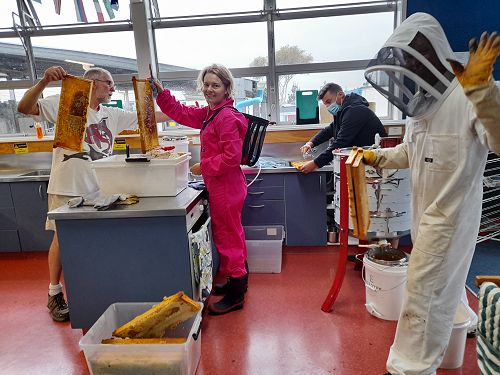
On a cloudy, but warm and still Saturday morning in March, the adult members of our school Kaitiaki Pī Team (beekeepers) met to harvest honey from our three apiaries.
Our group of workers that morning consisted of teachers Leanne Stubbing, Louise Moncrief and Ian Svela, along with Graeme Chisnall, a local beekeeper and our community expert. Donning our protective suits, we lit the smokers, collected our hive tools and prepared to open our hives for inspection and to remove extra honey. Prior to removing this honey, samples had been professionally tested and declared safe for eating.
Fast fact: Beekeepers use smoke to keep bees calm during hive inspections. When bees sense danger, they release an alarm pheromone called isopentyl acetate from a gland near their stingers. This chemical wafts through the air and alerts other bees to be ready to attack. Smoking a beehive masks this pheromone, allowing the beekeeper to safely perform a hive inspection.
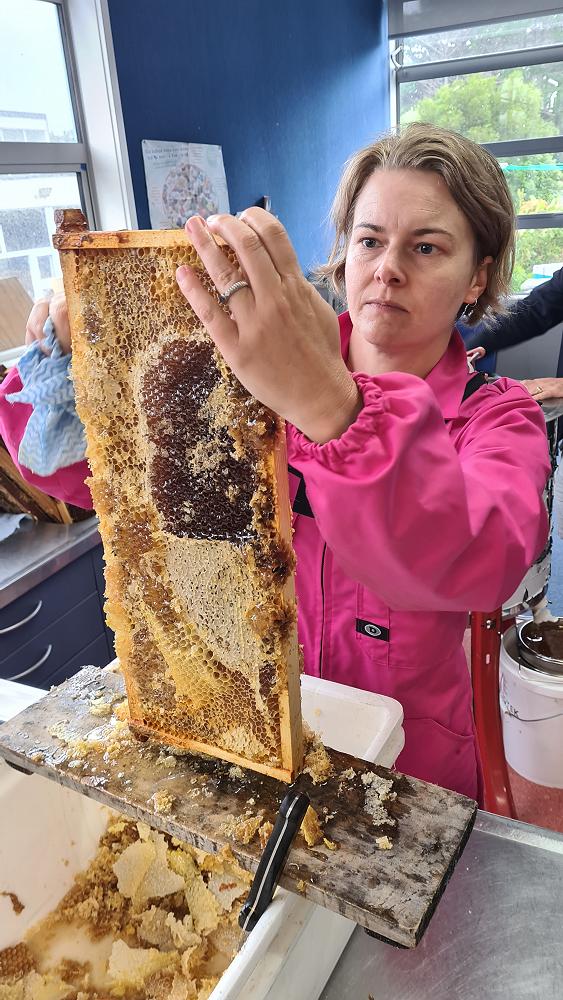
Being sure to leave some frames full of honey as stores for our hives to feed on over winter, the team began removing extra honey laden frames. “Here hold this,” said Graeme as he passed a frame of capped honey to Whaea Leanne, “how much do you think this weighs?”. “Woah, it’s quite heavy. I think it’s…2kg?” “Nailed it!” Graeme exclaimed, “It’s probably somewhere between that and 3kg, I estimate we’ve harvested about 56kg of honey in total this year.” That wasn’t bad considering that we had only recently added the third hive and started to grow our other two colonies to the point of being able to produce a good amount of honey. We brought the frames inside and placed them inside the extraction machine.
The extraction process is pretty straightforward. First, frames must be uncapped (have the thin layer of wax removed) to expose the honey. Then, four frames are placed vertically inside the extraction machine, which is spun by hand. The drum in which the frames spin slopes inwards and down, collecting the honey, which comes off of the frames while they spin. The result is liquid honey flowing through the spout at the bottom into strainers which remove impurities.
Mr. Miller (another NIS teacher) and his lovely daughters showed up to help out too. Without Mr. Miller’s strong arms spinning the extractor, there wouldn’t have been as much honey harvested so quickly. His help was much appreciated, as was the taste testing from his kids — quality control! 😁
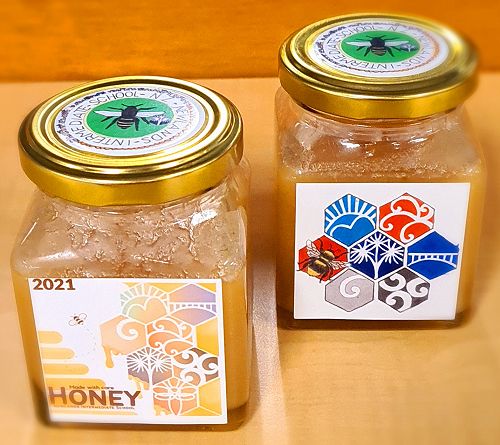
Later in the week, our student members of the Kaitiaki Pī Team began to jar the honey. Taking precautions to be very clean and tidy, they worked until all of the jars were filled. A school-wide label design competition was held and netted three winners, whose designs were professionally printed by Wellington Signs of Petone. The team labelled all of the jars and are excited to start sales. Next up for the team, besides regular care for our hives, is learning how to render used beeswax from our hives. Using the cleaned wax cappings and other recycled wax from the hives will allow them to make their own candles and sell these as well, to make money for the school.
Sales for honey are in school, cash only, at $8 per jar from April 4th - 8th, while supplies last. Limit 1 jar per student.
Gallery