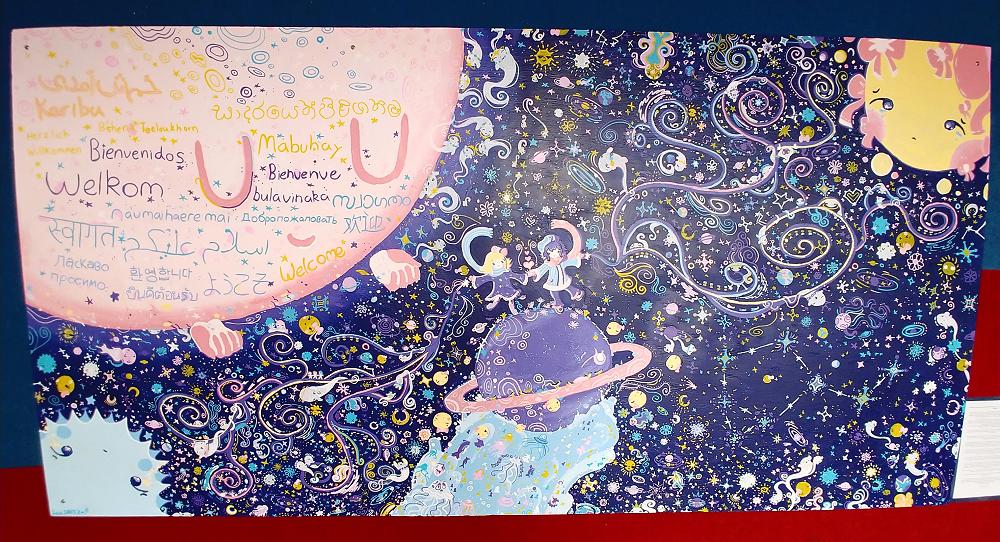
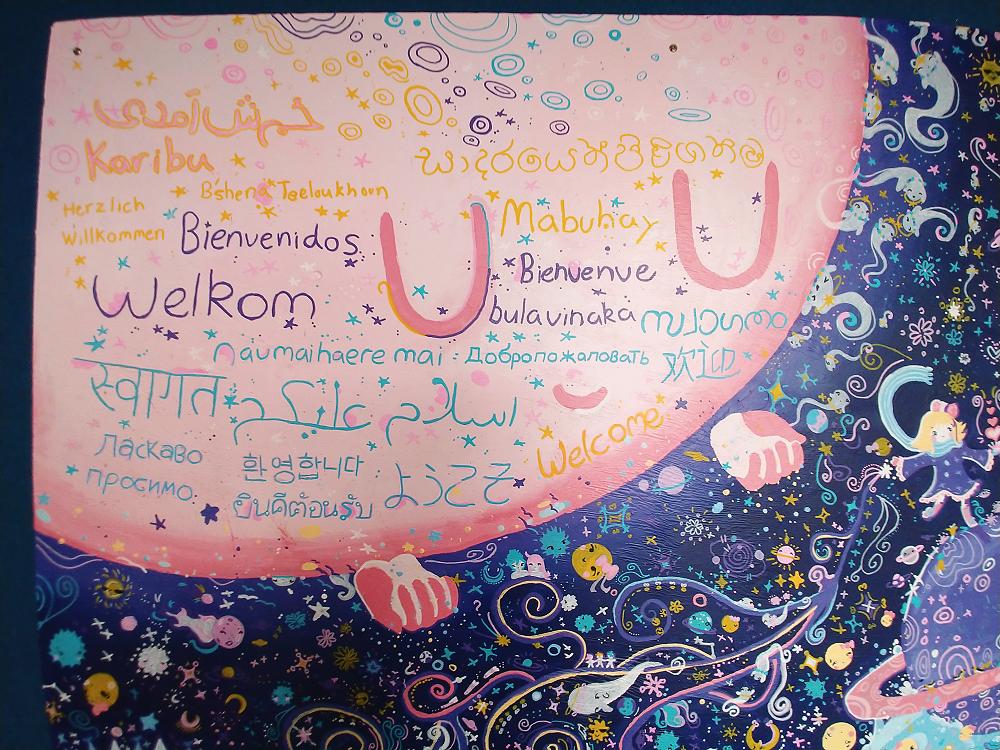
Welcome, Nau mai haere mai, 欢迎, नमस्ते, Welkom,ようこそ, Mabuhay, اسلام عليكم, 환영합니다 ยินดีต้อนรับ.
This mural was made in 2023 as a creative interpretation to welcome the community; parents and children alike.
It's a crossover of two worlds, the expanding universe and the depths of oceans, sprinkled with childlike wonder, happiness and sorrow. Venturing out of your mortal realm and comfort to experience the wonders of your life. It's a metaphor for growth that any age can understand. Where else will you see such care?
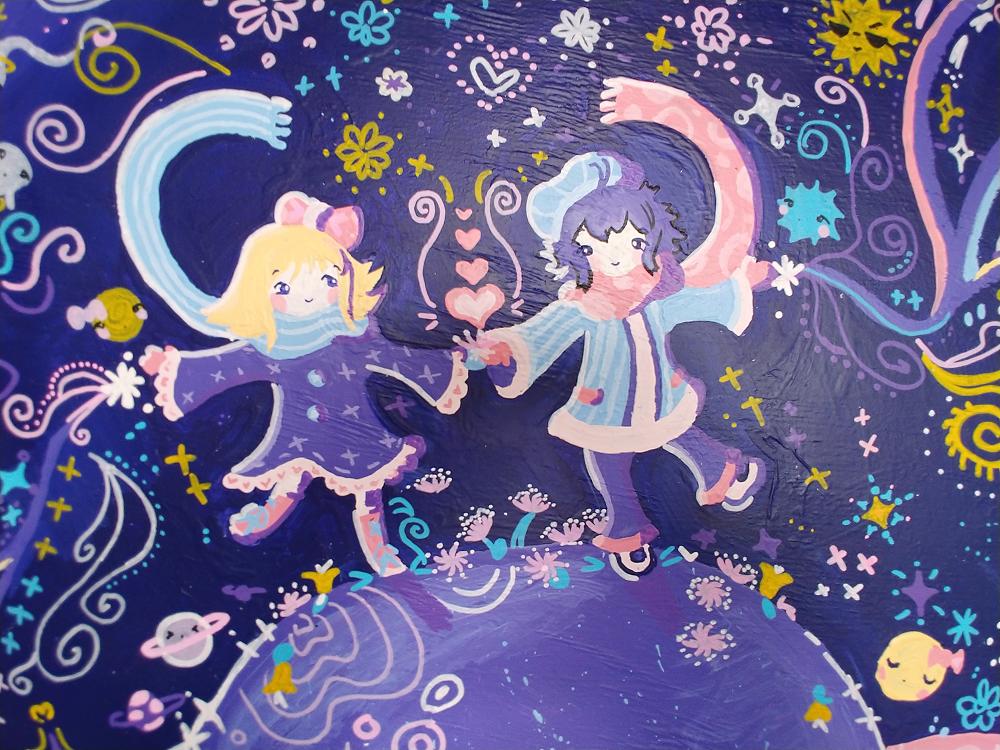
Let's start with the people in this piece: who are they? And what do they represent? They are called Tsuki-chan (left) and Hoshi-kun (right). Their names are originally in Japanese, and they translate to “Moon” and “Star”. Originally, they are from a song that references a similar thing: Love. The song is titled “And then you became the moon” By an artist called “KiKuo.”
It's a song that uses taboo topics, like death, and brings them into a different light. It also represents a plethora of other things, like love, the universe and space, reincarnation, etc.
They are there to represent a community and the children and friendships at this school. That you can travel far from the universe and expand your knowledge, without leaving behind the people you love. After all, what is life without growth?
Another recurring item in the piece is that these two characters are commonly misrepresented as the Moon and Sun, When, in reality, it is the Star and Moon. They are the celestial bodies of the two previously mentioned characters, Tsuki-chan and Hoshi-kun.
The two big celestial bodies in each corner are drifting away from each other, hence the sorrow aspect.
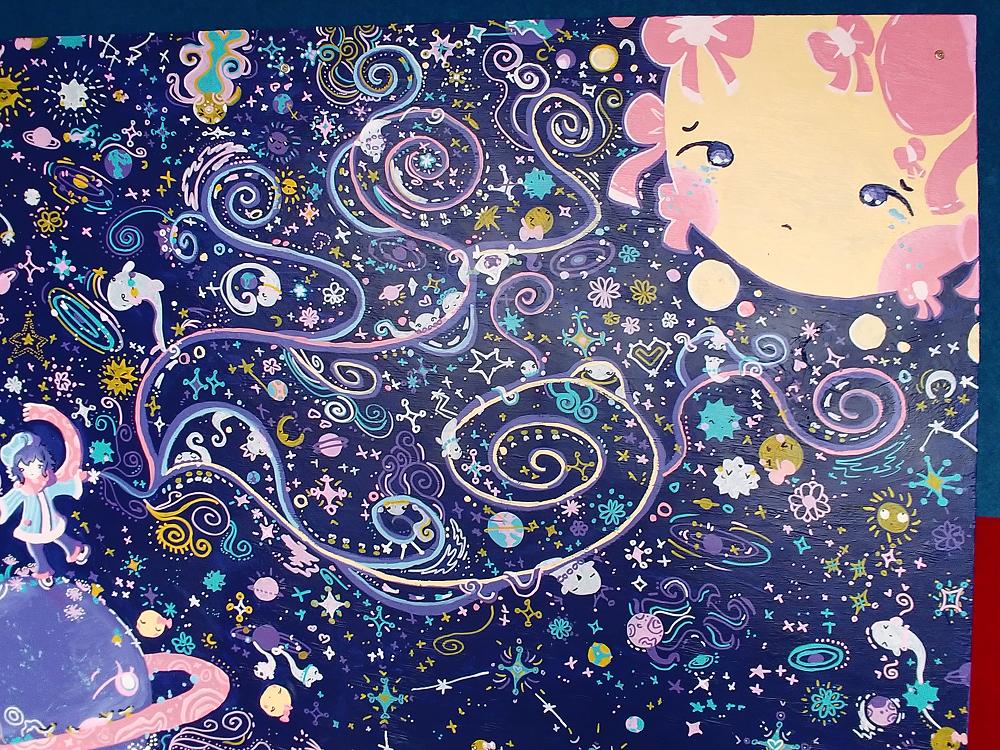
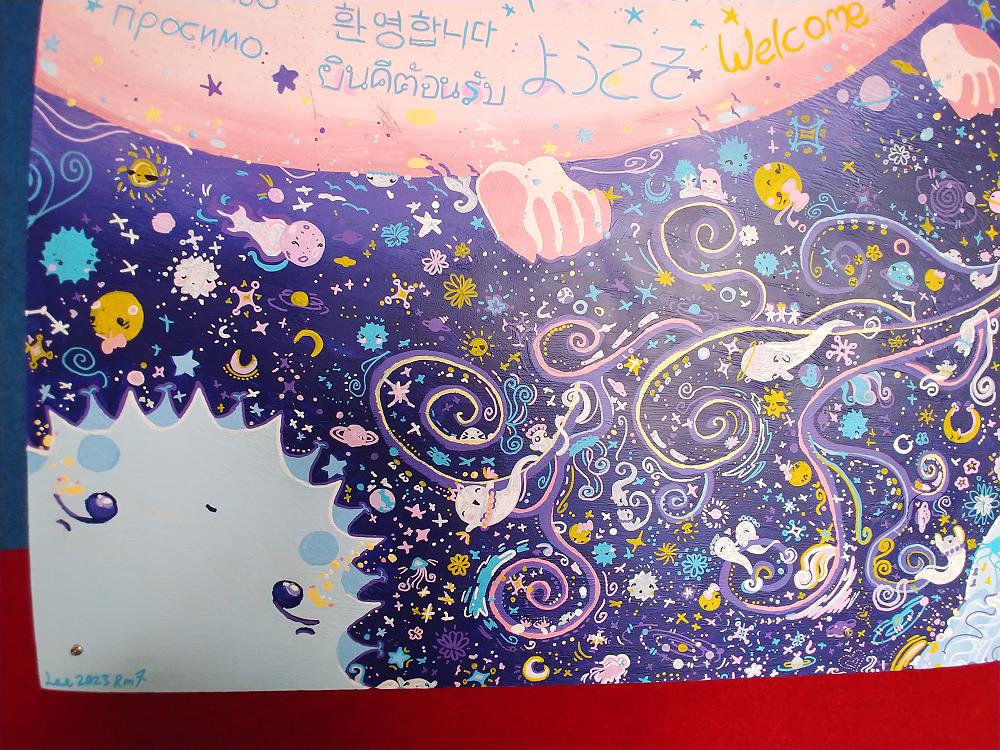
With their tears creating stars in the universe. It's a light representation of one of the Matariki beliefs: That in the pain of the physical separation of his parents Tāwhirimātea ripped out his eyes and threw the crumbled pieces into the Milky Way. And also, the separation of Ranginui and Papatūānuku is represented in this form.
The big pink sun in the top left corner is where the “welcome” aspect becomes literal, with “welcome” carved onto it in multiple different languages, including NZ sign language! It's used to represent the different cultures and languages in not just our school but our Newlands community as a whole. Languages like Chinese, Hindi, Arabic, Korean, Maori. Can you find the language you speak at home?
There is obviously much care taken with the detail of the piece. Whenever I draw extremely detailed space backgrounds, I like to show an expanding universe, accurate or not. Including ghosts, multiple living beings, stars and planets and black holes. I believe this is “The universe we could see without light pollution.”
There are so many little details in this piece. Constellations, the Pleiades cluster, multiple references to Matariki and our home planet, the aforementioned Hoshi-kun and Tsuki chan. There are even some Hihi birds, a reference to the 2023 bird of the year for Room 7! There are lots of references to Matariki. From the actual 9 visible stars in the cluster to the 9 special ghosts orbiting the sun, and the 9 moons orbiting the purple planet riding the wave.
And here's the good part — wind. Those spirals that cover the board at the top right and bottom left are an artistic approach to wind, which we are all very, VERY familiar with in Wellington.
We could even do an “I spy”! How many ghosts can you see? What about the multiple suns? How many languages can you read?
This is a piece meant to represent our community and how vast the universe is just beyond our school, Newlands, Wellington and New Zealand as a whole. Even venturing from beyond our solar system, to travel through the universe, metaphorically and literally. We are always expanding our knowledge at this school, and a dramatic representation of it was necessary.
Welcome to our school.