Winter International Film Festival of Antarctica
This Monday is the only Monday that I have ever been excited to go to school.
In past Mondays I have found myself wishing I could flee 4,000 miles south to Antarctica but this Monday Antarctica came to us.
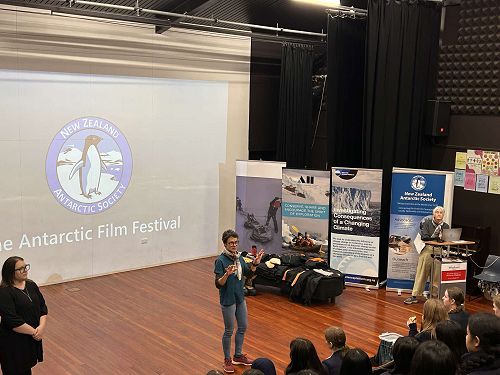
We had the immense privilege of hosting the Winter International Film Festival of Antarctica, a showcase of documentaries and short films produced by various research stations around Antarctica. The film festival was brought to us by the New Zealand Antarctic Society with support from Antarctica New Zealand.
These films had powerful messages mixed with amusing antics and a lot of penguins attempting to eat cameras, a lot of camera hungry penguins. The continent was brought to life with amazing footage of intricate ice cave systems, vast dry valleys, extensive ice shelves, and incredible ice covered mountains. The films introduced us to the locals, clingy Emperor Penguins, chubby Weddell Seals, and amusing Australians with power tools.
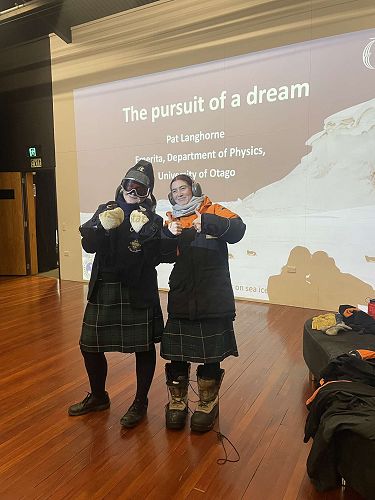
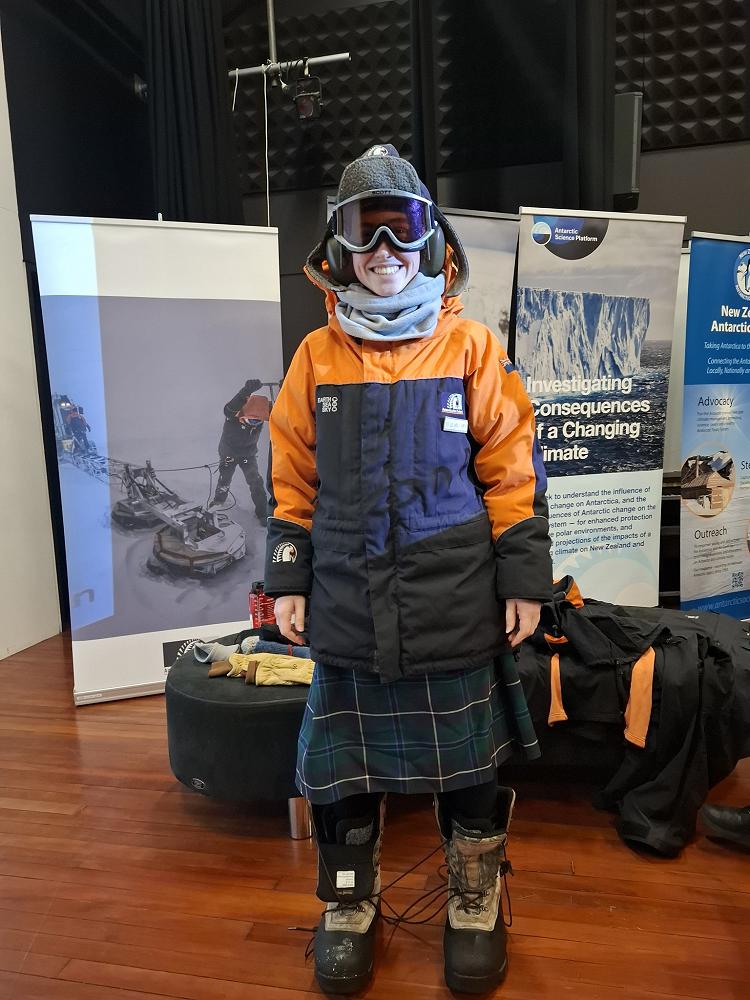
We also had the honour of meeting the New Zealand Antarctic society President Hubertien Wichers who, despite all her work surrounding the Antarctic, has never been to Antarctica. She brought with her a showcase of the official Scott Base issued gear which we enjoyed trying on, massive boots, snow goggles, bright orange jackets, and layers upon layers of thermal gear.
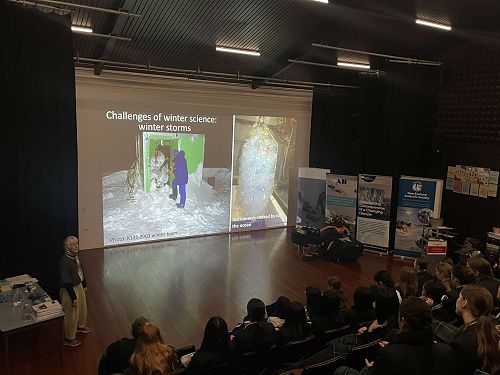
In addition to the films we were treated to a talk from one of the most inspiring scientists who has been researching sea ice since she was 21. Professor Pat Langhorne has played a fundamental role in developing science on the ice as well as bringing women to Antarctica. When she first applied to participate in ice research in Antarctica she was rejected. She said “they were interested in Pattrick Langhorne but not Patricia Langhorne.” In the face of sexism she rose above it and led a lengthy and successful career in ice science; she was 30 when she first visited Antarctica in 1985 and since then she has had a significant role in both science in Antarctica and the advocacy for equality for women in science.
Her research has been vital in understanding the importance of caring for Antarctica, helping us to understand the significance of ice shelves and how they impact the world.
In 2019 she was awarded The New Zealand Antarctic Medal, for her contribution and service to Antarctic Science. Professor Pat Langhorne has been teaching Physics and researching the physical processes of sea ice at the University of Otago since 1988.
She is featured in the award winning film Mighty Indeed which follows three generations of scientists studying sea ice in a changing climate, and what it will mean for the planet. Dr Natalie Robinson, Antarctica New Zealand scholarship recipient Jacqui Stuart and Prof Pat Langhorne feature in the film, which showcases their ground-breaking research, and what it’s like to work in the most extreme environment on Earth. Mighty Indeed was the winner of Best Feature (New Zealand) and Best Director (New Zealand) for Vanessa Wells at Doc Edge Awards 2025.
It was an incredible experience to meet this inspiring, pioneering woman and hear her story. If only every Monday could be as inspirational as this Monday was. This experience has inspired me to pursue my dreams of going to the South Pole so that maybe one day I can come back to show off what I’ve done to the students of Otago Girls’ High School and make an otherwise mundane Monday exciting for the Emma Bolters of the future.
Gallery