
Women's work
The Women’s Work Art Collective, co-founded by Otago Polytechnic’s Ana Terry, aims to keep feminism in the public eye.
Amidst the urgent social justice movements jostling for our attention today, feminism might seem outdated or even redundant. Collective founders and artists Linda Cook, Anita DeSoto, Emma Cook, and Ana Terry argue that feminism still has a vital role to play in politics, society, and art. After all, they point out, many women remain overlooked and unacknowledged, particularly those in their middle years or older who all too often take on the work of caring for children, elderly parents, and other whānau members. In a contemporary art world of shrinking opportunities, most focused on young artists, outlets for older women are scarce. The Women’s Work Art Collective was formed to offer support, connection and solidarity for its members and female artists over 50. Although their art media and practices are diverse, the group share a desire to stimulate and challenge viewers to question our existing social structures.
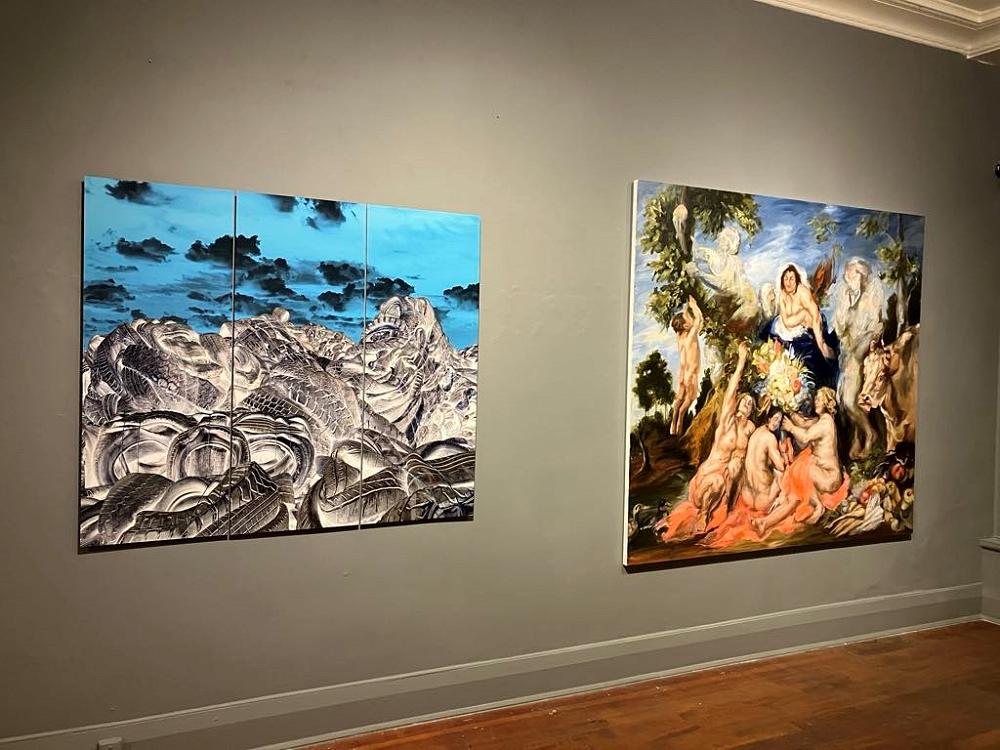
The exhibition Intersection at Ōtepoti Dunedin’s Olga Gallery in June 2025 is the collective’s first. The works shown include a series of hand-made books by poet Emma Cook with cross-stitched covers, paintings by Anita de Soto, and mixed media panels using clay and discarded packaging materials by Linda Cook.
Ana Terry’s triptych “Leviathan” is an imposing work employing photographic prints on aluminium. Ana’s role as a Learning and Teaching Specialist and principal lecturer in Visual Communication for Learning Design at Otago Polytechnic draws on her expertise in visual literacy and her background in graphic design. Her art and installations often use discarded materials or forms found in the environment to gesture towards the larger systems we live and operate within. In “Leviathan,” a pile of tyres in the foreground reminds us of rubbish tips and environmental pollution, yet Ana has highlighted their sinuous shapes to suggest writhing, living forms. The work’s title evokes both the Biblical sea serpent and Thomas Hobbes’s treatise on society and government, criticising the patriarchal and corporate worlds of industry and profit. Ana says of the work:
The massive writhing forms and textures registered a living reptilian monster, which led to considering the duality of female power as both life-giving and destructive.